

Floatation tanks

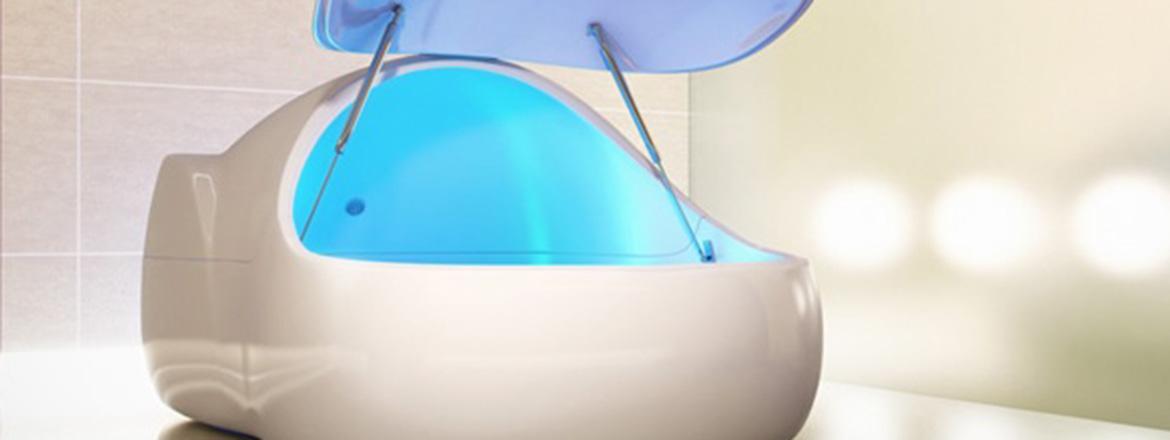
Float tanks (also known as floatation tanks, float pods, or sensory deprivation tanks) have grown in popularity as wellness facilities that promote relaxation, stress reduction, and sensory isolation. In float tanks, the user floats on his or her back in a warm, near-saturated solution of magnesium sulphate (MgSO4), which buoys the user up and creates a feeling of weightlessness. The tank, pod, or chamber is also kept dark and warm, and users wear ear plugs to reduce sound input.
Although the practice involves floating in "water," the use and operation of a float tank differs markedly from conventional recreational water facilities, leading to questions as to how they should be classified and regulated. Float solution has very different chemical and physical properties compared to recreational water, which affects many aspects of float tank design and operation. The solution in the float tank is not changed between users. Rather, it is cycled several times through a filtration and sanitizing system. Several hundred “floats” may occur in the same solution before it is changed. Float solution may be difficult to test (for halogens, pH, and microbes) through conventional recreational water testing methods. Due to these characteristics, they present unique environmental public health considerations that differ from conventional pools, spas, and other recreational water facilities.
The resources below are intended to help environmental public health professionals:
- Understand key health hazards and safety concerns in float tanks
- Learn about common disinfection methods to reduce microbiological hazards in float tanks
- Identify existing guidance documents and guidelines related to float tanks construction, operation, and management
Float tank operation and environmental public health considerations
- Survey of float tank operating practices (Suppes et al., 2023)
This journal article describes the outcomes of a survey of 45 float tank operators in the U.S. The results demonstrate a wide variation in water treatment and maintenance practices, highlighting the need for standardized guidance, licensing, and further research to support safe float tank operation.
- Float tanks: Considerations for environmental public health (NCCEH, 2016)
This NCCEH evidence review discusses the primary potential public health risks related to float tanks, including the potential for pathogen survival, issues with disinfection and testing methods, the risk of accidental death and injury, and personal injury. The document also lays out some of the evidence gaps and proposes research to adequately address these unknowns.
- Float tanks: Review of current guidance and considerations for public health inspectors (NCCEH, 2016)
This NCCEH evidence review discusses current guidance and regulation of float tanks in other jurisdictions and identifies some of the key groups that have been involved in developing and promoting float tank standards/criteria for design and operation. The document also draws on the experience of Vancouver Coastal Health (Vancouver, BC) in planning and inspecting the regions’ many commercial float facilities.
- Evidence brief: Risk of infection in the use of floatation tanks (Public Health Ontario, 2016)
This document examines evidence from the academic literature regarding whether the use of float tanks poses an infection risk. The document covers pathogen survival, filtration and disinfection, and exposure pathways.
Past reported cases and investigations
- Floatation tank associated Pseudomonas aeruginosa infection (Rehbein et al., 2019)
This journal article describes a clinical case of Pseudomonas aeruginosa infection associated with a float tank in Canada and summarizes the resulting public health investigation.
- An outbreak of skin rash traced to a portable floating tank in Norway, May 2017 (Hyllestad et al., 2019)
This journal article describes an outbreak of Pseudomonas aeruginosa linked to a portable floating tank in Norway and the public health investigation that followed.
Regulations, standards, and guidance for float tanks
Canadian resources
- Guidelines for floatation tanks (BC Ministry of Health, 2016)
This guideline describes best practices for the safe design, operation, maintenance, and monitoring of commercial float tank facilities to minimize health hazards and prevent the transmission of infectious diseases.
United States resources
- 2024 Model Aquatic Health Code (US Centres for Disease Control, 2024)
This guidance provides evidence-based information for public health agencies and aquatics industry to safely operate and manage a variety of aquatic venues, including float tanks.
- Safely managing floatation tanks: A quick guide for health departments and operators (National Association of County and City Health Officials (NACCHO), 2023)
This quick guide summarizes key recommendations from the Model Aquatic Health Code to help health departments and operators safely design, operate, maintain, and disinfect float tanks, reducing the risk of waterborne disease transmission and protecting public health.
- Washington state’s approach to regulating floatation tanks (NACCHO, 2017)
This webinar reviews the challenges encountered by Washington State’s Water Recreation Program, and considerations for developing codes.
- Float tanks guidelines for regulating floatation systems as special use pools (Washington State Department of Health, 2017)
This guideline provides regulatory guidance for the design, construction, permitting, operation, water treatment, sanitation, monitoring, and safety management of float tank facilities to protect public health.
International resources
- Guidelines for floatation tank installation, operation, monitoring and risk management (Government of Western Australia Department of Health, 2017)
This guideline provides best practices on the design, installation, operation, water treatment, monitoring, and risk management of commercial float tanks to ensure public health and safety by minimizing microbiological risks and meeting aquatic facility regulatory requirements.
Industry standards
- North American float tank standard (Float Tank Association, 2025)
This standard provides industry best practices for the safe design, construction, operation, sanitation, maintenance, and risk management of float tanks to support consistent health and safety standards for floatation facilities. The US Floatation Tank Association is an American industry-led organization that provides a range of information resources to the float industry.
- NSF/ANSI/CAN 50: Equipment for pools, spas, hot tubs and other recreational water facilities (National Sanitation Foundation, 2025)
This standard establishes public health and safety requirements for commercial aquatic facilities, which now includes float tanks. Previously, float tanks were assessed under the Component Certification Specification for Floatation or Sensory Deprivations Systems and Related Equipment (CCS-12804) (National Sanitation Foundation, 2013).
Inclusion of external resources in NCCEH Subject Guides is for information only and does not constitute an endorsement of the organization, author, or content. This list is not intended to be exhaustive. Omission of a resource does not preclude it from having value.