

Rotary tattoo pens in personal services establishments: What are the risks?

Rotary tattoo pens are a recent but increasingly popular tool within the personal services world but may not be fully covered within current personal services establishment or body modification guidance or regulations. The aim of this blog is to identify the main concerns and risks around the use of tattoo pens and highlight the need for a revision of provincial guidelines on tattooing. To do so, we drew on the practical experience and observations of public health inspectors from BC and Ontario.
What are rotary pens
Rotary tattoo pens consist of a single-use disposable needle cartridge that plugs into the grip, through which a drive shaft connects into the motor. The grip may be single use disposable or reusable, but not necessarily autoclavable. The device is powered by either a power cord or a battery for wireless options (Figure 1). Numerous styles and varieties of rotary tattoo pens are currently available.
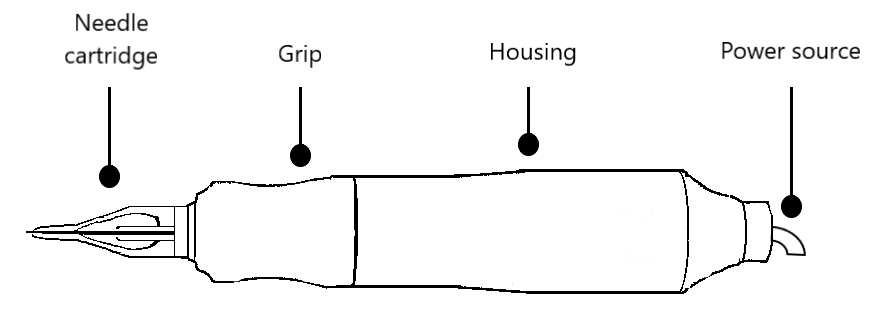
Figure 1. Schematic of a rotary tattoo pen showing the needle cartridge, the grip or cartridge holder (disposable or reusable), the housing containing the device motor, and the power source (corded in this instance).
Compared to traditional coil or rotary machines, rotary tattoo pens are lighter in weight and can be completely wireless. This may increase comfort and maneuverability during intensive or lengthy tattooing sessions. Needles are housed within a plastic cartridge, which decreases the chance of needle stick injuries when the device is not running, and needle bars can be swapped out quickly while working. Tattoos pens are also much quieter than the typical “buzzing” of the coil machine, which may be more appealing to clients.
What are the public health concerns related to rotary tattoo pens?
Challenge #1: Body fluid contamination of the exterior or interior of the reusable portion of the pen
As with conventional tattoo machines, using a rotary tattoo pen may generate a small amount of spatter composed of blood, interstitial fluid, water, and ink. This spatter may contaminate the device itself, as well as the power cord, the operator’s hand, and surrounding area. In addition, the rapid motion of the needle causes a small amount of fluid to be drawn up inside the needle cartridge. Unimpeded, those fluids can continue travelling upward along the drive shaft into the grip or even into the motor, causing difficulties with reprocessing or simply damaging the device. Manufacturers often do not provide adequate instructions for reprocessing, or those instructions may not align with public health recommendations (e.g., wiping down the non-autoclavable parts with isopropyl alcohol alone). There can also be design constraints where the unit cannot be taken apart, or where doing so would void a manufacturer’s warranty.
To reduce the risk of fluid contamination, single-use disposable needle cartridges should have a membrane or barrier to prevent backflow up into the grip. Greater awareness is needed among operators that cartridges with backflow prevention membranes are critical for client safety. In addition, although needle cartridges with backflow prevention are available, it is not always clear what the membranes or barriers are made of and there is no third-party validation that they are effective. While many reputable manufacturers supply cartridge with effective membranes, purchases are typically made online where the purchaser does not have access to a knowledgeable salesperson and will instead rely on brochures or other marketing materials to determine their equipment needs. Low-cost supplies purchased from online marketplaces may provide no information on the presence or quality of membranes.
Challenge #2: Rotary tattoo pens are being used outside of typical tattoo premises
Practitioners consulted for this document noted that tattoo pens are being increasingly used in salons, spas, and other settings by operators who offer tattooing as an add-on to their typical services. This is of concern for two reasons.
- Rotary pens are small and unobtrusive and can easily be tucked into a drawer or out of sight and it may not be apparent to public health inspectors that tattooing is being offered. The situation may be further complicated by cases in which salons rent space to those using tattoo pens, without indicating that tattooing is being done on the premises. Accordingly, there may not be appropriate equipment to support tattooing such as access to a dedicated procedure area, or designated space or equipment to clean and sterilize equipment.
- Lack of operator knowledge among persons tattooing outside of tattoo premises can mean that new users are learning on their own, rather than under the supervision of an experienced tattooist in a dedicated premises. Even if all infection control and prevention (IPAC) procedures are followed, tattooing is a skill that requires training and care to prevent the occurrence of injury or infection among clients. Common injuries include pigment overload (too much pigment loaded into the dermis, causing inflammation and granuloma formation) and overworked tattoos (needle trauma causing scarring and infection). Operators who tattoo outside of an inspected premises may not be aware of typical requirements for aftercare information and client record keeping. Inexperience combined with lack of appropriate practices and procedures may amplify the risk of adverse events for clients.
New guidance on rotary tattoo pens from Public Health Ontario
The rapid increase in the popularity in rotary tattoo pens and gaps in available guidance has proven a challenge for inspectors who encounter these devices in the field. Public Health Ontario (PHO) released a new resource on rotary tattoo pens entitled Reprocessing risks for tattoo cartridge grips (Feb 2024). Due to a lack of academic literature on rotary tattoo pen risks, this work was based on a review of manufacturer’s instructions for use and a jurisdictional scan of existing regulations and advice, including previous work by Toronto Public Health, Region of Durham Health Protection Division, and others.
In the PHO evidence brief, the authors re-affirm that because the cartridge grip (also called a cartridge holder) contacts a portion of the device that penetrates the skin, it should be considered semi-critical, based on the Spaulding classification used to guide re-processing of instruments, and should be (preferably) disposed of after use. Reusable grips should be pre-cleaned, disassembled, cleaned, sterilized (autoclaved), and properly stored before reuse. However, if the needle cartridge has a backflow prevention membrane and the inspector is satisfied that it works (based on a simple plunger test method described within the document), then the cartridge holder may be considered non-critical, and can be wrapped during use (Figure 2), followed by cleaning and intermediate- or low-level disinfection. The evidence brief also notes that operators should contact manufacturers for advice on disinfecting internal components of reusable grips in the event of a leak. Further implications for practice are discussed in the PHO evidence brief.
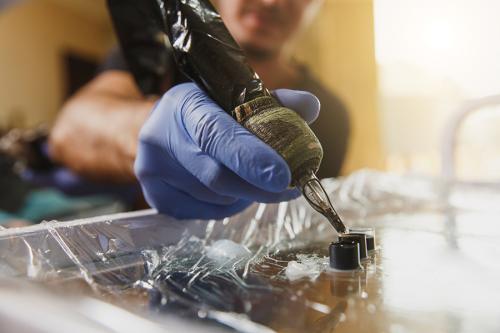
Figure 2. Use of a corded rotary tattoo pen with a disposable needle cartridge, plastic wrap covering the device and power cord, and disposable grip wrap over top. It is not apparent from the image whether the needle cartridge has a backflow prevention membrane.
What additional work is needed around rotary tattoo pens?
There are two major areas of work that are required to reduce the potential risks associated with increasing rotary tattoo pen usage.
The first is updating provincial and territorial guidance for personal services and body modification premises to include rotary tattoo pens, needle cartridges, and disposable vs. reusable grips/cartridge holders. These updates should cover:
- Requirement for backflow prevention in single use disposable needle cartridges;
- Guidance on acceptable rotary pen designs when it comes to the ability to remove and clean parts;
- Guidance on which parts of the rotary pens should be considered semi-critical vs. critical, including specifying the level of disinfection required and minimum acceptable wrapping practices to limit the risk of leakage.
- Guidance on how to evaluate needle cartridges with respect to membrane integrity. This might mean requiring a third-party verification (as offered by some manufacturers) or using the plunger test described by the PHO evidence brief. If using the plunger test, clarification will be required to understand who will perform this test (operator or inspector), as well as guidance on how many cartridges to test in a lot and when/how often lots should be tested;
- Guidance is required on what to do with the device should these measures fail (e.g., the needle cartridge leaks or wrapping tears or leaks).
The second major area of work is connecting with new rotary pen users and those using this device outside of typical tattooing premises. Public health units may wish to consider some of the following options:
- Publishing articles in industry media to explain the unique considerations around rotary tattoo pens and the importance of backflow prevention in needle cartridges;
- Encouraging cosmetology schools and online course providers to highlight the need for specialized infection prevention and control training for rotary tattoo pens;
- Approaching operators during inspections and querying whether tattooing is occurring on the premises, including micro-tattooing and permanent makeup;
- Strongly encouraging operators to purchase supplies from reputable sources, and to perform plunger tests before using a new brand of needle cartridges with a backflow prevention membrane;
- Reminding operators to stop using a particular brand of cartridge if it appears that ink is moving past the membrane.
Practitioners consulted in the development of this blog also noted that operators offering microblading, another form of tattooing, may also be expanding their practice with rotary tattoo pens. It may be necessary to connect with the microblading community to identify rotary tattoo pen users, and to improve advice on tattooing practice in general. These efforts must be ongoing, as tattooing practice and equipment will continue to evolve.
Summary
Given the rapid adoption of rotary pens in tattoo premises and beyond, these devices require special mention in IPAC guidelines for tattooing and strategies to educate new tattooists or trainees, including those working outside of traditional tattoo premises. Due to relatively recent uptake, there is currently no literature on whether rotary tattoo pens have been associated with outbreaks. It is, however, important to note that these devices are being used in some settings without appropriate client records, and identification or follow-up on a potential outbreak would be extremely difficult if one occurred. Indeed, the use of these devices outside of traditional tattoo shops run by experienced tattooists augment several potential risks for clients. Efforts should be made to expand the reach and coverage of tattooing/body modification guidance.