

Examining climate-driven influences on norovirus transmission and disease patterns

Key Messages |
|
Introduction
Norovirus infection is a major public health concern as the leading cause of acute gastroenteritis across all ages, causing approximately 685 million cases and 200,000 deaths annually worldwide.1 Research has shown that norovirus is sensitive to seasonal variations, and incidence is likely to increase in response to climate change and human factors such as increasing population density.2 Understanding these relationships may help to predict the impact of climate change on disease transmission and viral survivability in both the environment and viral hosts to enable effective and comprehensive adaptation strategies and public health responses.3 This evidence brief focuses on environmental factors that influence norovirus survival in the environment and contribute to contamination of foods and recreational water.
Background to noroviruses and their transmission
Noroviruses are non-enveloped viruses with a single-stranded RNA genome, classified in the family Caliciviridae. Noroviruses have a protective protein capsid that shields them from the environment and enables them to survive in seawater, groundwater, fresh water, soil, and on surfaces.4 This capsid also makes them resistant to conventional disinfection approaches like alcohol-based hand sanitizers and chlorine-based cleaners. A chlorine bleach solution with a concentration of 1,000-5,000 ppm with a contact time of at least five minutes is needed to disinfect surfaces.5 Noroviruses are characterized by environmental persistence and high infectivity, with less than ten viral genome equivalents being sufficient to cause infection.6 Infection can result in high excreted viral loads, and those who are infected can experience short-term immunity after recovery.1 Immunity to infection is short-lived (e.g., two to six months), and emergence of new variants can contribute to increased disease incidence where no prior immunity exists.7
Symptoms of norovirus infection usually begin 12 to 48 hours after exposure and may include diarrhea, vomiting, nausea, stomach pain, fever, headache, and body aches.8 In healthy adults, norovirus infections are self-limiting, with gastroenteritis symptoms lasting for two to three days.9 Certain groups such as persons with impaired immunity, young children, and the elderly, are at higher risk than others and can experience more severe symptoms over a longer duration.10 For example, norovirus causes the highest number of gastroenteritis episodes in young children and seniors (65+ years).7,11 Chronic infections have been recorded in immunocompromised individuals for months or years.12
Norovirus infections cause about 1 million of the 4 million foodborne illnesses experienced in Canada each year, resulting in approximately 1,180 hospitalizations.13 In 2023, the reported infection rate was 11.55 per 100,000 population, up from the pre-pandemic rate of 8.39 per 100,000 population in 2019. The true infection rate is likely much higher as only outbreaks are nationally notifiable, and there is a lack of community data from individual cases.11,14 The number of deaths and age-standardized death rate of norovirus-associated diseases increased from 1990 to 2019 in higher-income countries of North America, but the reported number is likely to be higher as norovirus infection is rarely noted as the cause of death on death certificates.10,15 In the US, the number of norovirus outbreaks in the 2024-2025 season was higher than reported during 2012–2020 and 2021-2024 seasons.16
Norovirus infections occur throughout the year but show seasonal patterns of recurrent outbreaks at certain times of the year, tending to peak in December-February in the Northern Hemisphere, and June-August in the Southern Hemisphere.3 Approximately three-quarters of all cases and outbreaks occur from October to March in the Northern Hemisphere and April to September in the Southern Hemisphere.17 This winter seasonality has led to norovirus infections being referred to as “winter vomiting disease.”17 Outbreaks in the Northern and Southern hemispheres do not always follow the same patterns, and some warm water outbreaks have been observed in countries such as Mexico.18
Human norovirus is primarily spread by fecal-oral or vomit-oral route through direct person-to-person contact.4,7 Infection can occur via ingestion of contaminated food and water, or via exposure to environmental fomites contaminated with the virus, such as touching a contaminated grocery bag or inhaling carpet dust.19,20 Some studies have suggested that airborne transmission via inhalation of norovirus particles suspended in microdroplets of vomitus may also be possible,1 such as in an enclosed bathroom stall after an infected person has been present.10
One of the main risk factors for disease is contact with an infectious person. Healthcare facilities such as nursing homes and hospitals, dining locations, schools, daycares, and vacation settings are the most common settings for norovirus outbreaks.4 Transmission in these settings is linked to:
- Proximity and increased interactions between people
- Environmental contamination and persistence of norovirus on surfaces (e.g., doorknobs, handles)
- Poor handwashing and cleaning practices allowing fecal-oral transfer
- Susceptibility of the population to norovirus infections
Foreign travel is also a risk factor due to changes in behaviour or exposure to a different viral strain.7 Contaminated drinking water is another cause of norovirus infections, especially private water supplies that could be impacted by septic tanks or other sources of human sewage.21 People can also be exposed to norovirus in recreational waters impacted by discharges of treated or untreated wastewater effluent, including following combined sewer overflow events.22
Food is a major source of exposure and can be contaminated at different points of production. Shellfish can be contaminated directly by pollution in shellfish-growing waters; ready-to-eat produce, such as fresh lettuce and berries, can be contaminated via fertilizer or contaminated irrigation water or infected personnel during harvesting and processing; other foods can be contaminated by poor food handler hygiene.10,23 Oysters and fresh lettuce have specific characteristics that make them higher risk foods for norovirus transmission. Oysters contain ligands that can tightly bind norovirus particles, and they are often eaten raw or lightly cooked. Fresh lettuce, also eaten raw, contains receptors that can bind norovirus to the surface, or can be contaminated by bacteria that contain norovirus binding proteins.24,25 This can be made worse by the inability to easily wash norovirus bound to plant cells or bacteria off of leaves.
Methodology
Literature search
A literature search was conducted in EBSCOhost databases (includes Medline, CINAHL, Academic Search Complete, ERIC, etc.), and Google Scholar. Peer-reviewed and grey English-language literature from 2015 to 2025 were collected, although older literature was also included if relevant. Additional references were added via forward and backward chaining of those search results and supplemental searches, as necessary. Each study was assessed by a single reviewer, and the results were synthesized narratively. The synthesis was subjected to internal and external review. Google was also used to identify additional relevant grey and industry literature. Complete search terms are listed in Appendix A.
Results
Climate-driven factors that may influence norovirus epidemiology
Given the wide range of factors that can affect norovirus transmission, including environmental factors and seasonal trends, it is important to gain a greater understanding of how these may be affected by a changing climate. Climate change is predicted to lead to major changes in temperature, precipitation, extreme weather events, and rising sea levels.26 These changes will directly influence terrestrial and aquatic ecosystems, impacting foodborne and waterborne pathogens and thereby shifting infectious disease burden. The seasonality of norovirus infections may also shift due to influences on viral transmissibility, host susceptibility, and viral resistance to environmental conditions.27
Changing precipitation patterns due to increased winter precipitation, and extreme precipitation events, can increase the risk of flooding, sewer overflows, and soil erosion that can contaminate water environments. Summer droughts can result in compacted soils that cause increased surface runoff following droughts and change pollutant loading patterns. Rising sea levels could lead to salinization in river deltas and coastal groundwaters, impacting the ecosystems within shellfish-growing waters.28 Furthermore, climate adaptation responses such as using reclaimed or potentially contaminated water to irrigate crops due to drought, population movements, and shared cooling spaces may further influence disease transmission patterns.29,30 Additional research and synthesis are necessary to delve into how norovirus epidemiology may be impacted by climate adaptation policies.
This section provides an overview of how various environmental factors influence norovirus growth, persistence, and transmission, and how climate change will potentially influence the significance of these factors.
Temperature
Norovirus particles can survive extreme temperature ranges, from -20C to > 65C.31,32 Laboratory studies assessing the effect of air and water temperature or other environmental conditions on human norovirus is challenging as it cannot be cultured in vitro in experimental conditions. Surrogate pathogens such as feline and murine calciviruses are commonly used instead. Murine norovirus has been found to be more persistent at lower temperatures (-20°C and 4°) than at higher ones (18°C and 30°C) on some surfaces (e.g., gauze or diaper material)33 and can survive longer in a stool suspension than on the surfaces studied.33 Murine norovirus has also been found to be mostly unaffected by monochloramine disinfectant at 4°C, but undetectable at 25°C after the same exposure period.34 Similarly, another study found that “putatively-infectious norovirus,” or norovirus assumed to cause infection, persisted longer on stainless steel and polyvinyl chloride (PVC) at 7°C than at 20°C, which may contribute to their transmission to foods.35 A review of other similar research corroborated the findings that broadly, norovirus are more persistent at lower temperatures.27
Norovirus incidence data can be employed to assess the potential effect of environmental factors on norovirus transmission and survival. Incidence of norovirus infection was found to have an inverse correlation with temperature, suggesting that low temperatures may contribute to the peak in winter months.21,36 Lopman et al. (2009) found that a 1% increase in temperature over a 49-day period was associated with a 15% decrease in norovirus reports.37 Low water temperature (<4°C) has been observed to be associated with an increase in norovirus prevalence and outbreaks.21,38 Additional studies in countries such as the US, Korea, and Japan corroborate the above findings – there are strong negative correlations between norovirus incidence, outbreaks, and temperature.27,30 However, the winter seasonality of norovirus is not mirrored in southern hemisphere countries such as Australia, New Zealand, and Brazil, where a summer seasonal peak and unevenly monthly distribution of outbreaks have been observed.27 This observation suggests that temperature alone cannot explain seasonal trends, and other factors must be considered. Low temperatures between -6.6°C and 20°C, relative humidity between 10 and 66%, and rainfall one day to three months before an outbreak have been found to favour the prevalence of norovirus.27
While warming generally does not appear to increase norovirus outbreaks, rising air temperatures due to climate change will cause an increase in surface water temperatures, and could also affect biogeochemical cycles, leading to changes in nutrient concentrations in water or soil, affecting growing seasons and lifecycle events in plants and animals.28 Warming water may also introduce new pathogens into oyster habitats. While temperatures have less direct impact on viral growth, they do affect growth and behaviour of food organisms linked to transmission of norovirus, such as oysters. Oysters filter feed higher volumes of seawater in warmer temperatures than in colder temperatures.39 In addition, bacteria grow faster in warmer temperatures – and bacteria that contaminate food surfaces could increase in a warming climate and contribute to norovirus binding on some foods (e.g., on lettuce). Further study is needed to understand how temperature could affect the food vehicles for norovirus.
Humidity
Climate change could affect localized or seasonal humidity.40 Humidity is typically measured as relative humidity (RH), which is temperature-dependent, or absolute humidity (AH) which is temperature-independent. AH may be a better determinant of virus survivability and infectivity than RH.41,42 While humidity does not affect norovirus survivability in water, it may affect its survivability on fomites, foods, and in aerosols. Most studies agree that low RH or AH, and low temperature support norovirus survival and infectivity.27 However, evidence on norovirus survival at various RH is conflicting. Some studies of enteric viruses, including noroviruses, found that infectivity was preserved at lowest and highest RH levels, and diminished at intermediate RH levels.41 However, a study found that murine norovirus persisted longer at lower RH (30%) than at higher RH (70%) on stainless steel surfaces.43 Another study confirmed that murine norovirus and another norovirus surrogate, MS2, survived longer at lower RH (50%).44 On the other hand, a study of noroviruses on stainless steel and PVC surfaces found that the virus retained its putative infectivity longer at high RH (86 ± 4 %) than at low RH (30 ± 10 %) at 20°C.35
Studies using epidemiological data appear to point toward an inverse association between norovirus incidence and RH. Lower RH was found to be associated with an increase in norovirus reports in a study in Korea.45 The Lopman et al. study (2009) found that a 1% increase in RH over a 35-day period was associated with a 2% decrease in norovirus reports in England and Wales.37 Another study in Japan noted that norovirus cases appeared earlier in the season in regions that experienced more rapid drops in RH.46 A study found that AH has a significant inverse relationship with weekly norovirus incidence. For every 5 g/m3 increase in AH, weekly counts of norovirus incidence decreased by 28% two weeks later.30
Rainfall and flooding
Heavy rainfall and flooding can lead to contamination of shellfish farming sites and other water bodies in various ways. Urban flooding can cause combined sewer overflows to release human sewage into aquatic environments and pathogens trapped in soils and sediments from previous contamination events may also be flushed out by new rainfall events. Increased rainfall in winter is another important factor influencing the seasonality of norovirus.17 For example, norovirus outbreaks and incidence in the community were found to be associated with high river flows in Toronto.38 Researchers hypothesized that during storm events, raw sewage from combined sewer overflows enter the Don River and travel to Lake Ontario, which provides drinking water to Greater Toronto Area.38 Low water temperatures may aid in viral survival, and resistance of norovirus to chlorination may allow it to persist in some treated waters. While Lopman et al. (2009) did not find an association between cumulative recent rainfall and norovirus incidence, their modelling may not have captured localized extreme rainfall events, which may be a more important contributor than rainfall events that do not cause flooding.37 A subsequent systematic review that includes this study and others examined the association between norovirus incidence, seasonality and environmental factors. It found a positive association between outbreaks and average rainfall in the wettest month.17 Norovirus can travel 10 km from a point-source of contamination in coastal areas of discharge and may disperse further along fresh-water plumes that sit on top of ocean water during heavy rain and flooding events.47
Solar radiation and ultraviolet light
Ultraviolet light (UV) between 100 to 400 nm can inactivate norovirus in oysters and wastewater.48-50 In the environment, sunlight provides UV radiation, inactivating viruses; however, thick cloud cover and a lower angle of sunlight into seawater during winter months can reduce the intensity of radiation reaching below the surface. These conditions allow norovirus to survive longer in oysters and seawater during winter months in the Northern hemisphere.48 In summer months, solar radiation can provide more virucidal effect, but warming water temperatures coupled with sewage or urban run-off can increase the growth of harmful algal blooms in fresh or brackish water, which reduces sunlight penetration aiding norovirus survival.48,51 In a groundwater study where solar radiation was absent, injected norovirus was detectable for three years and infectious for 60 days, highlighting the importance of UV in inactivating the virus.52
Salinity
Salinity may affect norovirus persistence and transmission in the environment due to the ability of viruses to bind to small-size sediments or silts in low-salinity conditions, providing protection and aiding their survival.53 A study examining the rate of inactivation of murine norovirus in sodium chloride (NaCl) solutions of 0, 0.5, and 1 M found that murine norovirus was more susceptible to inactivation in saline water than freshwater. However, seawater contains only about 3% NaCl which is equivalent to ~0.5 M NaCl. Only a 1.5-log10 reduction of murine norovirus was observed after three days in the study, suggesting prolonged norovirus survival is possible in saline waters.33 Other studies have also found that decreasing salinity supports norovirus survivability,54 and there may be a temperature relationship. For example, a study on murine norovirus exposed to oceanic water at Tateyama Bay, Japan, in summer and winter found that the virus was undetectable in summer/high-salinity conditions, but remained infective during winter/lower-salinity conditions.55 These results may be influenced by the effects of stronger sunlight and higher temperatures in summer on viral inactivation. In the same study, murine norovirus was inoculated in artificial seawater at salt concentrations of 0%, 1.5%, and 3.0%. No reduction in infectivity was observed for in the 0% saltwater, but infectivity was reduced in 1.5% and 3.0% salt water, indicating the influence of salt on norovirus viability.55 Heavy rainfall can lower salinity in brackish coastal waters, aiding norovirus survival. These extreme events may also flush out and resuspend pathogens bound to sediments or silts.
Other environmental factors
Extremely low gage height (depth of oyster beds) in combination with low water temperature, low salinity, strong offshore wind, and heavy antecedent rainfall are all potentially important factors in norovirus outbreaks associated with shellfish.56 One modelling study found that after gage height and temperature, strong wind was a predictor of norovirus outbreaks, ahead of rainfall and salinity.18,56 However, there is limited research on the role of wind in driving norovirus outbreaks, and the potential effects of wind could be varied.27 Onshore winds cause coastal water levels to rise, and offshore winds cause coastal water levels to fall and may suspend contaminants from land into the air and deposit them on oyster farms.56 Strong winds may also be associated with driving currents, which could affect dispersion of virus, or influence turbulence in coastal areas, resuspending virus.57 Climate change can influence wind patterns, and in turn may have variable effects on coastal upwelling or downwelling patterns, which could influence norovirus transmission in the environment. In BC, geographically dispersed norovirus outbreaks coincided with downwelling events, when winds push downwards onto marine water and into shore and shellfish harvesting areas.58,59
Human factors
Norovirus winter seasonality may be associated with human factors such as more time spent indoors in winter, or greater human interactions in winter in healthcare facilities.17,21 School year and multiple major holidays also align with the fall and winter season and may drive disease transmission.30 People also tend to spend more time indoors in winter, further exacerbating the likelihood of infection.17,21 Sporadic summer outbreaks may occur as a result of increased travel, particularly in areas where people are congregating in large numbers, such as on cruise ships, in camps, resorts, and recreational water activities, where the virus can persist on surfaces and easily spread among guests.17,21 High viral shedding and continual viral shedding for up to four weeks after infection enable efficient transmission between people, and as conditions become more favourable for the virus, there can be seasonal reactivation in winter.6
Health effects from climate-related events such as extreme heat or smoke exposure can affect susceptibility to illness, and displacement due to disasters such as extreme weather events may also lead to norovirus outbreaks due to compromised access to clean water and sanitation and overcrowding in shelters.60 Population displacement and crowding in these camps and shelters may introduce new norovirus variants to immunologically naïve populations, further increasing the likelihood of outbreaks and emergence of new norovirus strains.61 Children are particularly susceptible to moderate to severe norovirus illness as they are immunologically naïve to all circulating variants of norovirus.62
|
Why are oysters more prone to norovirus contamination |
|
Image
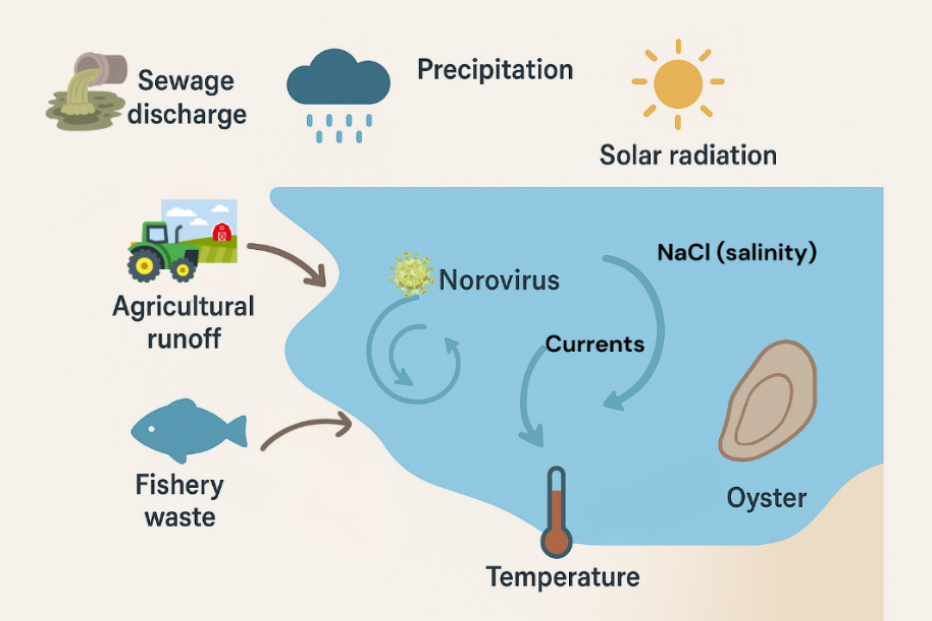
Shellfish are grown in coastal waters that can become contaminated by human and animal feces in the discharge from wastewater treatment plants, leaking septic fields, overboard discharges from commercial and recreational vessels, or urban runoff. Figure 1 depicts several ways that environmental factors can influence norovirus levels in shellfish such as oysters. Bivalve shellfish are filter feeders and can filter up to five litres per hour during active growing periods. They can retain and concentrate microbial pathogens such as Salmonella typhi, Vibrio parahaemolyticus, Vibrio vulnificus, hepatitis A virus and norovirus, and biotoxins found in the marine environments.23 Filter-feeding that coincides with community norovirus illnesses and discharge of norovirus-contaminated wastewater to shellfish growing seawaters can cause norovirus to accumulate in oysters. Different shellfish species exhibit varied affinity to different norovirus genotypes.63 For example, mussels test positive for norovirus GII more often than oysters, clams, and cockles, whereas GI.3 and GII.4 may have higher binding rates with Pacific oyster than with green-lipped mussel.63 Consumption of oysters, clams, or mussels raw or only lightly cooked, including the viscera, poses risk of developing foodborne illnesses. Over half of viral disease outbreaks (58.4%) from shellfish consumption globally are due to raw or undercooked oysters.23
|
Summary of potential climate-driven impacts
Climate change is influencing many of the drivers that impact norovirus persistence and transmission in the environment. These impacts may be additive, synergistic, or antagonistic. Awareness of these environmental drivers is important to improve understanding of how these climate-driven impacts could influence norovirus outbreaks. Warming air temperatures lead to increased humidity and rising temperatures in water bodies.6 Altered climatic system interactions result in more frequent extreme events such as excessive precipitation, floods, and droughts.6,67,68 Flooding can overwhelm wastewater treatment plants, releasing untreated wastewater.67 Droughts reduce water availability, and consequently may concentrate pathogens in water bodies. Shifts in coastal currents and wind patterns may also emerge. As a result, there may be subsequent impacts on norovirus transmission, host susceptibility to norovirus infection, and viral evolution toward resistance to environmental conditions.6 There is a potential evolution of new norovirus variants as well as movement of norovirus habitats. Population displacement and movement due to climate disasters may shift population immunity to existing norovirus strains.6 Population movement may further stress existing sewage treatment systems. All these factors may influence norovirus transmission, infections, and outbreaks.
Risk mitigation and reduction strategies
Multidisciplinary public health approach
Collaboration across public health, environment, food safety, research, surveillance, and climate sectors is necessary to mitigate climate-driven risks of norovirus infection. A whole-systems approach is needed to manage multiple contributing factors. Some suggestions include controlling human sewage sources that enter marine environments by improving infrastructure, creating regulations, increasing enforcement and compliance, and educating the public, commercial businesses, and various government authorities.69 Preventing contaminated effluent discharges and maintaining safe harvest areas depend on strong environmental safeguards, supported by regulations, surveillance and monitoring systems, and classification of sites based on water quality.67 Outbreak and incidence monitoring should be linked to climate and environmental monitoring to detect climate-change impacts.61
With climate change expected to intensify the occurrence of natural disasters, safeguarding the food supply is paramount. Robust coordination among governmental agencies, non-governmental organizations, and food industry partners is essential for implementing climate adaptation and risk mitigation and reduction strategies. These plans must encompass the whole food system, spanning agricultural production through to the food service sector.70
Predictive surveillance and forecasting
Satellite remote sensing technology is capable of monitoring environmental parameters such as solar radiation, water temperatures, salinity, humidity, precipitation, etc., in large areas such as oyster growing waters.64 Real-time monitoring data from the sensors can be used in combination with other data sources in predictive models for nowcasting and forecasting fecal coliform concentrations, which is an indicator of sewage contamination, and is sometimes used as a proxy for norovirus contamination.64 Some of these predictive models include regression models, Artificial Neural Networks (ANNs), Bayesian models, or process-based models.64 Advanced alert of potential outbreaks either before or at the onset of an outbreak would prevent or reduce risks to human health and costly oyster recalls. An alert could signal a responsible health agency to conduct sampling of harvesting waters and potentially implicated oysters to confirm the alert and close the contaminated area.56 Geoinformatics, the combination of remote sensing, geographic information systems, and statistical modelling, can be used in conjunction with molecular-based population genetics studies to monitor the distribution of pathogens as a result of climate influences.70 More research and literature synthesis is necessary to compare and contrast various norovirus forecasting and nowcasting models, and to incorporate climate variables such as rainfall, temperature, currents, wind, and other parameters to accurately predict norovirus contamination risks.57
Testing and monitoring
Currently, quantification of viral genome in samples and in end-product shellfish testing is by RT-qPCR (reverse-transcription quantitative polymerase chain reaction); however, the presence of viral genetic materials does not confirm infectivity.71 While no end-product testing is currently required in Canada, a proposed quantitative limit for norovirus levels in shellfish products intended for raw consumption is 200 genome copies per gram of digestive tissue (gc g-1 dt).71 Another suggestion for fast, real-time detection of norovirus is using DNA microarray-based techniques to provide fast, large-scale analysis of viruses.64 While the current cost is high, the cost could be reduced in future. More research is needed to develop rapid and sensitive methods to detect and study viral pathogens such as noroviruses that cannot be cultured in vitro.
Wastewater management and treatment
Guidelines in Canada and the US prohibit the farming and harvesting of shellfish within set distances from sewage treatment systems.72,73 However, climate change is affecting both the drivers of norovirus survivability and transmission and the quality and quantity of wastewater and sewage discharge reaching the environment.63 Therefore, existing approaches to defining buffer zones around prohibited areas such as sewage treatment systems need to be consistently monitored and may need to be revised. These zones should be informed by hydrodynamics in the receiving waters, models of sewage effluent dilution, or empirical sampling approaches, such as the use of bacteriophages as tracers of contamination spread.71 Norovirus has been observed up to 10 km away from the discharge point, indicating that it is capable of persisting in the environment and contaminating coastal zones.71 Active monitoring and testing of growing and harvesting waters would also help to reduce the risk of shellfish contamination and human infection.63 It has been proposed that a norovirus limit of 1000 gc g−1 in shellfish production waters would keep the level of norovirus in shellfish below the proposed 200 gc g-1 dt limit.71
Proper wastewater treatment is crucial to reduce or eliminate norovirus viral load in wastewater effluent. However, wastewater treatment processes are typically designed for reducing bacterial load, and the effectiveness for removing virus can vary depending on the processes used. Studies have found that primary treatment (settlement of sewage solids) results only in 1-2 log10 reduction in viral load. The effectiveness of secondary treatment to reduce viral load can vary significantly based on the chosen process and virus genotype.
A review comparing several secondary treatment processes (e.g., waste stabilization pond, activated sludge, and trickling filter) found that while activated sludge is more effective than the waste stabilization pond for reducing norovirus load, the differences are marginal with removal of 1-2 log10 units and 1.2-1.8 log10 units respectively.67 Tertiary treatment can improve viral inactivation using processes such as membrane bioreactor, UV disinfection, and chlorine disinfection.67 An optimized activated sludge process combined with tertiary UV treatment reduces norovirus GI by 2 log10 and norovirus GII by 2.9 log10.67 Membrane bioreactor technology, which combines activated sludge and membrane filtration, reduced norovirus GI and GII by between 3.3 to 6.8 log10 units.67 It should be noted that norovirus is resistant to chlorine disinfection, and only high concentrations and long contact times may be effective. Advanced oxidation processes that use UV light to create radicals from disrupting added hydrogen peroxide, or (UV/H2O2) show the most potential to inactivate viruses in tertiary and quaternary wastewater treatments.49
Further research is necessary to determine the efficacy of tertiary treatment to reduce overall norovirus viral load to non-infectious levels to justify investing in such upgrades given the significant costs. Effectiveness of treatment depends on not only the initial viral load, but also environmental factors such as those mentioned earlier (e.g., temperature, humidity), and the turbidity of the wastewater.74 Nevertheless, upgrades to wastewater collection and treatment systems such as expansion of storm tanks, removal of combined sewers, and adding treatment of storm water may improve the quality of the treated effluent and prevent untreated sewage reaching shellfish growing waters.
Post-harvest shellfish treatments
Depuration
This process involves the natural purging of pathogens from shellfish in clean, controlled water using chlorine, iodophor, UV radiation, or ozone.74 Studies have found that the effectiveness of depuration depends on shellfish species and norovirus genotypes.63 Depuration may not be as effective in winter months when oyster metabolic activity is reduced.23 While this method is able to reduce viral load, its ability to reduce viral load to non-infectious levels is contested.71
Relaying
Relaying is the process in which oysters from harvesting areas that are classified as lower quality are placed into a higher quality area for a minimum of two months.71 While some studies have found this process to be effective, the limited availability of pristine oyster growing areas located away from areas subject to fecal contamination and the significant cost to transport oysters from one site to another continue to be barriers for its adoption.71 Furthermore, climate change may reduce the number of coastal areas that are suitable for depuration.
Thermal and non-thermal treatments
Norovirus is inactivated by thermal methods such as cooking, but consumption of contaminated raw shellfish poses health risks. Boiling oysters inoculated with 5-6 log10 PFU/ml of murine norovirus for three minutes dropped the viral titers to below the limit of detection.75 The BC Centre for Disease Control recommends cooking oysters to an internal temperature of 90°C for 90 seconds to fully inactivate norovirus.76 In the European Union, legislation also requires oysters to be cooked to an internal temperature of 90°C for 90 seconds.74 Notably, when commercial processing follows these recommendations, no outbreaks have occurred.
Non-thermal treatments are typically able to inactivate pathogens while preserving the physical characteristics of foods. Numerous non-thermal treatments are currently being investigated for norovirus inactivation. A detailed discussion of non-thermal treatments is out of scope for the present review; however, a review by Yang et al. (2022) summarized several studies in which irradiation processing methods including electron beams, gamma rays, and X-rays were effective in reducing murine norovirus and human norovirus in shellfish such as oysters and abalone.63 High hydrostatic pressure processing is another non-thermal method that has shown promising results in norovirus inactivation in shellfish.63 Other non-thermal processing methods include ultraviolet light and plasma processing.63
Vaccines
While vaccine research on norovirus is ongoing and some early preclinical data appears to be promising, norovirus presents some unique challenges for vaccine development. The norovirus strains that can infect humans are found in 32 different genotypes.7 The GI and GII genotypes cause the majority of infections, including the rapidly evolving GII.4 viruses.7 New GII.4 variants emerge every two to four years, and immunity after viral infection wanes over time, posing questions about long-term effectiveness and the need for updated boosters.77
Food safety controls and practices
In additional to environmental transmission in foods, norovirus infection is also associated with fresh foods such as ready-to-eat produce and improper food preparation and handling practices. Extreme weather events may result in flooding, contaminating farms and croplands.70 Droughts may cause scarcity in clean irrigation water for crops such as fresh produce.78 To mitigate these risks, it is vital to strengthen preparedness to protect food during disasters and emergencies, especially in areas prone to flooding, windstorms, or droughts.70 Communications with food processors, food service establishments, and the public should be prompt during active norovirus outbreaks and emergencies to reduce the risk of infection. Other adaptation strategies include building rainwater storage systems to alleviate water shortage during drier periods and flood damage, or moving farms to more climatically hospitable areas.78 Food safety regulation throughout the food system from harvesting to retail should be strictly monitored and enforced to reduce the risk of contamination during this process.
Summary
Norovirus is a leading cause of gastroenteritis globally, and growing evidence highlights how environmental factors, intensified by climate change, shape its transmission and outbreak patterns. Temperature, humidity, rainfall, flooding, salinity, and other environmental drivers influence norovirus persistence in water and food such as fresh produce and shellfish, thereby affecting human exposure. These dynamics illustrate that norovirus epidemiology is not determined by a single factor but by the interaction of environmental conditions, viral evolution, and host susceptibility. As climate change accelerates shifts in hydrological cycles, ocean conditions, and extreme weather events, coordinated and multidisciplinary strategies that integrate environmental monitoring, predictive modelling, wastewater management, and food safety interventions will be essential to mitigate norovirus risks. These strategies would enable public health agencies to better anticipate and reduce the climate-driven risks of norovirus contamination, protecting both communities and food supplies.
This synthesis highlights several critical knowledge and research gaps. The mechanisms linking climate variability to outbreak dynamics remain poorly understood, and further investigation is needed to clarify which environmental conditions most strongly coincide with large norovirus outbreaks and how these conditions interact with each other. Improvements to current surveillance systems are needed to develop predictive models capable of providing early warning of potential contamination events. Advancements in rapid and sensitive detection methods are also required to strengthen epidemiological analyses and outbreak investigations. Additional gaps include limited evidence on the effectiveness of wastewater treatment processes in inactivating norovirus, and insufficient evaluation of mitigation measures that could reduce environmental contamination and outbreak frequency. Finally, more research and synthesis are needed to understand norovirus infection risks specific to Indigenous populations, who may face disproportionate impacts due to frequency and method of shellfish consumption, systemic vulnerabilities, and inequities in water and food safety infrastructure.
Acknowledgements
We acknowledge the valued input of reviewers for their knowledge and feedback in the production of this document and for those who assisted in the review, including Juliette O’Keeffe, Senior Scientist, NCCEH; Michele Wiens, Information Specialist, NCCEH; and Lorraine McIntyre.
Appendix A
A combination of the search terms below was used to find relevant literature:
Initial search with the following terms, but modified later to include contamination in shellfish terms, food supply, mitigation/interventions, etc.
“Climate Change” OR “global warming” OR “global heating” OR “climate variability” OR “climate variation” OR “rising temperature” OR “warmer water” OR “warmer ocean” OR “ocean warming” OR “extreme heat” OR “extreme weather” OR “temperature change” OR “warmer weather” OR “warmer days” OR “heavy rainfall” OR flooding OR “increasing precipitation” OR “more rain” OR “more precipitation”
OR
Norovirus OR gastroenteritis OR “food poisoning” OR calicivirus OR “stomach pain” OR nausea OR vomiting OR dizziness OR dizzy OR “foodborne illness” OR “waterborne disease” OR “water-transmitted infection” OR foodborne OR enteric
OR
“virus viability” OR “virus survival”
//more added related to:
contamination in shellfish terms, food supply, mitigation/interventions, etc.
Additional keywords used to search in Google Scholar include:
“climate adaptation” AND “norovirus”
burden AND norovirus AND Canada
norovirus AND “food handling” AND “climate change”
References
- Xiao S, Tang JW, Li Y. Airborne or fomite transmission for norovirus? A case study revisited. Int J Environ Res Public Health. 2017;14(12):1571. Available from: https://www.mdpi.com/1660-4601/14/12/1571.
- Chiu S-C, Hu S-C, Liao L-M, Chen Y-H, Lin J-H. Norovirus Genogroup II epidemics and the potential effect of climate change on norovirus transmission in Taiwan. Viruses. 2022;14(3). Available from: https://doi.org/10.3390/v14030641.
- Ahmed F, Liberda EN, Solomon A, Davey R, Sutherland B, Tsuji LJS. Indigenous land-based approaches to well-being: the Niska (Goose) Harvesting Program in Subarctic Ontario, Canada. Int J Environ Res Public Health. 2023;20(4). Available from: https://doi.org/10.3390/ijerph20043686.
- Public Health Agency of Canada. Pathogen safety data sheets: Infectious substances – norovirus. Ottawa, ON: Government of Canada; 2020. Available from: https://www.canada.ca/en/public-health/services/laboratory-biosafety-biosecurity/pathogen-safety-data-sheets-risk-assessment/norovirus-pathogen-safety-data-sheet.html.
- Centers for Disease Control and Prevention. How to prevent norovirus. Atlanta, GA: US CDC; 2025. Available from: https://www.cdc.gov/norovirus/prevention/index.html.
- Rohayem J. Norovirus seasonality and the potential impact of climate change. Clin Microbiol Infect. 2009;15(6):524-7. Available from: https://doi.org/10.1111/j.1469-0691.2009.02846.x.
- Lopman B. Global burden of norovirus and prospects for vaccine development. Atlanta, GA: US Centers for Disease Control and Prevention; 2015. Available from: https://www.cdc.gov/norovirus/downloads/global-burden-report.pdf.
- Centers for Disease Control and Prevention. About norovirus. Atlanta, GA: US CDC. Available from: https://www.cdc.gov/norovirus/about/index.html.
- Public Health Agency of Canada. Norovirus: symptoms and treatment. Ottawa, ON: Government of Canada; 2022. Available from: https://www.canada.ca/en/public-health/services/food-poisoning/norovirus.html.
- de Graaf M, van Beek J, Koopmans MPG. Human norovirus transmission and evolution in a changing world. Nat Rev Microbiol. 2016 Jul 1;14(7):421-33. Available from: https://doi.org/10.1038/nrmicro.2016.48.
- Hughes SL, Greer AL, Elliot AJ, McEwen SA, Young I, Papadopoulos A. Detection and phylogenetic analysis of hepatitis A virus and norovirus in marine recreational waters of Mexico. Can Commun Dis Rep. 2021 Oct 14;47(10):397-404. Available from: https://doi.org/10.2166/wh.2009.114.
- Chaimongkol N, Kim DY, Matsushima Y, Durkee-Shock J, Barton K, Ahorrio CN, et al. A decade of chronic norovirus infection surveillance at the National Institutes of Health clinical research center: Clinical characteristics, molecular epidemiology, and replication. J Infect Dis. 2024;231(3):784-94. Available from: https://doi.org/10.1093/infdis/jiae440.
- Public Health Agency of Canada. Infographic: food-related illnesses, hospitalizations and deaths in Canada. Ottawa, ON: Government of Canada; 2016. Available from: https://www.canada.ca/en/public-health/services/publications/food-nutrition/infographic-food-related-illnesses-hospitalizations-deaths-in-canada.html.
- Public Health Agency of Canada. National case definition: norovirus. Ottawa, ON: Government of Canada; 2008. Available from: https://www.canada.ca/en/public-health/services/diseases/norovirus/health-professionals/national-case-definition.html.
- Zhang X, Chen C, Du Y, Yan D, Jiang D, Liu X, et al. Global burden and trends of norovirus-associated diseases from 1990 to 2019: an observational trend study. Front Public Health. 2022 Jun 17;Volume 10 - 2022. Available from: https://www.frontiersin.org/journals/public-health/articles/10.3389/fpubh.2022.905172.
- Centers for Disease Control and Prevention. NoroSTAT Data. Atlanta, GA: US CDC; 2025. Available from: https://www.cdc.gov/norovirus/php/reporting/norostat-data.html.
- Ahmed SM, Lopman BA, Levy K. A systematic review and meta-analysis of the global seasonality of norovirus. PLOS ONE. 2013;8(10):e75922. Available from: https://doi.org/10.1371/journal.pone.0075922.
- Miller ACEML. Literature review of environmental factors and major sources of sewage affecting norovirus. Vancouver, BC: BC Centre for Disease Control; 2017. Available from: http://www.bccdc.ca/resource-gallery/Documents/Guidelines%20and%20Forms/Guidelines%20and%20Manuals/Health-Environment/Lit%20review_norovirus_environ%20and%20sewage.pdf.
- Repp KK, Keene WE. A point-source norovirus outbreak caused by exposure to fomites. J Infect Dis. 2012;205(11):1639-41. Available from: https://doi.org/10.1093/infdis/jis250.
- Cheesbrough JS, Green J, Gallimore CI, Wright PA, Brown DWG. Widespread environmental contamination with Norwalk-like viruses (NLV) detected in a prolonged hotel outbreak of gastroenteritis. Epidemiol Infect. 2000;125(1):93-8. Available from: https://www.cambridge.org/core/product/866244656D770FEC22E2FC764E99B7ED.
- Semenza JC, Herbst S, Rechenburg A, Suk JE, Höser C, Schreiber C, et al. Climate change impact assessment of food- and waterborne diseases. Crit Rev Environ Sci Technol. 2012 Apr;42(8):857-90. Available from: https://doi.org/10.1080/10643389.2010.534706.
- Young I, Sanchez JJ, Tustin J. Recreational water illness in Canada: a changing risk landscape in the context of climate change. Can J Public Health. 2022. Available from: https://link.springer.com/article/10.17269/s41997-022-00688-8.
- Bellou M, Kokkinos P, Vantarakis A. Shellfish-borne viral outbreaks: a systematic review. Food Environ Virol. 2013 Mar;5(1):13-23. Available from: https://doi.org/10.1007/s12560-012-9097-6.
- Zhan X, Li Q, Tian P, Wang D. The attachment factors and attachment receptors of human noroviruses. Food Microbiology. 2024 Oct 1;123:104591. Available from: https://www.sciencedirect.com/science/article/pii/S0740002024001291.
- Deng W, Gibson KE. Interaction of microorganisms within leafy green phyllospheres: where do human noroviruses fit in? Int J Food Microbiol. 2017 Oct 3;258:28-37. Available from: https://www.sciencedirect.com/science/article/pii/S0168160517303070.
- Sterk A, Schijven J, de Nijs T, de Roda Husman AM. Direct and indirect effects of climate change on the risk of infection by water-transmitted pathogens. Environ Sci Technol. 2013 Nov 19;47(22):12648-60. Available from: https://pubs.acs.org/doi/10.1021/es403549s.
- Shamkhali Chenar S, Deng Z. Environmental indicators for human norovirus outbreaks. Int J Environ Health Res. 2017;27(1):40-51. Available from: https://doi.org/10.1080/09603123.2016.1257705.
- Sterk A, Schijven J, de Nijs T, de Roda Husman AM. Direct and indirect effects of climate change on the risk of infection by water-transmitted pathogens. Environ Sci Technol. 2013 2013/11/19;47(22):12648-60. Available from: https://doi.org/10.1021/es403549s.
- Amnuaylojaroen T, Parasin N. Human health adaptation strategies to climate-induced extreme weather events: a systematic review. Earth. 2024;5(4):724-42. Available from: https://www.mdpi.com/2673-4834/5/4/38.
- Mattison CP, Calderwood LE, Cates JE, Donald J, Hall AJ, Schmidt MA, et al. Seasonality of medically attended norovirus gastroenteritis and its association with climatic factors within an US integrated healthcare system, 2016–2019. PLoS ONE. 2025;20(5):e0318077. Available from: https://doi.org/10.1371/journal.pone.0318077.
- Mirmahdi RS, Montazeri N. Progress and challenges in thermal inactivation of norovirus in oysters. Crit Rev Food Sci Nutr.1-14. Available from: https://doi.org/10.1080/10408398.2025.2467209.
- Wikswo ME, Karst SM, Hall AJ. Chapter 16 - Noroviruses. In: Morris JG, Vugia DJ, editors. Foodborne Infections and Intoxications (Fifth Edition): Academic Press; 2021. p. 287-306. Available from: https://www.sciencedirect.com/science/article/pii/B9780128195192000025.
- Lee J, Zoh K, Ko G. Inactivation and UV disinfection of murine norovirus with TiO2 under various environmental conditions. Appl Environ Microbiol. 2008;74(7):2111-7. Available from: https://journals.asm.org/doi/abs/10.1128/aem.02442-07.
- Keller R, Tetro JA, Susan Springthorpe V, Sattar SA. The influence of temperature on norovirus inactivation by monochloramine in potable waters: testing with murine norovirus as a surrogate for human norovirus. Food Environ Virol. 2010;2(2):97-100. Available from: https://doi.org/10.1007/s12560-010-9037-2.
- Lamhoujeb S, Fliss I, Ngazoa SE, Jean J. Molecular study of the persistence of infectious human norovirus on food-contact surfaces. Food Environ Virol. 2009 Jun 1;1(2):51-6. Available from: https://doi.org/10.1007/s12560-009-9010-0.
- Chiu S-C, Hu S-C, Liao L-M, Chen Y-H, Lin J-H. Norovirus genogroup II epidemics and the potential effect of climate change on norovirus transmission in Taiwan. Viruses. 2022;14(3):641. Available from: https://www.mdpi.com/1999-4915/14/3/641.
- Lopman B, Armstrong B, Atchison C, Gray JJ. Host, weather and virological factors drive norovirus epidemiology: time-series analysis of laboratory surveillance data in England and Wales. PLOS ONE. 2009;4(8):e6671. Available from: https://doi.org/10.1371/journal.pone.0006671.
- Greer AL, Drews SJ, Fisman DN. Why “winter” vomiting disease? Seasonality, hydrology, and norovirus epidemiology in Toronto, Canada. Ecohealth. 2009;6(2):192-9. Available from: https://doi.org/10.1007/s10393-009-0247-8.
- Anderson S. The connection between climate change and the Pacific oyster microbiome and mortality. Vancouver, BC: University of British Columbia, Faculty of Science, Microbiology and Immunology; 2025. Available from: https://www.mbim.ubc.ca/news/the-connection-between-climate-change-and-the-pacific-oyster-microbiome-and-mortality.
- Bush E, Lemmen DS. Canada's changing climate report. Ottawa, ON: Government of Canada; 2019. Available from: https://changingclimate.ca/CCCR2019/.
- Colas de la Noue A, Estienney M, Aho S, Perrier-Cornet J-M, de Rougemont A, Pothier P, et al. Absolute humidity influences the seasonal persistence and infectivity of human norovirus. AEM. 2014;80(23):7196-205. Available from: https://doi.org/10.1128/AEM.01871-14.
- Colas S, Marie B, Lance E, Quiblier C, Tricoire-Leignel H, Mattei C. Anatoxin-a: Overview on a harmful cyanobacterial neurotoxin from the environmental scale to the molecular target. Environ Res. 2021 Feb 1;193:110590. Available from: https://www.sciencedirect.com/science/article/pii/S0013935120314870.
- Kim SJ, Si J, Lee JE, Ko G. Temperature and humidity influences on inactivation kinetics of enteric viruses on surfaces. Environ Sci Technol. 2012;46(24):13303-10. Available from: https://doi.org/10.1021/es3032105.
- Lee SJ, Si J, Yun HS, Ko G. Effect of temperature and relative humidity on the survival of foodborne viruses during food storage. Appl Environ Microbiol. 2015;81(6):2075-81. Available from: https://doi.org/10.1128/aem.04093-14.
- Kim YS, Park KH, Chun HS, Choi C, Bahk GJ. Correlations between climatic conditions and foodborne disease. Food Res Int. 2015 Feb 1;68:24-30. Available from: https://www.sciencedirect.com/science/article/pii/S0963996914001926.
- Inaida S, Shobugawa Y, Matsuno S, Saito R, Suzuki H. The south to north variation of norovirus epidemics from 2006–07 to 2008–09 in Japan. PLoS ONE. 2013;8(8):e71696. Available from: https://doi.org/10.1371/journal.pone.0071696.
- Campos CJA, Goblick G, Lee R, Wittamore K, Lees DN. Determining the zone of impact of norovirus contamination in shellfish production areas through microbiological monitoring and hydrographic analysis. Water Res. 2017 Nov 1;124:556-65. Available from: https://www.sciencedirect.com/science/article/pii/S0043135417306747.
- Rowan NJ. Current decontamination challenges and potentially complementary solutions to safeguard the vulnerable seafood industry from recalcitrant human norovirus in live shellfish: Quo Vadis? Sci Total Environ. 2023 2023/05/20/;874:162380. Available from: https://www.sciencedirect.com/science/article/pii/S0048969723009968.
- Kokkinos P, Venieri D, Mantzavinos D. Advanced oxidation processes for water and wastewater viral disinfection: a systematic review. Food Environ Virol. 2021 Sep 1;13(3):283-302. Available from: https://doi.org/10.1007/s12560-021-09481-1.
- de Abreu Corrêa A, Souza DS, Moresco V, Kleemann CR, Garcia LA, Barardi CR. Stability of human enteric viruses in seawater samples from mollusc depuration tanks coupled with ultraviolet irradiation. J Appl Microbiol. 2012;113(6):1554-63. Available from: https://doi.org/10.1111/jam.12010.
- Centers for Disease Control and Prevention. Harmful algal blooms: Contributing factors and impacts. Atlanta, GA: US CDC; 2024. Available from: https://www.cdc.gov/harmful-algal-blooms/about/harmful-algal-blooms-contributing-factors-and-impacts.html.
- Seitz SR, Leon JS, Schwab KJ, Lyon GM, Dowd M, McDaniels M, et al. Norovirus infectivity in humans and persistence in water. Appl Environ Microbiol. 2011 Oct;77(19):6884-8. Available from: https://doi.org/10.1128/AEM.05806-11.
- Maalouf H, Pommepuy M, Le Guyader FS. Environmental conditions leading to shellfish contamination and related outbreaks. Food Environ Virol. 2010;2(3):136-45. Available from: https://doi.org/10.1007/s12560-010-9043-4.
- Félix JL, Fernandez YC, Velarde-Félix JS, Torres BV, Cháidez C. Detection and phylogenetic analysis of hepatitis A virus and norovirus in marine recreational waters of Mexico. J Water Health. 2010;8(2):269-78. Available from: https://doi.org/10.2166/wh.2009.114.
- Takahashi H, Takahashi M, Ohshima C, Izawa Y, Uema M, Kuda T, et al. Differences in the viability of murine norovirus in different aquatic locations. Mar Pollut Bull. 2016 Nov 15;112(1):313-7. Available from: https://www.sciencedirect.com/science/article/pii/S0025326X16306336.
- Wang J, Deng Z. Modeling and prediction of oyster norovirus outbreaks along Gulf of Mexico Coast. EHP. 2016;124(5):627-33. Available from: https://ehp.niehs.nih.gov/doi/abs/10.1289/ehp.1509764.
- Miller A, Cumming E, McIntyre L, Environmental Transmission of Norovirus into Oysters Working Group. Summary working group report of the environmental transmission of norovirus into oysters. Vancouver, BC: British Columbia Centre for Disease Control; 2018. Available from: http://www.bccdc.ca/resource-gallery/Documents/Guidelines%20and%20Forms/Guidelines%20and%20Manuals/Health-Environment/ETNO%20Full%20Report.pdf.
- David ST, McIntyre L, MacDougall L, Kelly D, Liem S, Schallié K, et al. An outbreak of norovirus caused by consumption of oysters from geographically dispersed harvest sites, British Columbia, Canada, 2004. Foodborne Pathog Dis. 2007 Fall;4(3):349-58. Available from: https://doi.org/10.1089/fpd.2007.0015.
- Meghnath K, Hasselback P, McCormick R, Prystajecky N, Taylor M, McIntyre L, et al. Outbreaks of norovirus and acute gastroenteritis associated with British Columbia oysters, 2016-2017. Food Environ Virol. 2019 Jun;11(2):138-48. Available from: https://doi.org/10.1007/s12560-019-09374-4.
- Palacio H, Shah U, Kilborn C, Martinez D, Page V, Gavagan T, et al. Norovirus outbreak among evacuees from Hurricane Katrina -- Houston, Texas, September 2005. MMWR Morb Mortal Wkly Rep. 2005 Oct;54(40):1016-8. Available from: https://www.cdc.gov/mmwr/preview/mmwrhtml/mm5440a3.htm#:~:text=The%20epidemiologic%20and%20laboratory%20findings,a%20convention%20center%2C%20smaller%20shelters%2C.
- Rohayem J. Norovirus seasonality and the potential impact of climate change. Clin Microbiol Infect. 2009;15(6):524-7. Available from: https://doi.org/10.1111/j.1469-0691.2009.02846.x.
- Shah MP, Hall AJ. Norovirus illnesses in children and adolescents. Infect Dis Clin North Am. 2018 Mar;32(1):103-18. Available from: https://doi.org/10.1016/j.idc.2017.11.004.
- Yang M, Zhao F, Tong L, Wang S, Zhou D. Contamination, bioaccumulation mechanism, detection, and control of human norovirus in bivalve shellfish: a review. Crit Rev Food Sci Nutr. 2022 2022/11/14;62(32):8972-85. Available from: https://doi.org/10.1080/10408398.2021.1937510.
- Wang J, Deng Z. Detection and forecasting of oyster norovirus outbreaks: Recent advances and future perspectives. Mar Environ Res. 2012 Sep 1;80:62-9. Available from: https://www.sciencedirect.com/science/article/pii/S0141113612001389.
- Burkhardt W, Calci KR. Selective accumulation may account for shellfish-associated viral illness. AEM. 2000;66(4):1375-8. Available from: https://journals.asm.org/doi/abs/10.1128/aem.66.4.1375-1378.2000.
- Provost K, Dancho Brooke A, Ozbay G, Anderson Robert S, Richards Gary P, Kingsley David H. Hemocytes are sites of enteric virus persistence within oysters. AEM. 2011 Dec 1;77(23):8360-9. Available from: https://doi.org/10.1128/AEM.06887-11.
- Campos CJ, Lees DN. Environmental transmission of human noroviruses in shellfish waters. Appl Environ Microbiol. 2014 Jun;80(12):3552-61. Available from: https://doi.org/10.1128/AEM.04188-13.
- Salubi EA, Gizaw Z, Schuster-Wallace CJ, Pietroniro A. Climate change and waterborne diseases in temperate regions: a systematic review. J Water Health. 2024;23(1):58-78. Available from: https://doi.org/10.2166/wh.2024.314.
- Miller ACEMLEToNiOWG. Summary working group report of the environmental transmission of norovirus into oysters. Vancouver, BC: BC Centre for Disease Control; 2018. Available from: http://www.bccdc.ca/resource-gallery/Documents/Guidelines%20and%20Forms/Guidelines%20and%20Manuals/Health-Environment/ETNO%20Full%20Report.pdf.
- Tirado MC, Clarke R, Jaykus LA, McQuatters-Gollop A, Frank JM. Climate change and food safety: A review. Food Res Int. 2010;43(7):1745-65. Available from: https://www.sciencedirect.com/science/article/pii/S0963996910002231.
- Hassard F, Sharp JH, Taft H, LeVay L, Harris JP, McDonald JE, et al. Critical review on the public health impact of norovirus contamination in shellfish and the environment: a UK perspective. Food and Environmental Virology. 2017;9(2):123-41. Available from: https://doi.org/10.1007/s12560-017-9279-3.
- Canadian Food Inspection Agency. Canadian shellfish sanitation program manual. Ottawa, ON: Government of Canada; 2023 Aug 12. Available from: https://inspection.canada.ca/en/food-guidance-commodity/fish/canadian-shellfish-sanitation-program.
- US Food and Drug Administration. National shellfish sanitation program (NSSP): guide for the control of molluscan shellfish. Silver Spring, MD: US FDA; 2023. Available from: https://www.fda.gov/food/federal-state-local-tribal-and-territorial-cooperative-human-food-programs/national-shellfish-sanitation-program-nssp.
- Savini F, Giacometti F, Tomasello F, Pollesel M, Piva S, Serraino A, et al. Assessment of the impact on human health of the presence of norovirus in bivalve molluscs: what data do we miss? Foods. 2021;10(10):2444. Available from: https://www.mdpi.com/2304-8158/10/10/2444.
- Shao L, Chen H, Hicks D, Wu C. Thermal inactivation of human norovirus surrogates in oyster homogenate. Int J Food Microbiol. 2018 Sep 20;281:47-53. Available from: https://www.sciencedirect.com/science/article/pii/S0168160518302708.
- British Columbia Centre for Disease Control. Guide for restaurant operators serving raw oysters and bivalve shellfish. Vancouver, BC: BC Centre for Disease Control; 2019. Available from: https://www.bccdc.ca/resource-gallery/Documents/Educational%20Materials/EH/FPS/Fish/GuideForRestaurantsServingRawOystersAndBivalveShellfish.pdf.
- Hall AJ, I. GR, and Parashar UD. New insights into the global burden of noroviruses and opportunities for prevention. Expert Rev Vaccines. 2016 Aug 2;15(8):949-51. Available from: https://doi.org/10.1080/14760584.2016.1178069.
- Duchenne-Moutien RA, Neetoo H. Climate change and emerging food safety issues: A review. J Food Prot. 2021 Nov 1;84(11):1884-97. Available from: https://www.sciencedirect.com/science/article/pii/S0362028X22057118.
Citation
Related Resources


Using advanced surveillance tools to understand norovirus evolution, public health impacts, and to enhance outbreak response
 view
view