

Artificial turf playing fields: Health risks and environmental concerns

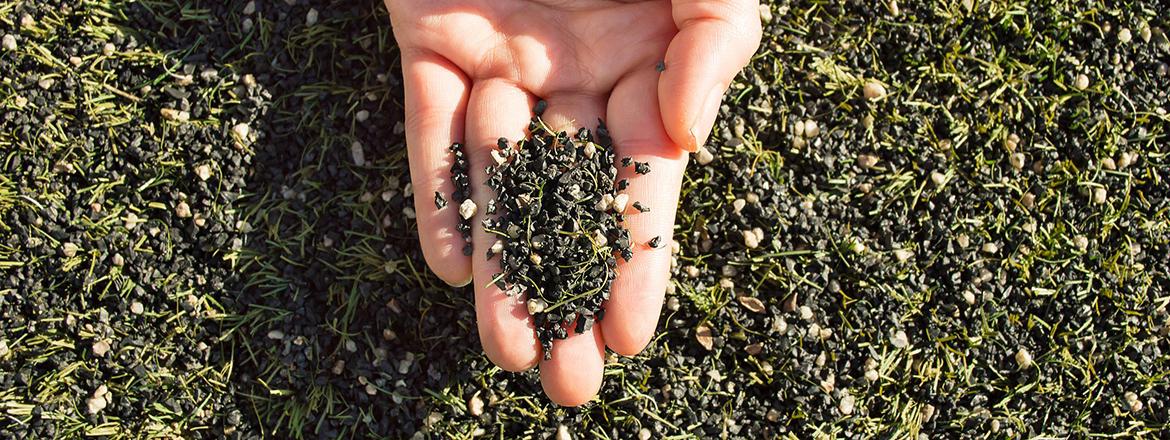
Modern artificial turf is used both indoors and outdoors across a wide range of locations. These include recreational and professional sports fields, playgrounds, residential spaces, public streetscapes and boulevards, and public parks. Artificial turf playing fields can provide access to durable play spaces for recreation and exercise for more hours per year than natural turf, particularly in adverse weather conditions. Despite greater installation cost, maintenance costs are lower as artificial turf does not require mowing, or the same amount of watering compared to natural grass. However, costs related to the end-of-life removal and replacement of artificial turf must also be considered.
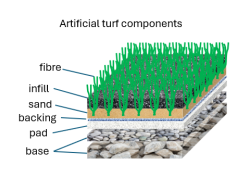
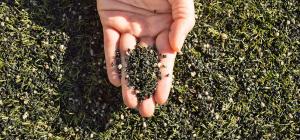
Concerns have been raised about potential health risks resulting from exposure to chemicals of concern found in artificial turf infill, backing, and fibres. Of most concern, crumb rubber infill, made from recycled tires, is known to contain metals, volatile organic compounds (VOCs), polycyclic aromatic hydrocarbons (PAHs), phthalates, PFAS compounds, and 6PPD among other chemicals. Alternative infills like thermoplastic elastomers (TPE) and ethylene propylene diene monomer (EPDM) also contain chemicals of concern, though levels are generally lower. There are also environmental and indirect health concerns related to the release of chemicals and microplastics into water bodies and surrounding environments, and the impacts use of these materials may have on biodiversity and climate change resilience.
There are gaps in the health evidence needed to guide decisions on the use of artificial turf in play fields. Evidence gaps are related to the release of chemicals from artificial turf, the bioaccessibility of these chemicals and exposure models needed to determine associated health risks. To address this, and building on past work by the NCCEH, a collection of resources has been gathered to signpost to the evidence currently available that contributes to health risk assessment of artificial turf. The resources below have been assembled to help explain the types of evidence available, strengths and limitations, and remaining data gaps. Links to several thorough past reviews on artificial turf and its health and environmental impacts are provided below.
Human health risk assessments (HHRA)
To be included in this list, each study had to be a peer-reviewed or agency-published report, thoroughly justify its methods, be publicly available, and in English.
- OEHHA synthetic turf study public review draft (State of California, OEHHA, 2025)
This draft report provides information on the State of California Office of Environmental Health Hazard Assessment (OEHHA) HHRA on the potential negative human health effects linked to the use of recycled tire materials in playgrounds and artificial turf.
- OEHHA synthetic turf studies (State of California, OEHHA, 2025)
This website provides further information for the State of California OEHHA human health risk assessment on the potential negative human health effects linked to the use of recycled tire materials in playgrounds and artificial turf. Links are provided for presentation and report materials associated with the studies.
- An evaluation of the possible health risks of recycled rubber granules used as infill in synthetic turf sports fields(European Chemicals Agency, 2018)
This report describes the methods and assumptions used by ECHA to assess the cancer risks and non-cancer hazards of recycled crumb rubber to child, youth, and adult players, as well as maintenance workers.
- Comprehensive multipathway risk assessment of chemicals associated with recycled ("crumb") rubber in synthetic turf fields(Peterson et al., 2018)
This article describes a human health risk assessment for crumb rubber in children, youth, and adults exposed through oral, dermal, and inhalation pathways. The authors conduct a parallel analysis for natural turfs to demonstrate the potential toxicological consequences of urban pollution on natural turfs as an alternative to artificial turfs.
- Evaluation of health risks of playing sports on synthetic turf pitches with rubber granulate: Scientific background document(Rijksinstituut voor Volksgezondheid en Milieu, 2017)
This report describes the methods and assumptions used by RIVM to assess the cancer risks and non-cancer hazards of recycled crumb rubber to child, youth, and adult players, with a special focus on child and lifelong goalkeepers.
Additional bioaccessibility and exposure studies
- Synthetic turf field recycled tire crumb rubber research under the Federal Research Action Plan: Final report part 2 (US EPA, 2024)
This report summarizes findings from both Part 1 and Part 2 of the Federal Research Action Plan (FRAP) on Recycled Tire Crumb Used on Playing Fields and Playgrounds. Part 1 characterized tire crumb rubber, featuring chemical characterization, emission and bioaccessibility analysis. Part 2 characterized human exposures to chemicals in tire crumb rubber through play and spectating. The study did not calculate cancer and non-cancer risks and therefore does not constitute an HHRA.
- Federal Research Action Plan (FRAP) on recycled tire crumb used on playing fields and playgrounds (US EPA, 2025)
This website provides details and report links for Part 1 and Part 2 of the Federal Research Action Plan (FRAP) on Recycled Tire Crumb Used on Playing Fields and Playgrounds study.
- Assessment of the bioaccessibility of PAHs and other hazardous compounds present in recycled tire rubber employed in synthetic football fields (Armada et al., 2023)
This article describes a study that assessed the bioaccessibility of PAHs, and other chemicals including 6PPD from playing field samples of crumb rubber. This study used human simulated body fluids and a multi-phase digestion model, which was different from FRAP or OEHHA bioaccessibility analysis with simulated biological fluids. The study calculated exposure via ingestion for a 3–6-year-old child.
Epidemiological studies
- Incidence of malignant lymphoma in adolescents and young adults in the 58 counties of California with varying synthetic turf field density(Bleyer and Keegan, 2018)
This article describes an epidemiological study analyzing the relationship between the increasing numbers of artificial turfs in California and the incidence of lymphoma, one of the cancers of concern in children playing on artificial turf fields.
- Investigation of reported cancer among soccer players in Washington State(Washington State Department of Health, 2017)
This report represents the first and currently only epidemiological study into the association between artificial turf and cancer. The authors analyzed the number of cancers expected among young soccer players, based on cancer statistics for Washington and US Residents as a whole, and compared these to the number of cancers observed. The study found a lower-than-expected number of cancers among young soccer players, including among those previously believed to be at highest risk (i.e., goalies).
Reviews and reports covering health and environment concerns
-
Artificial turf playing fields: A review of the evidence on health risks and environmental concerns (Goulding, 2025)
This NCCEH evidence review summarizes the recent evidence on health effects of artificial turf from academic and grey literature, including HHRAs The review also covers research on other health concerns such as heat exposure, skin abrasions and other injuries, and environmental concerns associated with artificial turf. Mitigation and abatement strategies for both health and environmental concerns are explored.
- Understanding and managing artificial turf Impacts on rainwater, urban heat, and biodiversity for the City of Vancouver (Klasios, 2025)
This report details the results of a multi-phase project on the impacts of artificial turf on rainwater management, urban heat, and biodiversity conservation to help the City of Vancouver better manage artificial turf on private property as part of its climate adaptation goals.
- A systematic review of the environmental and health effects of waste tires recycling (Hashamfirooz et al., 2025)
This systematic review summarizes findings from 19 studies that researched health-related impacts of recycled tire-based products. The review also synthesizes research on the release of chemicals of concern from recycled tires.
- Rubber crumb infill in synthetic turf and health outcomes: A review of the literature on polycyclic aromatic hydrocarbons and metalloids (Karatela et al., 2025)
This article reviews the literature on the health impacts of crumb rubber, detailing studies on chemical composition, epidemiologic, metabolic, and simulation studies on rubber crumb infill exposure in humans and in vivo exposure in animal models.
- The effect of synthetic grass sports surfaces on the thermal environment: A systematic review (Singh et al., 2024)
This systematic review identifies and synthesizes research related to the impact of artificial turf surfaces on thermal environment, comparing artificial turf sports surfaces to natural turf, and different types of artificial turf. The included studies mostly report on air and surface temperature, but some studies report on radiant temperature and other environmental parameters.
- Environmental impacts of artificial turf: A scoping review (Bø et al., 2024)
This article is a scoping review of key topics related to environmental impacts of artificial turf, such as chemical composition, release of chemicals and microplastics, and energy costs/carbon footprint. The article also analyses what research gaps remain.
- Exploring the human health Impact of artificial turf worldwide: A systematic review (Ryan-Ndegwa et al., 2024)
This systematic review includes 30 studies that describe the prevalence and characteristics of certain chemicals present in artificial turf infill and fibres, including 14 HHRA studies that evaluate the risks to human health posed by use of artificial turf.
- Health impacts of artificial turf: Toxicity studies, challenges, and future directions (Murphy and Warner, 2022)
This article reviews the literature on chemical composition of artificial turf components, related chemical ecotoxicity studies in invertebrate, vertebrate animal model and in vitro studies, and human health impacts of artificial turf.
- Human health risk assessments addressing artificial turf and crumb rubber (Eykelbosh, 2022)
This NCCEH evidence brief compiles a table of HHRAs published from 2006 to 2021 on artificial turf. The included studies focus on the risks of using styrene-butadiene crumb rubber infill.
- Artificial turf: Contributions and limits of health research in decision making (Eykelbosh, 2019)
This NCCEH article and the accompanying presentation briefly review recent human health risk assessments on artificial turf and discuss the expected contributions of upcoming projects. The article also covers risk communication and management strategies, highlights the need for more research on artificial turf, and advocates for a community-based approach to decisions.
- Environmental and health impacts of artificial turf: a review(Cheng et al., 2014)
This article provides an excellent overview of the benefits and disadvantages of artificial turf, as well as a detailed description of the physical and chemical characteristics of the assembled product and its components, human exposure pathways, and the impact of environmental factors on degradation.
Canadian municipal policy documents on the use of artificial turf
- Sport field strategy: Environmental and human health report (Appendix B) (City of Vancouver, 2024)
This report is an appendix of the City of Vancouver's Sport field strategy main report. It outlines the environmental and human health considerations associated with artificial turf surfaces and highlights concerns about the potential release of chemicals from crumb rubber infill and artificial turf fibres. The report explores recommendations for alternatives to crumb rubber such as natural turf and innovative artificial materials.
- Health impact assessment of the use of artificial turf in Toronto (Toronto Public Health, 2015)
This human health impact assessment considers risks and benefits of artificial turf in an urban environment, including the creation of urban heat islands, effects on water usage, storm water management, and aquatic toxicology, greenhouse gas emissions, positive and negative impacts on the built environment, availability of greenspace, and equitable access to recreational space.
Inclusion of external resources in NCCEH Subject Guides is for information only and does not constitute an endorsement of the organization, author, or content. This list is not intended to be exhaustive. Omission of a resource does not preclude it from having value.
Related Resources


Public health practices to support psychosocial and mental health response and recovery post-flooding
 view
view