

Wildfire smoke: What is the relationship between outdoor and indoor air pollutants?

Key Messages |
Climate change is driving more frequent and severe episodes of wildfire smoke, raising concerns about indoor infiltration of outdoor air pollutants during these events. This review focused on the available evidence describing indoor versus outdoor concentrations of non-particulate matter (PM) air pollutants during episodes of smoke from wildfires and similar combustion events. The evidence on non-PM pollutants is supported by additional evidence on PM pollutants, including factors that influence indoor infiltration and strategies to reduce indoor exposure to wildfire smoke.
|
Introduction
Climate change is increasing the frequency, severity, and duration of wildfires worldwide. The smoke plumes created by these events can have substantial impacts on the air quality in nearby communities as well as those much further away, presenting a growing public health concern in Canada and elsewhere. Wildfires release particulate matter (PM) and other non-PM pollutants that are linked to serious respiratory and cardiovascular health effects. While attention is often focused on outdoor air quality, most people spend most of their time indoors, raising questions about the level of exposure to smoke inside buildings. Exposure to smoke indoors depends on the outdoor pollution levels and on individual building construction, maintenance, and use. Currently, in the absence of an extreme heat event, Health Canada recommends staying inside during wildfire smoke events, and protecting indoor air by closing windows and doors and using portable air cleaners (PACs) or air conditioning devices on recirculate mode.1 Understanding how outdoor smoke enters indoor spaces is critical for developing strategies to reduce exposure and protect health.
The aim of this review is to synthesize available evidence on how outdoor smoke affects indoor air quality, with a focus on non-PM pollutants, factors that affect infiltration, and strategies for protecting indoor air quality during smoke events. The review examines findings across a range of smoke sources, including wildfires, residential wood burning, and other biomass burning. It then summarizes the available evidence on common patterns and differences in air pollutant infiltration, mitigation measures, and building characteristics.
| Definitions |
|
Methodology
Literature search
A systematic literature search was conducted using variants and Boolean operator combinations of key search terms such as “wildfire,” “smoke,” “combustion,” “prescribed burn,” “biomass burning,” “infiltration,” “inside,” “concentrations,” and “indoor air quality” (a full list of search terms is available upon request). The following databases were searched: MEDLINE, Embase, CINAHL, and Environment Complete. Bibliographies and citations of key articles were used to retrieve additional literature via forward and backward chaining, along with supplemental searches as necessary. English documents published over the previous 20 years (2004–2025) were considered.
Table 1 provides a summary of the inclusion and exclusion criteria for studies. The titles and abstracts of results were screened by one reviewer. The full texts of results included in title and abstract screening were retrieved and screened by a single reviewer. Continuous artificial intelligence (AI) reprioritization was used to sort results during both levels of screening (DistillerSR), but all references were screened manually. Exclusions included sources published ahead of print, before peer review, and mathematical modelling studies that exclusively used estimated data.
The original objective of this review was to examine indoor infiltration of non-PM pollutants during smoke episodes because there is very limited evidence on this topic compared with indoor infiltration of PM. As such, the search strategy was designed to identify studies that measured both indoor and outdoor concentrations of non-PM pollutants during smoke episodes. However, most studies that measured non-PM pollutants also measured PM, and these results were also considered in the review. Forward and backward chaining of key studies identified additional results providing evidence on pollutant infiltration indoors and the influence of interventions (air cleaners, window closing) or building characteristics on indoor concentrations. Many of the studies identified through forward and backward chaining measured only indoor and outdoor PM, and those with relevant information were included; however, a systematic search for PM-specific studies was not conducted for this review because it was beyond the scope of the primary research question.
The quality of included evidence was evaluated using critical appraisal tools, as indicated by the study design below. Completed quality assessments for each included study are available on request.
| Study Design | Critical Appraisal Tool |
| Randomized Controlled Trial | JBI Checklist for Randomized Controlled Trials |
| Quasi-experimental | JBI Checklist for Quasi-Experimental Studies |
| Analytical Cross Sectional | JBI Checklist for Analytical Cross Sectional Studies |
Table 1. Inclusion and exclusion criteria
| Inclusion | Exclusion | |
| Population | General population exposed in residential environments (both indoor and outdoor), clean air spaces, public/institutional buildings (e.g., schools, daycares, malls, libraries, community centres, healthcare centres, long-term care centres, etc.), vehicles | Population exposed in industrial workplaces |
| Context | During combustion-derived air pollution episodes that may be caused by fire (wildland, coal mine fires, peat fires, interface fires, landscape fires, agricultural fires, prescribed burns, industrial fires, landfill fires, tire fires, any multi-day structural fires (e.g., 9/11), and residential wood combustion (i.e., wood stoves), including studies that use source attribution methods) | During non-combustion derived episodes, air pollution events exclusively due to engine exhaust, traffic pollution, coal combustion, etc. (not excluding coal mine fires) |
| Exposure | Staying indoors, closing windows and doors | |
| Comparator | Indoor vs. outdoor; no comparator, during combustion event vs. not during combustion event | Gas burning appliances indoors
|
| Outcomes | Concentration of pollutants | |
| Study designs | Exposure studies (including randomized and non-randomized), before-and-after studies, case studies, laboratory studies, grey literature (incl. technical reports from standard setting bodies, NRC/NIST, etc.) | Modelling studies |
| Publication date | Published in last 20 years |
When reported in the included studies, data relevant to the research question, including study design, setting, location, population characteristics, interventions and outcomes, were extracted by one reviewer. The results were synthesized narratively due to the variation in methodology and outcomes for the included studies. The study protocol was registered in PROSPERO (CRD42024594865).
Background
The association between non-occupational wildfire smoke exposure and adverse health effects such as increased risk of cardiovascular and respiratory disease has been systematically reviewed and is well understood. However, most wildfire smoke studies have focused on PM mass concentrations and PM composition, not co-occurring pollutants.2,3 Moreover, differential risks of cardiovascular disease, depending on wildfire fuel type, have been documented,4 indicating the importance of understanding which types of pollutants can infiltrate indoors during a smoke episode and at what concentrations.
Combustion-derived air pollutants (i.e., smoke)
Smoke from combustion is a complex mixture of particles and gases, including large quantities of fine particulate matter or PM2.5. Smoke also contains gases such as carbon monoxide (CO) and nitrogen oxides (NOx), metals such as aluminum, iron, and manganese, and organic pollutants such as dioxins, furans, volatile organic compounds (VOCs), and polycyclic aromatic hydrocarbons (PAHs). The concentrations of these pollutants vary depending on the fuels combusted and the atmospheric conditions during the combustion event.
Wildfire smoke can differ from smoke derived from other types of combustion. For example, increased fractional concentrations of magnesium, phosphorus, and potassium, and increased concentrations of CO and nitric oxide (NO) gases have been measured in wildfire smoke. In comparison, traffic-related air pollution is typically characterized by increased concentrations of heavy metals such as nickel, iron, zinc, and manganese, as well as CO, sulfur oxides (SOx), NOx, and ozone (O3).5 Wildfire smoke often has low NOx levels but contains increased levels of volatile organic compounds (VOCs) such as benzene, acrolein, and formaldehyde, and PAHs such as acenaphthylene, fluorene, and phenanthrene.6,7 Furthermore, the median PM particle diameter in wildfire smoke plumes can be smaller than typical urban ambient air pollution.8
The mixture of air pollutants in wildfire smoke can change significantly as it ages in the atmosphere or when anthropogenic fuels are burning. For instance, VOCs undergo photochemical reactions leading to the formation of ozone and secondary organic aerosols that can condense on existing particles or form new particles depending on conditions and chemical speciation.9 PAHs also dynamically undergo phase partitioning between PM-bound and the vapour or gas phase during atmospheric aging, with recent studies indicating a decrease in PM-bound PAHs in aged smoke either by evaporation into the gas phase or by PAH decomposition.9,10 The dynamic interaction between the particles and gases in smoke has implications for infiltration into the indoor environment, especially with filtration devices such as PACs or heating, ventilation, and air conditioning (HVAC) systems and air conditioning units predominantly focusing on filtering smoke particles in the PM2.5 fraction. It is poorly understood how particles of different sizes and non-PM pollutants infiltrate indoors during smoke episodes, and how different interventions influence indoor pollutant concentrations.
Infiltration of air pollutants into buildings
Although modern buildings are designed to limit the infiltration of outdoor air or exfiltration of indoor air for heating and cooling efficiency, even the most advanced buildings are not airtight. Infiltration of air pollution is typically measured by two values. The first is the ratio between indoor and outdoor pollutant concentrations (I/O ratio), with values above 1 indicating air pollutants are higher indoors than outdoors. Indoor sources of pollutants can include cooking, burning candles, or using wood-burning appliances. Another measure of air infiltration is the infiltration factor (Finf), which is similar to the I/O ratio, but removes indoor pollutant spikes that do not correspond to an outdoor spike. Finf is a better indicator of the influence of outdoor pollution on indoor air quality.
Outdoor air can enter a building through openings in the envelope, such as around poorly sealed doors and windows, through holes drilled for lighting, fixtures, or communications cables, or through passive air vents, chimneys, or fireplaces. Buildings that are at negative pressure (e.g., interior pressure is lower than exterior air pressure), can cause air to be drawn inside. Depending on the building type, both filtered and unfiltered outdoor air can also be deliberately drawn into a building via air intakes for HVAC systems and air conditioning units. Pollutants can be introduced to indoor air unintentionally when seals around these units have broken down or when air filters are overloaded or installed improperly.11 Moreover, some HVAC systems cannot accommodate high-efficiency filters and may introduce outdoor air pollutants indoors directly. For example, minimum efficiency reporting value (MERV) 13 filters block at least 50% of particles in the 0.3–1.0 µm size range as air passes through the filter.12 Lower rated filters are not as effective at filtering smaller particles, which predominate in wildfire smoke. Where feasible, upgrading HVAC systems to use higher MERV rated filters, and maintaining positive air pressure indoors, can prevent or slow the entry of air pollutants into a building.13
Building occupants can also influence outdoor air infiltration. During clean air periods, indoor pollutants are removed either passively or actively. Passive air exchange occurs through open windows and doors, or leakage through other openings in the building envelope. Active or mechanical air exchange occurs through HVAC systems and exhaust fans in kitchens, bathrooms, or other locations. Active ventilation, (i.e., the use of externally vented exhaust fans or appliances) can cause negative pressure to develop within a building. When negative pressure builds indoors, the infiltration of outdoor air can increase due to the increased pressure differential between the indoor and outdoor environments.14
Additional building features can reduce the infiltration of outdoor air pollutants. These include using things like door sweeps, weather stripping, or functional dampers. The full range of considerations for preparing a structure for smoke episodes is outside the scope of this review. For more information on preparing buildings, see the following resources:
- Guideline 44-2024 - Protecting building occupants from smoke during wildfire and prescribed burn events (ASHRAE, 2024)
- A public health companion for ASHRAE Guideline 44: Protecting building occupants from smoke during wildfire and prescribed burn events (NCCEH, 2025)
Research questions
This review synthesizes current evidence on the impacts of outdoor smoke on indoor air quality, with particular attention to non-PM pollutants, infiltration factors, and measures to protect indoor air during smoke events. Specifically, this review sought to answer the following questions:
- What is the relationship between outdoor and indoor air pollutant concentrations during smoke episodes?
- What is the impact of closing windows and doors on indoor air pollutant concentrations during smoke episodes?
- What is the impact of using portable air cleaners (PACs) on indoor air pollutant concentrations during smoke episodes?
- How do building features impact the relationship between indoor and outdoor air pollutant concentrations during smoke episodes?
Results
Overview of studies
This review identified a total of 41 studies of moderate to high quality, including 23 quasi-experimental studies, 12 analytical cross-sectional studies, four randomized controlled trials, and two cohort studies (Appendix A). These studies covered a range of smoke episodes caused by combustion events. Sixteen were specific to wildfire smoke episodes or seasons, seven examined smoke from residential wood burning, two examined both wildfire and residential wood smoke, five examined episodes of haze (biomass, wildfire and urban air pollution), two covered biomass burning (indoor biomass cooking, and agricultural biomass burning), and one study was conducted during a landfill tire fire. The majority of studies were carried out in North America, with the remainder of the studies performed in Australia, Singapore, Brazil, and Spain.
The 41 included studies examined a range of pollutants:
- PAHs (n = 3; 7%)
- Trace metals, ions, and minerals (n = 3; 7%)
- Black carbon (BC) (n = 3; 7%)
- Inorganic gases (n = 4; 10%)
- Levoglucosan, as a marker of biomass burning (n = 4; 10%)
- PM number concentrations (n = 6; 15%)
- PM2.5 mass concentrations (n = 31; 76%)
The sampling period for measurements ranged from 1.5 hours to 9 years, contributing to variability in reported concentrations. The settings for pollutant measurements in these studies also ranged from residential detached homes (n = 21; 51%) to apartment buildings (n = 5; 12%), and 12 studies (29%) examined air pollutants in public buildings such as schools, university buildings, a public library, assisted living or skilled nursing facilities, churches, fitness centres, childcare centres, museums, community centres, a fire station, and a homeless shelter. When reported, most buildings in these studies were built within the past 50 years.
Many of the included studies examined the effect of an intervention on reducing levels of indoor air pollutants during smoke episodes. When considering window use, nine studies reported windows to be closed, and 11 studies reported windows open at least some of the time, or window status was not reported. In total, 14 studies examined the use of PACs, nine examined the role of HVAC systems in reducing indoor air pollutant concentrations, and two examined both.
What is the relationship between outdoor and indoor air pollutant concentrations during smoke episodes?
Several different patterns of indoor-outdoor air pollutant relationships emerged across the studies in this review (Appendix B). Observations are reported below by pollutant type.
Non-PM pollutants
PAHs
Three studies examined PAH concentrations in the context of a wildfire smoke episode, agricultural burning, and a landfill tire fire. In Ghetu et al., comparing wildfire and non-wildfire periods revealed that indoor vapour-phase low molecular weight (LMW) and high molecular weight (HMW) PAH concentrations increased by three and six times, respectively, during wildfire periods.15 Furthermore, indoor HMW PAH concentrations were generally higher than outdoor concentrations, except when the average air quality index for particulate matter exceeded 115 (unhealthy for sensitive groups).16
Cristale et al. examined the sugarcane burning season in Brazil, reporting that indoor PAH concentrations increased from 2.35 to 22.9 ng/m3 when comparing against the non-burning season in one residential home.17 The most abundant PAH compounds measured indoors during the burning period were phenanthrene, fluoranthene, pyrene, benzo(e)pyrene, and benzo(g,h,i)perylene. However, building materials and techniques relevant to the local climate in Brazil may result in different indoor concentrations when comparing with North American structures.
Another study by Artíñano et al. on landfill tire fire pollutants reported indoor PAH levels in deposited dust samples did not increase between fire and non-fire periods.18 However, outdoor concentrations were elevated during the fire period relative to a reference sampling site 6 km away, with the top two most abundant PAHs measured being fluoranthene and pyrene at 27 and 64 ng/m2, respectively. At the reference site, outdoor concentrations of 6.5 and 24 ng/m2 were reported for fluoranthene and pyrene, respectively. Further research is needed to clarify which PAHs are more prevalent during wildfires, and which are most able to infiltrate into the indoor environment. This would clarify the potential types of health risks, because some PAHs are carcinogens.15
Trace metals, ions, and minerals
Three studies reported on concentrations of trace metals, ions, and minerals indoors and outdoors during smoke episodes—two about haze and one about a landfill fire. Metals and other elements that are found at low concentrations attached to particles include iron, potassium, and zinc. Ions include species such as nitrate, oxalate, or ammonium. During one haze episode in Singapore, Tran et al. reported that total ions and water-soluble trace metals in PM2.5 increased from 8.77 to 14.98 µg/m3 and 0.75 to 1.53 µg/m3 indoors, respectively, when compared with non-hazy periods in a naturally vented (windows open) apartment.19 Associated I/O ratios of 1.00 and 0.79 were reported for ions and trace metals, respectively. By mass, the most abundant indoor ions during hazy periods were sulfate and ammonium.
With respect to health risks, inhalational exposure to sulfate ions at the levels reported by Tran et al. (7482.15 ± 85.92 ng/m3) during the 2019 haze episode represent a fraction of the daily ingestion exposure from drinking water estimated by Health Canada.20 Similarly for ammonium, the increased levels in indoor air (2875.5 ± 7.1 ng/m3) are a fraction of the concentrations estimated by Health Canada in typical outdoor urban air (25,000 ng/m3).21 Trace metals, potassium, tin, and zinc were the most abundant by mass indoors during haze episodes. In another study examining a haze episode in 2015, Sharma et al. performed carcinogenic and non-carcinogenic health risk estimates based on indoor measured levels of trace metals. They reported elevated lifetime cancer risk values of 5.67 x 10⁻⁶ for naturally vented conditions and 1.10 x 10⁻⁶ for windows closed with a PAC running.22 Both reported values exceed the limit of 1 x 10⁻⁶ or one person in a population of one million developing cancer in their lifetime, representing a potential cancer risk. Non-carcinogenic health risk estimates were not elevated in the study.
In addition to haze studies, analysis of samples taken during a landfill tire fire in Artíñano et al. found indoor concentrations of total minerals in deposited dust samples were lower than outdoor concentrations (3075 vs. 5639 µg/m2), with calcium oxide reported as the most abundant (1375 µg/m2) inorganic species measured indoors.18 Note that the concentration of calcium oxide would be further decreased if airborne and, for comparison, the current exposure limit for Ontario workplaces is set at 2 mg/m3 over an eight-hour shift.23
Inorganic gases
A total of four studies examined several common inorganic gases that can be produced by combustion processes, including carbon monoxide (CO), carbon dioxide (CO2), and nitrogen dioxide (NO2). Three of the studies were focused on wildfire smoke, and one on indoor biomass burning appliances. The available evidence indicates that smoke episodes outdoors have little impact on indoor levels of these gases, which can have significant indoor sources. In Kaduwela et al., no differences were reported for CO2 when comparing wildfire and non-wildfire periods in a high school, and there were no increases in local ambient outdoor concentrations CO2.24 In Lee et al., CO2 was increased on wildfire smoke days (809.2 ppm) compared with non-wildfire days (689 ppm) in licensed childcare care facilities in British Columbia; however, this was likely due to decreased natural ventilation (i.e., closing windows) rather than wildfire smoke impacts.25
Shrestha et al. reported that during wildfire periods, detached houses without significant indoor sources such as gas stoves had similar concentrations of NO2 indoors and outdoors, and were not impacted by wildfire plumes.26 Concentrations of indoor CO were elevated compared with outdoor concentrations in this study (0.69 vs. 0.20 ppm). However, 26 of the 28 homes contained gas water heaters with standing pilot lights, and the study concluded these were the major source of CO, even after filtering the data for indoor source spikes. This study also reported up to a three-fold increase in indoor CO levels during wildfire plume periods, but concentrations remained well below the 1-hour 25 ppm Health Canada limit for residential exposure. Lastly, this study indicated that proximity to major roadways influenced indoor and outdoor NO2 concentrations. Similarly, in Weaver et al., indoor CO levels were predominantly impacted in homes actively cooking with a biomass stove (0.002 vs. 11.2 ppm), not neighbouring homes (0.001 vs. 0.2 ppm) when comparing against baseline periods.27
Levoglucosan
Levoglucosan is a chemically stable organic compound that is released in large quantities during the combustion of wood or biomass and can be used a marker of wood or wildfire smoke. Four studies in this review examined levoglucosan concentrations in the context of residential wood combustion; however, due to methodological differences in detection and sampling, absolute values greatly varied (range 0.034, 613 ng/m3) between studies. When considering relative concentrations, both Wheeler et al. and Allen et al. reported lower concentrations of levoglucosan indoors compared with outdoors, and an I/O ratio of 0.36 was reported by Wheeler et al.28,29
PM
The review included 20 studies that measured PM2.5 concentrations during smoke episodes or seasons. The median (range) outdoor PM2.5 mass concentration was 37.4 (3.9–157.0) µg/m3 (Appendix B). The sampling periods for both indoor and outdoor measurements ranged from 3 hours to 334 days, and averaging periods consisted of 1 hour (n = 7), 24 hours (n = 9), 48 hours (n = 1), 7 days (n = 2), and 11 days (n = 1). For context, the Canadian Ambient Air Quality Standards for PM2.5 24-hour average is currently 27 µg/m3 and will be reduced to 23 μg/m3 in 2030.30 For the 13 studies specific to wildfire smoke episodes or seasons, the median outdoor value was 32.9 (5.0–127.0) µg/m3. Although only four of these wildfire-specific studies reported average outdoor PM2.5 concentrations during non-wildfire periods, the values were notably lower with a median of 4.6 (2.0–9.1) µg/m3.
Indoor PM2.5 concentrations were lower than outdoor values across all 20 studies. The indoor PM2.5 median (range) value was 31.5 (5.2–98.0) µg/m3. These values represent non-intervention or baseline conditions during a smoke episode. For the 13 studies specific to wildfire smoke episodes or seasons the median was 27.8 (5.2–92.0) µg/m3. Once again, the four studies with values during non-wildfire periods reported a much lower median concentration of 4.7 (1.3–7.5) µg/m3.
Indoor/outdoor (I/O) ratios were calculated for 12 of the 20 studies, with a median (range) of 0.74 (0.31–1.3) reported during smoke episodes or seasons. For the seven wildfire-specific studies, the median was 0.67 (0.31–0.93). High I/O ratios may not always be due to increased infiltration of outdoor air pollutants because this value can be affected by indoor sources of such as cooking, vacuuming, smoking, or lighting candles or incense. Overall, however, the findings from these studies indicate that indoor air was influenced by outdoor air during smoke episodes.
To more accurately estimate the level of outdoor PM2.5 infiltrating indoors, seven studies used censoring algorithms to remove data where indoor air PM2.5 peaks did not correspond to outdoor PM2.5 peaks. The resulting ratio, or infiltration factor (Finf) was calculated across nine studies for PM2.5 during smoke episodes or seasons, with a median (range) of 0.45 (0.20–0.70). Seven of these studies were specific to wildfire smoke episodes or seasons with a median Finf value of 0.58 (0.27–0.70). When considering heavy wildfire smoke events, where outdoor PM2.5 levels exceeded the CAAQS PM2.5 24-hour average value of 27 µg/m3, Finf values decreased moderately to 0.44 (0.27–0.59) across five studies. This may be due to the increased outdoor component in the Finf calculation, and people implementing interventions (i.e., closing windows or using PACS) as the outdoor air quality worsens. For comparison, three of these five studies calculated Finf values for non-wildfire periods and reported mean values of 0.39, 0.29, and 0.45.31-33
In addition to PM2.5 mass concentrations, four of the 20 studies examined PM number concentrations for particles ranging in size from 0.3 to 10 µm. Artinano et al. measured PM1 indoors and outdoors in a public school near a landfill tire fire and found that particle counts were an order of magnitude lower indoors compared with outdoors (3.9 × 10⁴ vs. 3.8 × 10⁵ #/cm3).18 Three of the four studies examined PM number concentrations during wildfire smoke events or seasons and reported lower particle counts indoors compared with outdoors. For example, Dev et al. reported PM0.3-10 number concentration I/O values of 0.37, 0.14, and 0.44 for a public building and two houses, respectively, and Shrestha et al. reported a mean PM0.5-2.5 Finf of 0.4 for 28 residential detached homes.26,34
What is the impact of closing windows and doors on indoor air pollution concentrations during smoke episodes?
Closing windows and doors during combustion-derived air pollution episodes is often recommended as a strategy to reduce smoke exposure indoors. This review identified 11 studies that indicated whether windows and doors were closed during the study period (Table 2). Overall, indoor concentrations of air pollutants were consistently lower when windows were closed during smoke events, as indicated by lower I/O and Finf values described in the following paragraphs. Furthermore, indoor concentrations were substantially reduced when windows were closed and PACs were used. (See next section for more details).
In six studies when the windows were reported to be closed, the median I/O ratio for PM2.5 was 0.62. In seven studies when windows were open at least some of the time or window status was not reported, the median I/O ratio was 0.76. Along with reduced I/O ratios, there was a median 32% reduction in PM2.5 concentrations indoors compared with outdoors when windows were closed in nine reporting studies. Comparably, the median reduction in PM2.5 concentrations was 23% for the 11 studies with windows open at least some of the time or window status was not reported. The median outdoor concentrations were similar for both sets of studies, at 42.17 vs. 45.4 µg/m3, respectively. Variability in data collection and reporting for other air pollutants precluded a similar overview analysis.
Several studies included windows open or closed in their study design and statistical modelling. During a heavy smoke haze, Tran et al. examined the difference between having windows open in an high-rise apartment compared with having the windows closed with an air conditioner unit equipped with MERV 7 filters running.19 The study found that all I/O ratios were reduced when windows were closed and the air conditioner was running compared with natural ventilation, though no statistical significance was reported. I/O ratios for PM2.5 were reduced from 0.98 to 0.72, black carbon from 0.97 to 0.60, ions from 1.00 to 0.71, and trace metals from 0.79 to 0.42. For PM2.5 specifically, this equated to a 45% decrease in indoor concentrations from 48.93 vs. 26.80 µg/m3. In a similar design, Sharma et al. measured the difference between having windows open and closed in a different high-rise apartment during a haze episode, and reported indoor PM2.5 concentrations were reduced from 98 to 71 µg/m3 and I/O ratios were reduced from 0.76 to 0.62.22 Once again, the statistical significance of these reductions was not reported.
In the case of wildfire specific studies, Shrestha et al. reported that PM0.5-2.5 number concentration and black carbon Finf values were significantly increased by 45% and 67%, respectively, when windows were open in residential detached homes for more than 12 hours of the sampling period.26 This increase in Finf also corresponded to a 33% increase in indoor PM0.5-2.5 number concentration and 237% increase in black carbon. Similarly, Walker et al. reported that leaving windows/doors open increased indoor concentrations of PM2.5 on wildfire days by 11.4% per every 10% increase in days with windows/doors open (95% CI: 6.4, 16.7) across 20 residential detached homes in Montana.31 Although four studies tracked the amount of time windows were open or closed during the study period,15,35-37 none used this information as a covariate in the analysis of indoor air pollutant concentrations.
Finally, there was little information on the effect of leaving exterior doors open or closed during smoke episodes. Holder et al. examined door opening across 13 buildings, reporting open doors led to increased infiltration rates and/or indoor PM2.5 concentrations at seven locations, decreased values at four locations, and had no impact at two locations.38 The mixed results were somewhat explained by 11/13 locations maintaining positive pressure indoors, reducing infiltration of outdoor air. Maintaining positive pressure inside buildings to reduce infiltration of outdoor air during smoke episodes is recommended in ASHRAE Guideline 44.39
Table 2. Building characteristics and the effect of having windows/doors closed on indoor air pollution concentrations during smoke episodes. [Download PDF to view tables]
What is the impact of using portable air cleaners (PACs) on indoor air pollutant concentrations during smoke episodes?
PACs are a commonly recommended intervention for reducing concentrations of combustion-derived air pollutants indoors. The NCCEH recently completed a systematic review of the effectiveness of air filtration and air cleaning during smoke episodes, and reported an average reduction of 56% (range 5.3–99%) for indoor PM2.5 mass concentrations across 17 studies.49
To examine the effect of using PACs with windows and doors closed in homes or other buildings, 14 studies that included measurements of both indoor and outdoor air pollutants were included in this review. The PACs evaluated used several different technologies such as HEPA filters (two studies), HEPA filters combined with activated charcoal filters (seven studies), MERV 13 filters (four studies), and an electrostatic precipitator combined with an activated charcoal filter (one study) (Table 3). Of the seven studies that reported having closed windows during study periods, indoor PM2.5 mass concentrations were reduced from a median (range) of 29.2 (5.2–98) µg/m3 in the control or baseline smoke condition to 8.51 (0.4-30.7) µg/m3 in PAC condition, or a 71% (18–99%) reduction. For comparison, an overall median indoor PM2.5 concentration of 32.8 µg/m3 was reported across 17 studies in this review, regardless of window status. When considering the impact of PACs on median I/O ratios for PM2.5 mass concentrations, a decrease from a median of 0.74 (0.31–0.93) in the baseline or PAC-off condition to 0.25 (0.003–0.72) in the PAC-on condition was reported across five studies. Four studies examining PAC use indicated that windows were left open for some or all of the study period or did not report on status. In these four studies, PACs were found to be less effective, with indoor PM2.5 mass concentrations reduced by 37% (25–59%).
Two studies examined haze air pollution episodes with windows open, windows closed, and windows closed with PAC-on conditions. In Tran et al., indoor PM2.5 mass concentrations in a single apartment were reduced from 48.9 to 26.8, when the windows were closed with an AC unit turned on and reduced again to 15.1 µg/m3 when the PAC was turned on. The I/O ratios were reduced from 0.98 to 0.72 to 0.25 under the same conditions, respectively.19 Similar results were reported by Sharma et al., with indoor PM2.5 concentrations of 71, 98, 23 µg/m3 and I/O ratios 0.76, 0.62, 0.32 reported for windows open, windows closed, and windows closed and PAC on conditions, respectively.22 The higher indoor PM2.5 concentrations during the windows closed condition are explained by the outdoor PM2.5 concentrations being higher during the windows closed condition (157 ± 107 µg/m3) than during the windows open condition (94 ± 34 µg/m3).
For non-PM pollutants, only one study examining indoor air pollution concentrations during a haze episode reported on the impact of using a PAC. Tran et al. reported that running a PAC with HEPA and activated charcoal filter in an apartment with the windows closed reduced total ions, and trace metals by 74% and 86% (11.1 and 1.33 µg/m3), respectively, when compared with the windows-open condition.19 Closing windows and turning on the AC reduced total ions and trace metals by 35% and 57% (5.3 and 0.9 µg/m3), respectively. The I/O ratios were also reduced for ions (1.00 to 0.71 to 0.21), and trace metals (0.79 to 0.42 to 0.07) comparing windows open, AC with windows closed, and PAC-on with windows closed and AC off, respectively. Aside from Tran et al., three residential wood combustion studies examined the effect of PAC use on concentrations of the non-PM biomass marker levoglucosan, finding a reduction in concentrations ranging from 32% to 74%.28,29,35
Table 3. Portable air cleaners (PACs) and indoor air quality during smoke episodes. [Download PDF to view tables]
How do building features impact the relationship between indoor and outdoor air pollutant concentrations during smoke episodes?
The amount of smoke pollution infiltrating into a building can be influenced by several factors related to the construction and mechanical systems present in the building. For instance, some buildings may have more cracks or sealant failures around doors and windows that let more air pass through the building envelope, or HVAC systems may draw outdoor pollutants indoors without adequate filtration. This effect was examined in Wheeler et al. when smoke PM2.5 infiltration in houses with lower and higher passive air exchange rates was compared. The first house had a 10.31 air changes per hour at 50 pascals pressure (ACH50), suggesting a tighter building envelope, while the second had an ACH50 of 20.40.51 The house with the lower ACH50 provided greater passive protection from infiltration of PM2.5 from smoke (68% vs. 31%). This review does not provide a comprehensive examination of the influence of all building features on infiltration of outdoor air pollutants, but provides context based on the factors discussed in the studies reviewed.
Number of windows
More windows can provide more potential gaps for outdoor air pollution to enter a structure. Walker et al. reported that residential detached homes (n = 14) and apartments (n = 2) with more than 10 windows had reduced PM2.5 Finf compared with homes that had fewer windows (0.29 vs. 0.39) (Table 3). However, the authors did not discuss why having more windows was associated with reduced Finf or whether the finding could be due to confounding variables, such as home age.31 The same study also found that residential detached homes built after 1975 had lower average PM2.5 Finf values (0.27) compared with homes built before 1975 (0.41).
Energy efficiency
One study on wildfire smoke in Colorado by Shrestha et al. assessed the effect of building methods/construction type on smoke infiltration. Residential detached homes (n = 28) were classified as certified built green (n = 5), energy efficient retrofitted (n = 13), or non-energy efficient retrofitted (n = 10). Built green homes were designed with improved energy-efficiency, including air-tight construction, rooftop solar panels, all-electric air heating, and water heating systems; whereas specific criteria for energy efficient retrofitted homes were not reported. In the certified green homes, the I/O values were 1.02 for PM0.5-2.5 number concentrations, 0.77 for black carbon, 3.94 for CO, and 1.29 for NO2. These same values for the energy efficient retrofitted homes were 0.57, 0.77, 2.37, and 1.15, respectively. For the non-energy efficient retrofitted homes, they were 0.66 , 0.60, 2.79, and 1.09, respectively.26 These results suggest that energy efficient retrofits provided the best protection from smoke infiltration. Although the certified built green program had measures that increased air tightness, two of the five homes had continuously operating exhaust fans, and three had heat recovery ventilators on timer switches. Operation of these mechanical systems during conditions of high outdoor PM2.5 concentration would increase infiltration and offset the benefits of the other measures. These results highlight the need to account for potential air pollution events in mechanical system design and operation. Furthermore, it is important to note that built green certifications in Colorado may not be representative of other jurisdictions.
Mechanical ventilation
In the Shrestha et al. study of residential detached homes (n = 28), PM0.5–2.5 particle number and black carbon Finf values were significantly higher by 18% and 4%, respectively, when mechanical ventilation was present.26 These results suggest that HVAC systems were increasing the concentrations of air pollutants indoors by bringing in more outdoor air that contained elevated levels of pollutants during smoke episodes. Note that the analysis of building type and mechanical ventilation reported in this study included combined data from periods of clear air and heavy smoke plumes (PM concentration ≤ 27 μg/m3).
Seven studies examined public buildings with HVAC systems during smoke episodes (Table 4). In two classrooms using fans to draw outdoor air indoors through a MERV 13 filter, relatively low I/O ratios of 0.06 to 0.2446 and Finf 0.05 to 0.0745 were reported by Tham et al. for PM0.3-10 particle number concentrations during haze episodes. In addition, increased positive pressure was measured in these classrooms when these systems were running. The authors indicated bringing filtered outdoor air indoors would reduce infiltration of unfiltered air, and remove PM, which may explain the low values reported.
In another study, Montrose et al. examined the impact of wildfire smoke on skilled nursing facilities that had HVAC systems with MERV 13 filters and reported a PM2.5 Finf of 0.29 (95% CI: 0.28, 0.30) on non-wildfire days and 0.59 (95% CI: 0.49, 0.71) on wildfire days.33 For context, the overall median PM2.5 Finf for the five wildfire-specific studies was 0.59 across all building types. Even though the skilled nursing facilities had HVAC systems, the authors indicated that increased infiltration of smoke PM2.5 into skilled nursing facilities may be influenced by seasonality and human behaviours such as door and window use, and that a more detailed analysis of overall building characteristics may explain some of the infiltration variability observed in the study. Lastly Holder et al. examined 23 public buildings in detail during wildfire smoke episodes. Four factors were significantly associated with higher indoor PM2.5 during smoke episodes in a multivariate analysis: filter bypass, HVAC condition, window type, and room pressure. Furthermore, there was a trend of increased I/O ratios observed when HVAC filter bypass was higher or when the HVAC system was in poor condition, and I/O ratios were decreased under positive pressure.38
Limited evidence on the impact of exhaust fans (i.e., stove hood fans or bathroom fans) during smoke episodes was identified in this review. These systems can have negative impacts on PM2.5 infiltration during periods of poor outdoor air quality due to the potential to create negative pressure indoors if more air is exhausted than is drawn inside.53 Shrestha et al. reported a significant association between the presence of a stove exhaust system and PM0.5-2.5 number concentration, black carbon, and CO Finf values. Both PM0.5-2.5 number concentration and black carbon Finf were reduced in homes with externally vented exhaust systems, but CO Finf was not. In addition, the built green homes category in Shrestha et al. included five homes, of which three had heat recovery ventilation systems and two had continuously running exhaust fans. PM0.5-2.5 number concentration, black carbon, and CO Finf were all significantly higher in the built green homes compared with energy efficient retrofit homes or non-retrofit homes. However, these results represent combined days with and without wildfire smoke impacts and the results may change when looking at wildfire impacted days alone.
Table 4. HVAC systems and combustion-derived air pollution episodes [Download PDF to view tables]
Summary
In this review, the relationship between concentrations of indoor and outdoor air pollutants during smoke episodes was examined in 41 studies, including wildfire events or seasons, residential wood burning, haze events, biomass burning, and a landfill tire fire. Although the original research question of this review focused on non-PM pollutants and included studies on PAHs, trace metals, ions, inorganic gases, and levoglucosan, most studies focused on measuring concentrations of PM2.5 (31 studies). These measurements were performed in a variety of settings that included public buildings such as schools, libraries, and care facilities, as well as apartment buildings and detached homes in North America, Australia, Singapore, Brazil, and Spain.
The evidence indicates that outdoor air pollution during smoke episodes strongly influences select indoor pollutant levels. Indoor vapour-phase LMW and HMW PAH concentrations were increased by three and six times respectively during wildfire periods in one study. For inorganic gases, four studies examining concentrations of CO, CO2, and NO2 indicated that outdoor smoke had little impact on indoor concentrations, likely because these gases have significant indoor sources compared with ambient levels. In one study where increased indoor CO concentrations were observed during a wildfire smoke episode, they did not reach levels of concern. Only one study examined indoor levels of trace metals, ions, and minerals during haze episodes and periods of good air quality, finding elevated levels of these pollutants indoors during the haze periods. Overall, more research is needed to understand the indoor infiltration of non-PM pollutants during smoke episodes, and their potential health risks.
Outdoor concentrations of PM during smoke episodes strongly influenced indoor concentrations. Accounting for indoor sources of PM, Finf values indicated that outdoor PM2.5 contributed to about 50% of the PM2.5 measured indoors. Overall, indoor concentrations of PM2.5 were consistently lower than outdoors (17/20 studies) but substantially elevated compared with indoor concentrations during periods without smoke (four studies, median 31.5 vs. 4.7 µg/m3). When comparing against outdoor PM2.5 concentrations, studies also showed that window closure reduced median indoor PM2.5 concentrations by 32% (9 studies) versus 23% (11 studies) for studies where windows with either open for a portion of the time or window status was not assessed. Portable air cleaners (PACs) were highly effective, lowering indoor PM₂.₅ by 71% (range 18–99%) when windows were closed. Conversely, when windows were left open, both infiltration and indoor concentrations of pollutants were higher (Figure 1).
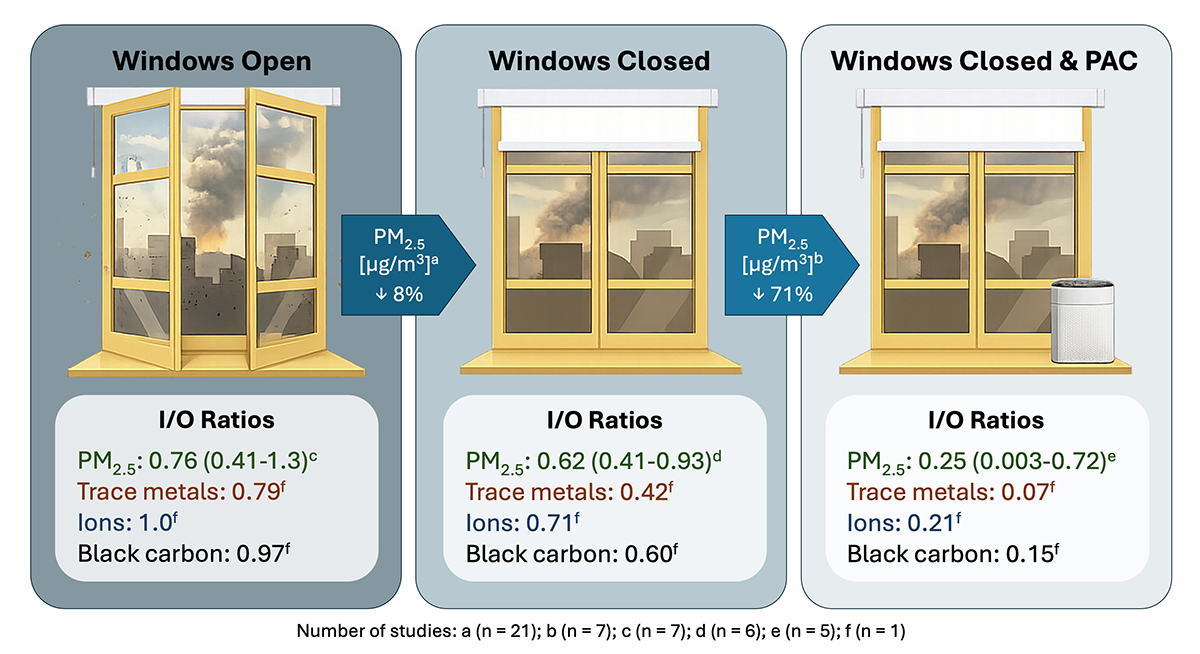
Figure 1: Summary of available evidence on the effect of closing windows and using a PAC on the infiltration of air pollutants indoors during a smoke episode. Indoor PM2.5 mass concentrations are indicated as percent reduction from windows open or not reported19,22,27,31,32,35-38,48,55,56 to windows closed22,33,40,41,43-45,50,52 conditions, and from windows closed to windows closed while operating a PAC conditions19,22,40,41,43,44,52. I/O ratios are reported from available literature with median and range if available for PM2.510,19,22,33,35,37,38,40,41,45,52,56, trace metals19, ions19, and black carbon19. This is an AI-assisted infographic.
Indoor exposures are also modified by building characteristics. Buildings with tighter building envelopes and newer construction provided better passive protection against PM₂.₅ infiltration compared with older or leakier homes. Public buildings with HVAC systems and high-efficiency filters demonstrated some of the lowest infiltration values, especially when indoor positive pressure was maintained, and the HVAC system was in good condition. However, other HVAC-equipped facilities showed that substantial infiltration can occur during smoke events, suggesting that system design and filter type are critical to protecting indoor air quality. Beyond HVAC design, other important factors such as human behaviour likely contributed to elevated levels of pollutants measured in these facilities (i.e., window and door opening).
Several evidence gaps were identified in this review. Although PM2.5 was well documented, the factors that influence infiltration of other smoke pollutants such as PAHs are less understood. Another evidence gap identified was the lack of studies on the impact of exhaust fans specifically during combustion-derived air pollution events. One study indicated that the presence of a continually running exhaust system in two homes may have led to higher infiltration of PM during periods of good air quality and during wildfire smoke episodes. However, the same study indicated that homes with an externally vented stove exhaust systems had reduced infiltration.
In summary, the findings of this review highlight that smoke pollution can readily penetrate indoors, but infiltration can be significantly reduced through building features, occupant behaviors, and interventions such as air sealing, PACs and HVAC filtration. Moreover, the most effective strategy to reduce indoor smoke pollution is to combine interventions such as closing windows, using a PAC, and maintaining positive pressure inside the building. Further study of non-PM pollutants is needed to better understand their indoor infiltration, and the potential long-term health impacts of exposure to smoke pollution.
Acknowledgements
We acknowledge the valued input from those who assisted in the production and review of this document including Michele Wiens, Information Specialist, NCCEH, Eric Coker, Senior Scientist, BC CDC, Juliette O’Keeffe, Senior Scientist, NCCEH, and Sarah Henderson, Scientific Director, NCCEH.
The National Collaborating Centre for Environmental Health (NCCEH) is hosted by the BC Centre for Disease Control and primarily funded by the Public Health Agency of Canada. This review has also been supported by Health Canada, and the views expressed herein do not necessarily represent the views of the Public Health Agency of Canada or Health Canada
Appendix A
Download PDF to view Table 5. Study details
Appendix B
References
- Health Canada. Wildfire smoke, air quality and your health: Protecting your physical and mental health. Ottawa, ON: Government of Canada; 2025 July 31. Available from: https://www.canada.ca/en/services/health/healthy-living/environment/air-quality/wildfire-smoke/protecting-your-physical-mental-health.html.
- Liu JC, Pereira G, Uhl SA, Bravo MA, Bell ML. A systematic review of the physical health impacts from non-occupational exposure to wildfire smoke. Environ Res. 2015;136:120-32. Available from: https://doi.org/10.1016/j.envres.2014.10.015.
- Gao Y, Huang W, Yu P, Xu R, Yang Z, Gasevic D, et al. Long-term impacts of non-occupational wildfire exposure on human health: A systematic review. Environ Pollut. 2023;320:121041. Available from: https://doi.org/10.1016/j.envpol.2023.121041.
- Austhof E, Brown HE, Ferguson D, Jernberg JB. What burns in a wildfire influences cardiovascular health outcomes: A systematic review and meta-analysis. Ecotoxicol Environ Saf. 2025;303:118751. Available from: https://doi.org/10.1016/j.ecoenv.2025.118751.
- Yin Z, Huang X, He L, Cao S, Zhang JJ. Trends in ambient air pollution levels and PM 2.5 chemical compositions in four Chinese cities from 1995 to 2017. J Thorac Dis. 2020;12(10):6396-410. Available from: https://doi.org/10.21037/jtd-19-crh-aq-004.
- Wentworth GR, Aklilu Y-a, Landis MS, Hsu Y-M. Impacts of a large boreal wildfire on ground level atmospheric concentrations of PAHs, VOCs and ozone. Atmos Environ. 2018;178:19-30. Available from: https://doi.org/10.1016/j.atmosenv.2018.01.013.
- Verma V, Polidori A, Schauer JJ, Shafer MM, Cassee FR, Sioutas C. Physicochemical and toxicological profiles of particulate matter in Los Angeles during the October 2007 Southern California wildfires. Environ Sci Tech. 2009;43(3):954-60. Available from: https://doi.org/10.1021/es8021667.
- Sakamoto KM, Allan JD, Coe H, Taylor JW, Duck TJ, Pierce JR. Aged boreal biomass-burning aerosol size distributions from BORTAS 2011. Atmos Chem Phys. 2015;15(4):1633-46. Available from: https://doi.org/10.5194/acp-15-1633-2015.
- Kim YH, Sinha A, George IJ, DeMarini DM, Grieshop AP, Gilmour MI. Toxicity of fresh and aged anthropogenic smoke particles emitted from different burning conditions. Sci Total Environ. 2023 Sep 20;892:164778. Available from: https://www.ncbi.nlm.nih.gov/pubmed/37302606.
- Liang Y, Wernis RA, Kristensen K, Kreisberg NM, Croteau PL, Herndon SC, et al. Gas–particle partitioning of semivolatile organic compounds when wildfire smoke comes to town. Atmos Chem Phys. 2023;23(19):12441-54.
- Holder A, Hassett-Sipple B, Coefield S, Ryder O, Hafner H. Best practices guide for improving indoor air quality in commercial/public buildings during wildland fire smoke events. Washinton, DC: US EPA; 2025. Available from: https://cfpub.epa.gov/si/si_public_record_Report.cfm?dirEntryId=365813&Lab=CPHEA.
- Health Canada. Guidance for Cleaner Air Spaces during Wildfire Smoke Events. Ottawa, ON: Government of Canada; 2020 Nov 13. Available from: https://www.canada.ca/en/health-canada/services/publications/healthy-living/guidance-cleaner-air-spaces-during-wildfire-smoke-events.html.
- Chen C, Zhao B, Yang X. Preventing the entry of outdoor particles with the indoor positive pressure control method: Analysis of influencing factors and cost. Build Environ. 2011;46(5):1167-73. Available from: https://doi.org/10.1016/j.buildenv.2010.12.003.
- Russell M, Sherman M, Rudd A. Review of residential ventilation technologies. HVAC&R Research. 2007;13(2):325-48. Available from: https://doi.org/10.1080/10789669.2007.10390957.
- Ghetu CC, Rohlman D, Smith BW, Scott RP, Adams KA, Hoffman PD, et al. Wildfire impact on indoor and outdoor PAH air quality. Environ Sci Tech. 2022;56(14):10042-52. Available from: https://doi.org/10.1021/acs.est.2c00619.
- U.S. air quality index. Air quality index (AQI) basics. Research Triangle Park, NC: Air Now. Available from: https://www.airnow.gov/aqi/aqi-basics/.
- Cristale J, Silva FS, Zocolo GJ, Marchi MRR. Influence of sugarcane burning on indoor/outdoor PAH air pollution in Brazil. Environ Pollut. 2012;169:210-6. Available from: https://doi.org/10.1016/j.envpol.2012.03.045.
- Artíñano B, Gómez-Moreno FJ, Díaz E, Amato F, Pandolfi M, Alonso-Blanco E, et al. Outdoor and indoor particle characterization from a large and uncontrolled combustion of a tire landfill. Sci Total Environ. 2017;593:543-51. Available from: https://doi.org/10.1016/j.scitotenv.2017.03.148.
- Tran PTM, Adam MG, Balasubramanian R. Mitigation of indoor human exposure to airborne particles of outdoor origin in an urban environment during haze and non-haze periods. J Hazard Mater. 2021;403:123555. Available from: https://doi.org/10.1016/j.jhazmat.2020.123555.
- Health Canada. Guidelines for Canadian Drinking Water Quality: Operational Parameters. Ottawa, ON: Government of Canada; 2025 Mar 21. Available from: https://www.canada.ca/en/health-canada/programs/guidelines-canadian-drinking-water-quality-operational-parameters.html#a1.2.
- Health Canada. Page 6: Guidelines for Canadian Drinking Water Quality: Guideline Technical Document – Ammonia. Ottawa, ON: Government of Canada; 2016 Jan 12. Available from: https://www.canada.ca/en/health-canada/services/publications/healthy-living/guidelines-canadian-drinking-water-quality-guideline-technical-document-ammonia/page-6-guidelines-canadian-drinking-water-quality-guideline-technical-document-ammonia.html#a5.0.
- Sharma R, Balasubramanian R. Indoor human exposure to size-fractionated aerosols during the 2015 Southeast Asian smoke haze and assessment of exposure mitigation strategies. Environ Res Lett. 2017;12(11). Available from: https://doi.org/10.1088/1748-9326/aa86dd.
- Government of Ontario. Current occupational exposure limits for Ontario workplaces under Regulation 833. Toronto, ON: Government of Ontario; 2025 Jun 26. Available from: https://www.ontario.ca/page/current-occupational-exposure-limits-ontario-workplaces-under-regulation-833.
- Kaduwela AP, Kaduwela AP, Jrade E, Brusseau M, Morris S, Morris J, et al. Development of a low-cost air sensor package and indoor air quality monitoring in a California middle school: Detection of a distant wildfire. J Air Waste Manag Assoc. 2019;69(9):1015-22. Available from: https://doi.org/10.1080/10962247.2019.1629362.
- Lee MJ, Dickson JM, Greif O, Ho W, Henderson SB, Mallach G, et al. Using low-cost air quality sensors to estimate wildfire smoke infiltration into childcare facilities in British Columbia, Canada. Environ Res, Health. 2024;2(2).
- Shrestha PM, Humphrey JL, Carlton EJ, Adgate JL, Barton KE, Root ED, et al. Impact of outdoor air pollution on indoor air quality in low-income homes during wildfire seasons. Int J Environ Res Public Heal. 2019;16(19):3535. Available from: https://doi.org/10.3390/ijerph16193535.
- Weaver AM, Gurley ES, Crabtree-Ide C, Salje H, Yoo E-H, Mu L, et al. Air pollution dispersion from biomass stoves to neighboring homes in Mirpur, Dhaka, Bangladesh. BMC Public Health. 2019;19(1):425. Available from: https://doi.org/10.1186/s12889-019-6751-z.
- Wheeler AJ, Gibson MD, MacNeill M, Ward TJ, Wallace LA, Kuchta J, et al. Impacts of air cleaners on indoor air quality in residences impacted by wood smoke. Environ Sci Tech. 2014;48(20):12157-63. Available from: https://doi.org/10.1021/es503144h.
- Allen RW, Carlsten C, Karlen B, Leckie S, Eeden Sv, Vedal S, et al. An air filter intervention study of endothelial function among healthy adults in a woodsmoke-impacted community. Am J Respir Crit Care Med. 2011;183(9):1222-30. Available from: https://doi.org/10.1164/rccm.201010-1572OC.
- Canadian Council of Ministers of the Environment. Canadian ambient air quality standards. Ottawa, ON: Government of Canada. Available from: https://ccme.ca/en/air-quality-report.
- Walker ES, Stewart T, Jones D. Fine particulate matter infiltration at Western Montana residences during wildfire season. Sci Total Environ. 2023;896:165238. Available from: https://doi.org/10.1016/j.scitotenv.2023.165238.
- Liang Y, Sengupta D, Campmier MJ, Lunderberg DM, Apte JS, Goldstein AH. Wildfire smoke impacts on indoor air quality assessed using crowdsourced data in California. Proc Natl Acad Sci U S A. 2021 Sep 7;118(36). Available from: https://www.ncbi.nlm.nih.gov/pubmed/34465624.
- Montrose L, Walker ES, Toevs S, Noonan CW. Outdoor and indoor fine particulate matter at skilled nursing facilities in the western United States during wildfire and non‐wildfire seasons. Indoor Air. 2022;32(6):e13060. Available from: https://doi.org/10.1111/ina.13060.
- Dev S, Barnes D, Kadir A, Betha R, Aggarwal S. Outdoor and indoor concentrations of size-resolved particulate matter during a wildfire episode in interior Alaska and the impact of ventilation. Air Qual Atmos Health. 2021;15(1):149-58. Available from: https://doi.org/10.1007/s11869-021-01094-8.
- Kajbafzadeh M, Brauer M, Karlen B, Carlsten C, Eeden Sv, Allen RW. The impacts of traffic-related and woodsmoke particulate matter on measures of cardiovascular health: a HEPA filter intervention study. Occup Environ Med. 2015;72(6):394. Available from: https://doi.org/10.1136/oemed-2014-102696.
- Barn P, Larson T, Noullett M, Kennedy S, Copes R, Brauer M. Infiltration of forest fire and residential wood smoke: an evaluation of air cleaner effectiveness. J Expo Sci Environ Epidemiol. 2008;18(5):503-11. Available from: https://doi.org/10.1038/sj.jes.7500640.
- He J, Huang C-H, Yuan N, Austin E, Seto E, Novosselov I. Network of low-cost air quality sensors for monitoring indoor, outdoor, and personal PM2.5 exposure in Seattle during the 2020 wildfire season. Atmos Environ. 2022;285:119244. Available from: https://doi.org/10.1016/j.atmosenv.2022.119244.
- Holder AL, Vreeland H, Brittingham H, Coefield S, Hassett-Sipple B, Deckmejian L, et al. Influence of Building Characteristics on Wildfire Smoke Impacts on Indoor Air Quality. ACS ES&T Air. 2025;2(8):1770-83.
- ASHRAE. Guideline 44-2024 - Protecting building occupants from smoke during wildfire and prescribed burn events. Peachtree Corners, GA: American Society of Heating, Refrigerating and Air-Conditioning Engineers, Inc.; 2024. Available from: https://store.accuristech.com/ashrae/standards/guideline-44-2024-protecting-building-occupants-from-smoke-during-wildfire-and-prescribed-burn-events?product_id=2923808.
- Willis L, Hart J, Nagisetty R, Comstock C, Gilkey D, Autenrieth D. The application of portable air cleaners in spaces occupied by vulnerable people during wildfire events. World Saf J. 2023 Jun;32(2):1-26. Available from: https://doi.org/10.5281/zenodo.8105756.
- May NW, Dixon C, Jaffe DA. Impact of wildfire smoke events on indoor air quality and evaluation of a low-cost filtration method. Aerosol Air Qual Res. 2021;21(7):210046. Available from: https://doi.org/10.4209/aaqr.210046.
- Wheeler AJ, Allen RW, Lawrence K, Roulston CT, Powell J, Williamson GJ, et al. Can public spaces effectively be used as cleaner indoor air shelters during extreme smoke events? Int J Environ Res Public Heal. 2021;18(8):4085. Available from: https://doi.org/10.3390/ijerph18084085.
- Xiang J, Huang C-H, Shirai J, Liu Y, Carmona N, Zuidema C, et al. Field measurements of PM2.5 infiltration factor and portable air cleaner effectiveness during wildfire episodes in US residences. Sci Total Environ. 2021;773:145642. Available from: https://doi.org/10.1016/j.scitotenv.2021.145642.
- Stauffer DA, Autenrieth DA, Hart JF, Capoccia S. Control of wildfire-sourced PM2.5 in an office setting using a commercially available portable air cleaner. J Occup Environ Hyg. 2020;17(4):109-20. Available from: https://doi.org/10.1080/15459624.2020.1722314.
- Tham KW, Parshetti GK, Anand P, Cheong DKW, Sekhar C. Performance characteristics of a fan filter unit (FFU) in mitigating particulate matter levels in a naturally ventilated classroom during haze conditions. Indoor Air. 2021 May;31(3):795-806. Available from: https://doi.org/10.1111/ina.12771.
- Cao Q, Chen A, Zhou J, Chang VW-C. Performance evaluation of filter applications in fan-coil units during the 2015 Southeast Asian haze episode. Build Environ. 2016;107:191-7. Available from: https://doi.org/10.1016/j.buildenv.2016.08.004.
- Chen A, Cao Q, Zhou J, Yang B, Chang VWC, Nazaroff WW. Indoor and outdoor particles in an air-conditioned building during and after the 2013 haze in Singapore. Build Environ. 2016;99:73-81. Available from: https://doi.org/10.1016/j.buildenv.2016.01.002.
- Reisen F, Powell JC, Dennekamp M, Johnston FH, Wheeler AJ. Is remaining indoors an effective way of reducing exposure to fine particulate matter during biomass burning events? J Air Waste Manag Assoc. 2019 May;69(5):611-22. Available from: https://www.ncbi.nlm.nih.gov/pubmed/30624153.
- Huff RD, Traynor RL, Camargo K, Leung T, Okeeffe J, Tutt E, et al. Rapid Review: What effect does indoor air filtration and air cleaning have on concentrations of pollutants and human health endpoints during combustion-derived air pollution episodes? Vancouver, BC: National Collaborating Centres for Environmental Health and Methods and Tools; 2025 Jan 31. Available from: https://ncceh.ca/resources/evidence-reviews/indoor-air-filtration-during-wildfires-impacts-air-quality-and-health.
- Prathibha P, Turner M, Wei L, Davis A, Vinsonhaler K, Batchelder A, et al. Usage and impact of a do-it-yourself air cleaner on residential PM2.5 in a smoke-impacted community. Atmos Environ. 2024;333:120650. Available from: https://doi.org/10.1016/j.atmosenv.2024.120650.
- Wheeler A, Reisen F, Roulston C, Dennekamp M, Goodman N, Johnston F. Evaluating portable air cleaner effectiveness in residential settings to reduce exposures to biomass smoke resulting from prescribed burns. Public Heal Res Pr. 2024;34(1). Available from: https://doi.org/10.17061/phrp33232307.
- Henderson DE, Milford JB, Miller SL. Prescribed burns and wildfires in Colorado: Impacts of mitigation measures on indoor air particulate matter. J Air Waste Manag Assoc. 2005;55(10):1516-26. Available from: https://doi.org/10.1080/10473289.2005.10464746.
- Rohit CH, Henderson SB, O'Keeffe J. A public health companion for ASHRAE Guideline 44: Protecting building occupants from smoke during wildfire and prescribed burn events. Vancouver, BC2025 Aug 20. Available from: https://ncceh.ca/resources/evidence-reviews/public-health-companion-ashrae-guideline-44-protecting-building.
- Mendoza DL, Benney TM, Boll S. Long-term analysis of the relationships between indoor and outdoor fine particulate pollution: A case study using research grade sensors. Sci Total Environ. 2021;776:145778. Available from: https://doi.org/10.1016/j.scitotenv.2021.145778.
- Allen RW, Leckie S, Millar G, Brauer M. The impact of wood stove technology upgrades on indoor residential air quality. Atmos Environ. 2009;43(37):5908-15. Available from: https://doi.org/10.1016/j.atmosenv.2009.08.016.
- Bravo-Linares C, Ovando-Fuentealba L, Orellana-Donoso S, Gatica S, Klerman F, Mudge SM, et al. Source identification, apportionment and toxicity of indoor and outdoor PM 2.5 airborne particulates in a region characterised by wood burning. Environ Sci Process Impacts. 2016;18(5):575-89. Available from: https://doi.org/10.1039/C6EM00148C.
- Coker ES, Ho W, Paul N, Lee MJ, Dickson JM, Greif O, et al. Enhancing wildfire smoke exposure assessment: A machine learning approach to predict indoor PM2.5 in British Columbia, Canada. ACS ES&T Air. 2024;2(1):73-89.
- Lunderberg DM, Liang Y, Singer BC, Apte JS, Nazaroff WW, Goldstein AH. Assessing residential PM(2.5) concentrations and infiltration factors with high spatiotemporal resolution using crowdsourced sensors. Proc Natl Acad Sci U S A. 2023 Dec 12;120(50):e2308832120. Available from: https://www.ncbi.nlm.nih.gov/pubmed/38048461.
- Burke M, Heft-Neal S, Li J, Driscoll A, Baylis P, Stigler M, et al. Exposures and behavioural responses to wildfire smoke. Nat Hum Behav. 2022 Oct;6(10):1351-61. Available from: https://www.ncbi.nlm.nih.gov/pubmed/35798884.
- O’Dell K, Ford B, Burkhardt J, Magzamen S, Anenberg SC, Bayham J, et al. Outside in: the relationship between indoor and outdoor particulate air quality during wildfire smoke events in western US cities. Environ Res, Health. 2022;1(1).
- Messier KP, Tidwell LG, Ghetu CC, Rohlman D, Scott RP, Bramer LM, et al. Indoor versus outdoor air quality during wildfires. Environ Sci Technol Lett. 2019;6(12):696-701. Available from: https://doi.org/10.1021/acs.estlett.9b00599.
- Chen Y, Li X, Zhu T, Han Y, Lv D. PM2.5-bound PAHs in three indoor and one outdoor air in Beijing: Concentration, source and health risk assessment. Sci Total Environ. 2017;586:255-64. Available from: https://doi.org/10.1016/j.scitotenv.2017.01.214.
- Zhang L, Yang Z, Liu J, Zeng H, Fang B, Xu H, et al. Indoor/outdoor relationships, signatures, sources, and carcinogenic risk assessment of polycyclic aromatic hydrocarbons-enriched PM2.5 in an emerging port of northern China. Environ Geochem Heal. 2021;43(8):3067-81. Available from: https://doi.org/10.1007/s10653-021-00819-z.
- Brown DR, Alderman N, Weinberger B, Lewis C, Bradley J, Curtis L. Outdoor wood furnaces create significant indoor particulate pollution in neighboring homes. Inhal Toxicol. 2014;26(10):628-35. Available from: https://doi.org/10.3109/08958378.2014.946633.