

Storyline of a silent killer: Extreme heat and media communication

Key messages |
|
Introduction
According to the International Panel on Climate Change 2021 report, heatwaves, also known as extreme heat events (EHEs) are becoming more prolonged, frequent, and extreme due to climate change.1 The unprecedented EHE in 2021 in British Columbia (BC), known as the 2021 Heat Dome, led to 619 heat-related deaths, and highlighted the need to protect populations in Canada from the increasing threat of extreme heat.2 The BC Coroner’s Service review of heat-related deaths in BC during the 2021 Heat Dome reported that 98% of the deaths occurred indoors, mostly in private residences without adequate indoor cooling. Sixty-seven percent of the decedents were 70 years of age or older, 90% were over age 60, more than 80% were listed on three or more chronic disease registries, and 56% lived alone.2 This report highlighted that certain populations are particularly susceptible to heat-related injury and death. Bearing in mind that all people who do not have access to safe temperatures in their homes are at risk of heat-related illnesses and death, Box 1 defines populations who are at the most risk.3
|
Box 1. Populations that are highly susceptible to heat-related injury or death. |
|
Adapted from: National Collaborating Centre for Environmental Health. Health checks during extreme heat events (2022).3
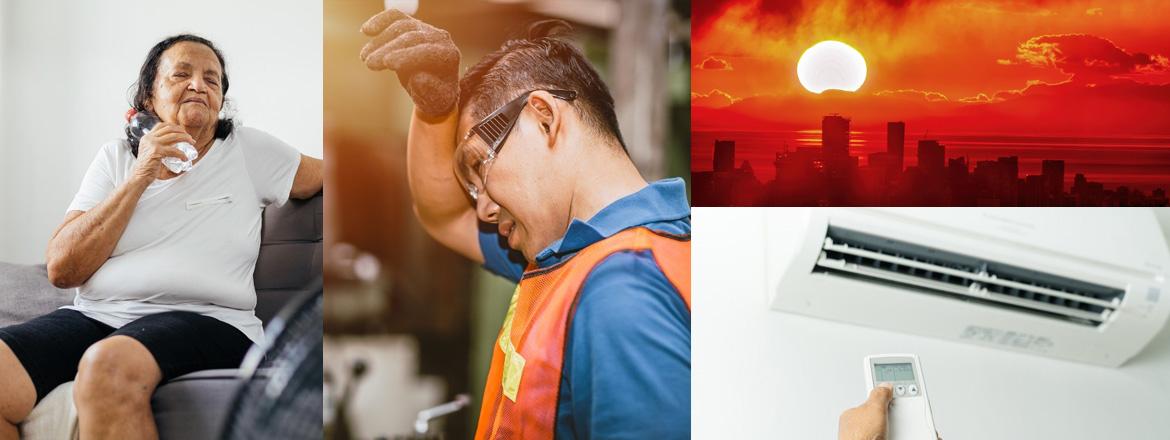
Appropriate public preparation for EHEs is key for health protection. Preparation can be improved through better understanding of heat alerts, populations at risk, the signs and symptoms of heat-related illnesses, effective individual interventions, and when to seek medical care.4,5 To protect health during EHEs, checking in with high-risk individuals multiple times daily is essential. Other effective interventions include finding ways to keep homes cool, for example using air conditioning, sleeping in the coolest room of the home, shutting windows/doors during the day, and opening when the outdoor temperature drops. Other important strategies are finding a cooler space if one is not available at home, such as a shopping centre or library, or finding ways to cool the body, like wearing a damp shawl/shirt, taking a cool bath/shower, or sleeping on damp sheets.4
Media professionals such as journalists, reporters, photojournalists and editors play important roles in conveying public health information during extreme weather events, such as EHEs.6 Media coverage can influence the degree to which public audiences assess EHE risk and importance, based on how much attention the event receives and how it is framed by the media.7,8 Given the importance of media coverage to prepare public audiences for EHEs, the NCCEH sought to review available guidance or information tailored to media professionals regarding effective communication about EHEs, heat health risk, and protective actions. This evidence brief presents a review of the practical guidance, recommendations, or best practices that are available to journalists and other media professionals. We also present evidence from studies on media communication during EHEs as well as more general guidance and information for journalists on climate change attribution and reporting.
Methodology
We identified literature through a search of EBSCOHost databases (including Medline, CINAHL, Academic Search Complete, ERIC, etc.), Google Scholar and Google search engines from March 2014 to March 2024. Variants and Boolean operator combinations were used with the search terms listed in Appendix A.
Results
Guidance and resources for media professionals on extreme heat event reporting
The most comprehensive resource identified in this review is a guidance brief from the Global Heat Health Information Network (GHHIN).9 Established through a collaboration between the United Nations, the World Health Organization, and the World Meteorological Organization, GHHIN brings together international experts in heat and its health effects. The mission of the GHHIN is to facilitate the distribution of information on global heat health to the public, aiming to raise awareness and assist policymakers in protecting communities from the preventable health hazards posed by extreme heat in the context of a changing climate.
The GHHIN guidance brief is tailored for the media, and is designed to improve the impact, effectiveness, and public value of extreme heat-related reporting. This resource is informed by experts in media communication of climate change risks, and work from organizations such as Covering Climate Now (CCN), and the World Weather Attribution (WWA). The document contains four key considerations, a list of groups at high-risk, practical recommendations, a list of additional reading, explanations of common jargon, and links to experts. The key recommendations in this guidance brief are to:
- Frame heat in the context of climate change
- Highlight actions and solutions, such as information on how to access cooling spaces or low-cost cooling techniques
- Give attention to the disproportionate impacts of extreme heat on at-risk populations (see Box 1)
- Portray the indirect impacts of EHEs in other areas, such as disease transmission, delivery of health service delivery, air quality, risk of wildfires and evacuation, etc.
The guide summarizes practical recommendations and steps that media professionals can take when covering extreme heat from a health perspective (Table 1). These include advice to conduct pre-season awareness coverage, adding a focus on nighttime temperatures and indoor settings, using more realistic imagery of the dangerous impacts of extreme heat, using positive action imagery, and balancing the focus between acute EHEs and the more chronic impacts of heat exposure. The guide also recommends choosing a variety of contextual interviews for story perspectives and focussing on local experts and researchers.
Table 1. Global Heat Health Information Network (GHHIN) practical recommendations for reporting on extreme heat events and the health impacts of extreme heat
|
Area |
Recommendation |
Information |
|
Timing |
Create pre-season awareness |
|
|
Coverage
|
Cover both nighttime and daytime heat |
|
|
Cover both indoor and outdoor settings |
|
|
|
Imagery
|
Include realistic imagery instead of fun in the sun |
|
|
Include positive action images |
|
|
|
Focus |
Balance focus of chronic heat exposure and extreme heat events |
|
|
Interviews
|
Choose a variety of interview contexts for story diversity and relevance |
|
|
Refocus to the local expert and research context |
|
|
|
Be strategic in areas with low acceptance of climate science or trust in the media |
|
|
|
Ask about symptoms, not diseases/disease events |
|
Adapted from: Global Heat Health Information Network (GHHIN) Reporting on heatwaves and the health impacts of heat. Geneva, Switzerland: World Health Organization and the World Meteorological Organization, 2023.9 Abbreviations: EHE, extreme heat event; ER, emergency room
Several sources of guidance for journalists on heat-health communication have been produced by Covering Climate Now (CCN). CCN is a not-for-profit organization that supports, educates, and brings together journalists and newsrooms to create accurate and engaging coverage on the climate crisis. CCN published a guide containing resources for reporting on who is most at risk from extreme heat, signs and symptoms of heat-related illness, what can be done to protect health during and after an EHE, and links to sample imagery.10 The CCN also launched a newsletter in June 2024, with its first edition focussed on extreme heat as a public health issue and presents reporting tips, story examples, and other resources.11
Through a webinar in 2023, CCN communicated several key points that media professionals can use to cover the human health impacts of extreme heat.12 This resource highlights the importance of communicating about the inequities related to the human health impacts of extreme heat, and how journalists can use health outcome data to emphasize these disparities and the overall severity of EHEs.
In a subsequent article, CCN provides advice to journalists about how to prepare for the 2024 heat season.13 This resource provides additional advice encouraging journalists to commit to covering extreme heat in ways that bring accountability to local, regional, and national governments. This could involve delving into the responses of cities to a previous year's heat events and exploring whether measures have been implemented to ensure residents' safety during future heat events. Further, CCN recommends that journalists consider communicating the connections between climate change, extreme heat, and storms as they unfold.
Further support for heat health communication is provided by The Science Media Centre of Canada (SMCC), an organization dedicated to helping journalists cover stories with scientific content. In 2017, the SMCC produced a resource that provides information on key people at risk, how communities are responding to extreme heat, the context for addressing urban heat island effects, and an example of the notification and warning process from Environment and Climate Change Canada (ECCC) to public health units and community partners.14
Studies on media communication during extreme heat events
Pre-season awareness, communication, and messaging
There were approximately 70,000 excess deaths reported during the EHE that affected most of Europe in the summer 2003, peaking during the month of August. In France alone, 14,729 cumulative excess deaths were reported between August 1st and 20th, 2003, compared with equivalent periods in 2000–2002, representing a 55% mortality increase.15 Analysis of media coverage during the 2003 EHE in France showed that story topics on extreme heat impacts focussed predominantly on economic, ecological, and recreational impacts compared with coverage on the heat health risks to people.16 The lack of health-relevant media coverage demonstrated that neither the media nor public health organizations were prepared to advise the public and those most at-risk on how to protect their health. The main recommendation related to the study findings was that increased collaboration between media and public health officials was necessary to avoid similar devastating EHE crises in future.
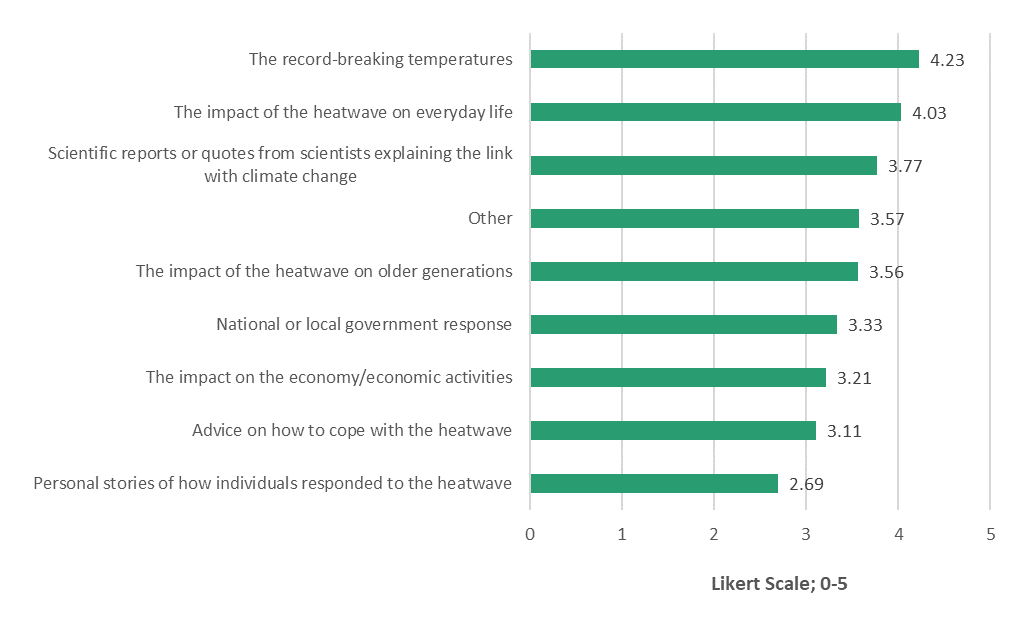
In late June and late July 2019, there were two distinct EHEs that affected European nations (referred to henceforth as the 2019 European EHEs), most notably Belgium, France, Germany, Luxembourg, the Netherlands, and the United Kingdom (UK).17 Studies on the 2019 European EHEs have also described how the dangers and health risks were not widely reported by the media.6,18 Through a survey of attitudes, motivations, and role perceptions following these EHEs, “record breaking temperatures” was reported by journalists as the most important aspect they should cover. This is a common trend across media coverage of EHEs, which can be a distraction from other important topics, such as health risks and health protection.19 The journalists also stated it was important to report about heat impacts on older generations, but this did not translate to actual coverage during the event (Figure 1).6,18,20
Figure 1. Aspects considered important by journalists to include in coverage of the 2019 European extreme heat events (EHEs). The Likert scale ranges from 0 (not important) to 5 (very important), and the bars show mean values for 39 journalists interviewed.
Adapted from: Strauss 2022 Reporting on the 2019 European EHEs and climate change: journalists’ attitudes, motivations and role perceptions.20
Other studies on media communications during EHEs provide further key findings (Table 2), most of which are similar to the recommendations from guidance in the GHHIN and CNN resources.
Table 2. Key study conclusions regarding media reporting on extreme heat events (EHEs)
| Context |
Specific action for media professionals and outlets/agencies |
|
Pre-season awareness, and heat health protective messaging during an EHE |
|
|
Imagery |
|
|
Overlapping crises |
|
|
Climate change attribution |
|
Abbreviations: EEA, extreme event attribution; EHE, extreme heat event
A recent systematic review of Canadian media coverage during the 2021 Heat Dome examined how health impacts were addressed.19 The review identified significant deficiencies in the communication of the health impacts of extreme heat, populations most at risk, and how to mitigate the health impacts.19 Notably, narratives tended to prioritize sensational elements such as record-breaking temperatures and impacts to infrastructure rather than human health implications. Only 13% of media articles focussed on populations who are at highest risk of heat-related illnesses. The review found that there was a lack of pre-season reporting, suggesting a deficiency in pre-emptive public health awareness campaigns. Rural areas were also notably underrepresented in media discourse, compared with urban centres. The study authors concluded by calling on public health officials to aid local media outlets and journalists by offering guidance and pre-prepared messages on extreme heat events, heat health information, and effective health-protective measures to assist heat-vulnerable populations before, during, and after EHEs. In addition, collaboration is key to crafting and disseminating the messages, so health and media professionals should work together as partners prior to the heat season and in anticipation of expected EHEs.
Workplace safety is also important to consider during an EHE. The 2021 Heat Dome significantly impacted the health and safety of multiple occupational groups in BC, ranging from work disruptions and schedule changes to adjustments in work practices and reports of heat-related illnesses.21 To address this, during an EHE, the media can play a role in communicating workplace safety information to the public, such as appropriate heat mitigation strategies like wearing adapted clothing that promotes cooling, seeking shade, and adjusting water-delivery practices.
Individuals experiencing homelessness are an at-risk population during EHS. However, during the 2021 Heat Dome in BC, there were very few deaths among people experiencing homelessness (n = 3, 0.5%), despite the region having one of the highest homelessness rates in Canada.2 This was the impetus for a case study that identified Canadian news media that specifically included public warnings about the heat risks for people experiencing homelessness.22 This kind of media messaging and grassroots initiatives tailored to support homeless individuals during the 2021 Heat Dome may have played a role in lessening the adverse effects of heat on this population.
Imagery
Imagery is an important journalistic and reporting tool to explain and frame the context of an article, making it memorable and emotive.25,26 Content and visual discourse analyses of news coverage of the 2019 European EHEs in France, Germany, the Netherlands, and the UK (245 images and associated articles), found that many visuals associated with the articles were positively framed, in contrast to the article text.18 The most common choice of image was of people having fun in or by water, thereby framing heat events as “fun in the sun.” In most cases where the images were chosen to represent the heat health risks, people were not included. The authors called on those involved in media creation, including collection curators, photojournalists, and editors, to question the use of images and visual portrayals in media content on extreme heat. They suggested that collaboration could help to create media discourse that is more accountable and inclusive of the people who are affected the most. Notably, these findings were supported by climate experts in a media report analyzing “sunny coverage” of UK EHEs.27 In the Guardian report, experts asserted that the sunny and dry weather conditions observed in the UK during the EHEs were frequently depicted as positive events, often featuring images of individuals sunbathing, playing in fountains, or consuming ice cream, thereby framing these conditions as celebratory.
A recent content analysis of 845 images published in association with Canadian media articles during the 2021 Heat Dome showed that just 16% (n = 133) portrayed the heat as dangerous.23 Of these images, only 46% (n = 61) portrayed human suffering, and only 4% (n = 5) portrayed heat as an indoor danger compared with 96% (n = 840) portraying it as an outdoor danger. The images also lacked representation of people most at risk from the EHE, such as older adults. Depiction of actions to the reduce the risks of indoor heat were also underrepresented, with only 4% (n = 33) showing air conditioning, fan use indoors, or other cool indoor spaces. This analysis also found a mismatch between images used, the danger faced by people most at risk from extreme heat, and evidence-based approaches to protect health indoors. The study authors concluded by urging government bodies, public health agencies, and media partners to prioritize using images that align with evidence-based health messages when disseminating heat preparedness and response information.
Climate change attribution
During the 2019 European EHEs, content analysis of media coverage in France, Germany, the Netherlands, and the UK showed that only about 11% of articles mentioned any link to climate change.6 This is despite a reported uptick of mentions of climate change in global media coverage of EHEs between 2013 and 2018.28 The survey of journalists’ attitudes motivations and role perceptions regarding reporting on EHEs found there was a notable lack of knowledge on extreme event attribution studies among survey participants.20 Nevertheless, journalists interviewed reported a strong desire to cover the link between climate change and the probability of extreme weather events such as EHEs (Figure 1).
Some media services have specialized reporters for climate change-related coverage; however, this study reported there were fewer specialized reporters compared with generalist reporters covering EHEs. When it comes to climate change attribution, journalists most frequently relied on and quoted primary sources such as meteorologists, authors of scientific reports, scientists, and scientific reports. In addition, journalists reported perceiving their role as educators rather than advocates, and do not report having substantial time and resource constraints imposed on them to produce their extreme heat-related media products. The study authors concluded that presenting the strengths and limitations of climate models through workshops could potentially facilitate accurate and timely reporting on climate change attribution.20
Overlapping crises
Another paper on the 2021 Heat Dome explored its confluence with the COVID-19 pandemic in Canadian media-based public health communication, and found there were many conflicting health messages, potentially confusing the public about appropriate health precautions.24 The study results suggest that the COVID-19 pandemic might have exacerbated the health impacts of the 2021 Heat Dome, given pandemic-related public health measures such as social distancing could have discouraged individuals from taking necessary heat precautions, such as accessing a centre or seeking timely healthcare. This highlights the importance of consistent public health messaging and unified heat health guidance when facing simultaneous EHEs and other public health crises. The study authors called for health authorities and professionals within health and public safety systems to collaborate proactively and directly with the media, ensuring that public health messaging in news coverage is effective, timely, and appropriately prioritized during overlapping crises.
Guidance and resources for media professionals on climate change reporting and attribution
Guidance consistently recommends that media professionals cover climate change attribution in articles about EHEs, except in contexts where there is minimal acceptance of climate science or trust in the media.9,20,29 There are several recent guides and resources for journalists and other media professionals focussed on climate change reporting and attribution that may be useful for covering EHEs (Table 3).29-31
One example is provided by World Weather Attribution (WWA), a not-for-profit initiative that works with scientists to quantify how climate change influences the intensity and likelihood of an extreme weather event.29 WWA uses weather observations and computer modelling, immediately after an event, to draw its conclusions and inform decisions and actions that improve community and national resiliency in response to extreme weather events. The WWA 2022 guide discusses how to present accurate information to audiences regarding the impact of climate change on the rising occurrences of extreme events, while avoiding both overemphasis and underrepresentation of the connection.29 Regarding EHEs, WWA asserts that the 2021 Heat Dome in Western Canada and US, and the Siberian EHE of 2020, would have been impossible without human-caused climate change. The likelihood of deadly hot and humid events in northern India and Pakistan in 2015, as well as events in China, Argentina, all over Europe and North America, North and Central Africa, Australasia, and Southeast Asia, were all made dramatically more likely by climate change. The guidance also notes that EHEs over a large geographic area or over a long timeframe have a stronger direct connection to anthropogenic climate change.
Additional guidance and resources for media professionals on climate change reporting and from organizations such as European Broadcasting Union, CCN, Climate Central, International Journalists’ Network, Reuters Institute, Society for Environmental Journalists, and International Press Institute are summarized below (Table 3).
Table 3. Guidance and information for journalists on climate change reporting and attribution
|
Organization |
Guidance and information available |
|
World Weather Attribution (2022) |
|
|
European Broadcasting Union (2023) |
|
|
Covering Climate Now (2024, 2023) |
|
|
Climate Central (2024) |
|
|
International Journalists’ Network (2022) |
|
|
Reuters Institute (2023) |
|
|
Society of Environmental Journalists (2020) |
|
|
International Press Institute (2024) |
|
|
Re.Climate™ (2023) |
|
Summary
Media professionals play pivotal roles in communicating about EHEs, their health effects, and effective health protection. Key guidance and evidence-based suggestions are available for media professionals on heat health risk communication before and during an EHE. The GHHIN guidance brief is tailored for media, and is designed to improve the impact, effectiveness, and public value of extreme heat-related reporting. Its key recommendations are to frame heat in the context of climate change, highlight actions and solutions, and give attention to the inequitable, indirect, and cascading impacts of extreme heat. Specific recommendations include creating pre-season awareness, covering overnight and daytime heat, and focussing on indoor temperatures in addition to outdoor temperatures. Images and text should convey the true risks of EHEs, focus on the most susceptible populations, and communicate about protective actions, rather than simply showing people recreating in the sun. Studies on media communication propose that strengthened cooperation between media professionals and public health experts holds promise for improving public health outcomes during EHEs. Overlapping crises especially require a proactive and direct collaborative approach between media and public health partners. In conclusion, improved approaches to communication by media professionals and enhanced collaboration between media and public health professionals has the potential to better protect public health during EHEs.
Acknowledgements
We would like to acknowledge the generous funding and support from Health Canada. Without this contribution, this work would not have been possible.
The views expressed herein do not necessarily represent the views of Health Canada.
We would also like to thank Michele Wiens, who performed searches for this review and editorial review of this report. Also, thanks to Dr. Juliette O’Keeffe and Dr. Sarah Henderson who provided senior guidance for this project and review of this report.
Appendix A
Combinations of the search terms below in Table 4 were used in the literature search.
Table 4. Search terms used in the literature review
|
Source |
Information |
|
Issue/Focus
|
(“extreme heat” OR “hot weather” OR “heat exposure” OR “heat day” OR “heat dome” OR “heat event” OR “extreme weather” OR “heat alert” OR “heat adaptation” OR “heat wave” OR heatwave OR “heat stroke” OR “temperature extreme” OR “extreme temperature” OR “extreme event” OR "weather event" OR "weather extreme" OR emergency OR “ambient temperature”) (TI TITLE) |
|
Exposure |
(communication OR communicate OR communicating OR message OR messaging OR media OR news OR facebook OR "social media" OR internet OR television OR radio OR awareness OR public OR broadcasting OR alert OR notifying OR notification OR guidance OR guidelines OR advice OR “heat protection” OR “heat protective” OR guide OR kit OR toolkit OR toolbox OR "best practice" OR tips OR communique) (TI TITLE) |
|
Outcome |
(evaluate OR evaluation OR effective OR effectiveness OR impact OR reduction OR reduce OR assist OR help OR improvement OR improve OR mitigate OR adapt OR adaptation OR preparedness OR strategy OR strategies OR mitigation OR resilience OR resilient OR resiliency OR mitigating OR response OR "public health response") (TI TITLE) |
|
Geography |
Not specified |
|
Language |
English |
References
- Watts N, Amann M, Arnell N, Ayeb-Karlsson S, Beagley J, Belesova K, et al. The 2020 report of the Lancet countdown on health and climate change: responding to converging crises. The Lancet. 2021;397(10269):129-70. Available from: https://doi.org/10.1016/S0140-6736(20)32290-X.
- British Columbia Coroners Service. Extreme heat and human mortality: a review of heat-related deaths in B.C. in summer 2021. Victoria, BC: British Columbia Coroners Service; 2022 Jun. Available from: https://www2.gov.bc.ca/assets/gov/birth-adoption-death-marriage-and-divorce/deaths/coroners-service/death-review-panel/extreme_heat_death_review_panel_report.pdf.
- National Collaborating Centre for Environmental Health. Health checks during extreme heat events. Vancouver, BC: NCCEH; 2022 Jun 22. Available from: https://ncceh.ca/documents/guide/health-checks-during-extreme-heat-events.
- British Columbia Centre for Disease Control. Preparing for heat events. Vancouver, BC: BCCDC; 2024; Available from: http://www.bccdc.ca/health-info/prevention-public-health/preparing-for-heat-events#emergency.
- Kenny GP, Tetzlaff EJ, Journeay WS, Henderson SB, O’Connor FK. Indoor overheating: a review of vulnerabilities, causes, and strategies to prevent adverse human health outcomes during extreme heat events. Temp. 2024. Available from: https://doi.org/10.1080/23328940.2024.2361223.
- Painter J, Ettinger J, Doutreix M-N, Strauß N, Wonneberger A, Walton P. Is it climate change? Coverage by online news sites of the 2019 European summer heatwaves in France, Germany, the Netherlands, and the UK. Clim Change. 2021;169(1-2). Available from: https://doi.org/10.1007/s10584-021-03222-w.
- Xinsheng L, Lindquist E, Vedlitz A. Explaining media and congressional attention to global climate change, 1969-2005: an empirical test of agenda-setting theory. Political Res Q. 2009 Jun;64(2):405-19. Available from: https://doi.org/10.1177/1065912909346744.
- Ettinger J, Walton P, Painter J, Osaka S, Otto FEL. “What’s up with the weather?” Public engagement with extreme event attribution in the United Kingdom. Weather Clim Soc. 2021 Apr 1;13(2):341-52. Available from: https://doi.org/10.1175/WCAS-D-20-0155.1.
- Global Heat Health Information Network. Reporting on heatwaves and the health impacts of heat. Geneva, Switzerland: Word Health Organization and the World Meteorological Organization; 2023 Jul. Available from: https://ghhin.org/resources/reporting-on-heatwaves-and-the-health-impacts-of-heat/.
- Covering Climate Now. Reporting guidance: 2024’s extreme heat. Washington, DC: CCN; 2024 Jun. Available from: https://coveringclimatenow.org/from-us-story/reporting-guidance-2024s-extreme-heat/.
- Covering Climate Now. Covering extreme heat. Washington, DC: CCN; 2024 Jun. Available from: https://coveringclimatenow.org/resource/climate-change-reporting-101/.
- Covering Climate Now. Talking shop: covering the human impact of extreme heat. Washington, DC: CCN; 2023 Aug. Available from: https://coveringclimatenow.org/event/covering-the-human-impact-of-extreme-heat/.
- Covering Climate Now. Prepare your newsroom for 2024’s extreme heat. Washington, DC: CCN; 2024 Mar. Available from: https://coveringclimatenow.org/from-us-story/prepare-your-newsroom-for-2024s-extreme-heat/.
- Science Media Centre of Canada. Climate change, extreme heat and health: SMCC backgrounder. Virgil, ON: SMCC; 2017 Jun 25. Available from: http://sciencemediacentre.ca/site/climate-change-extreme-heat-and-health-smcc-backgrounder/.
- Fouillet A, Rey G, Laurent F, Pavilion G, Bellec S, Guihenneuc-Jouyaux C, et al. Excess mortality related to the August 2003 heat wave in France. Int Arch Occup Environ Health. 2006;80(1):16-24. Available from: https://doi.org/10.1007/s00420-006-0089-4.
- Boyer L, Robitail S, Auquier P. Heat wave in France: how did the media treat the crisis? Br Med J. 2003;327(7419):876-. Available from: https://doi.org/10.1136/bmj.327.7419.876.
- Vautard R, van Aalst M, Boucher O, Drouin A, Haustein K, Kreienkamp F, et al. Human contribution to the record-breaking June and July 2019 heatwaves in Western Europe. Environ Res Lett. 2020 Aug;15(9):094077. Available from: https://dx.doi.org/10.1088/1748-9326/aba3d4.
- O'Neill S, Hayes S, Strauβ N, Doutreix M-N, Steentjes K, Ettinger J, et al. Visual portrayals of fun in the sun in European news outlets misrepresent heatwave risks. Geogr J. 2023;189(1):90-103. Available from: https://rgs-ibg.onlinelibrary.wiley.com/doi/abs/10.1111/geoj.12487.
- Tetzlaff EJ, Goulet N, Gorman M, Richardson GR, Enright PM, Meade RD, et al. Hot topic: A systematic review and content analysis of heat-related messages during the 2021 Heat Dome in Canada. J Public Health Manag Pract. 2024;30(2):295-305. Available from: https://doi.org/10.1097/PHH.0000000000001817.
- Strauss N, Painter J, Ettinger J, Doutreix M-N, Wonneberger A, Walton P. Reporting on the 2019 European heatwaves and climate change: journalists’ attitudes, motivations and role perceptions. Journal Pract. 2022 Mar;16(2-3):462-85. Available from: https://doi.org/10.1080/17512786.2021.1969988.
- Tetzlaff EJ, Goulet N, Gorman M, Ioannou LG, Kenny GP. Working under the 2021 Heat dome: a content analysis of occupational impacts mentioned in the Canadian media. Healthcare. 2023;11(17):2423. Available from: https://doi.org/10.3390/healthcare11172423.
- Tetzlaff EJ, Mourad F, Goulet N, Gorman M, Siblock R, Kidd SA, et al. "Death is a possibility for those without shelter": a thematic analysis of news coverage on homelessness and the 2021 heat dome in Canada. Int J Environ Res Public Health. 2024;21(4):405. Available from: https://doi.org/10.3390/ijerph21040405.
- Tetzlaff EJ, Goulet N, Yapici N, Gorman M, Richardson GRA, Enright PM, et al. Beach day or deadly heatwave? Content analysis of media images from the 2021 heat dome in Canada. Clim Change. 2024;177(5):74. Available from: https://doi.org/10.1007/s10584-024-03713-6.
- Tetzlaff EJ, Goulet N, Gorman M, Richardson GRA, Kenny GP. The intersection of the COVID-19 pandemic and the 2021 heat dome in Canadian digital news media: a content analysis. Int J Environ Res Public Health. 2023;20(17). Available from: https://doi.org/10.3390/ijerph20176674.
- Joffe H. The power of visual material: persuasion, emotion and identification. Diogenes. 2008;55(1):84-93. Available from: https://doi.org/10.1177/0392192107087919.
- Graber DA. Seeing Is remembering: how visuals contribute to learning from television news. J Commun. 1990;40(3):134-56. Available from: https://doi.org/10.1111/j.1460-2466.1990.tb02275.x.
- Talyor M. Sunny coverage of UK heatwaves forgets risks, say climate experts. The Guardian. 2020 Jun 4. Available from: https://www.theguardian.com/uk-news/2020/jun/04/sunny-coverage-of-uk-heatwaves-forgets-risks-say-climate-experts.
- Hopke JE. Connecting extreme heat events to climate change: media coverage of heat waves and wildfires. Environ Commun. 2020;14(4):492-508. Available from: https://doi.org/10.1080/17524032.2019.1687537.
- Clarke B, Otto F. Reporting extreme weather and climate change. A guide for journalists. London, UK: World Weather Attribution; 2022. Available from: https://www.worldweatherattribution.org/wp-content/uploads/ENG_WWA-Reporting-extreme-weather-and-climate-change.pdf.
- European Broadcasting Union. Climate journalism that works: between knowledge and impact. Geneva, Switzerland: European Broadcasting Union; 2023. Available from: https://www.ebu.ch/files/live/sites/ebu/files/Publications/strategic/open/News_report_2023_Climate_Journalism.pdf.
- Society of Environmental Journalists. Climate change resource guide. Washington, DC: SEJ; 2020. Available from: https://www.sej.org/climate-guide.
- Covering Climate Now. Climate change reporting 101. Washington, DC: CCN; 2024 Jun. Available from: https://coveringclimatenow.org/resource/climate-change-reporting-101/.
- Covering Climate Now. Best practices for climate journalism. Washington, DC: CCN; 2023 Feb. Available from: https://coveringclimatenow.org/resource/climate-reporting-best-practices/.
- Covering Climate Now. Making the climate connection. Washington, DC: CCN; 2023 Oct. Available from: https://coveringclimatenow.org/resource/your-guide-to-making-the-climate-connection/.
- Climate Central. Climate shift index2024 [cited 2024 May 21]. Available from: https://csi.climatecentral.org/climate-shift-index.
- Climate Central. 2024 Summer package2024 [cited 2024 May 21]. Available from: https://www.climatecentral.org/climate-matters/2024-summer-package.
- International Journalists’ Network. Strategies for dynamic climate change reporting. Washington, DC: International Center for Journalists; 2022. Available from: https://ijnet.org/en/resource/strategies-dynamic-climate-change-reporting.
- Reuters Institute. How to fix climate journalism. Oxford, UK: Reuters Institute; 2023. Available from: https://reutersinstitute.politics.ox.ac.uk/how-fix-climate-journalism.
- International Press Institute. Climate and environmental journalism under fire. Vienna, Austria: International Press Institute; 2023 Feb. Available from: https://ipi.media/new-ipi-report-reveals-safety-crisis-faced-by-climate-and-environmental-journalists/.
- Re.Climate. Climate change and wildfires in Canada's national media. Ottawa, ON: Carleton University; 2023. Available from: https://reclimate.ca/wp-content/uploads/2023/11/Re.Climate-Report-Media-Coverage-2023.pdf.
Citation
Related Resources
Unmasking the evidence for reducing harms from wildfire smoke: The role of air cleaners and masks
 view
view