

Environmental pathways of antimicrobial resistance: A One Health case study

Key Messages |
|
Introduction
Excessive and improper use of antimicrobials across healthcare, agriculture, and other sectors has contributed to the development of antimicrobial resistance (AMR) in bacteria, parasites, viruses, and fungi. This in turn reduces the effectiveness of medicines, including antibiotics, antivirals, antifungals, and antiparasitics used to treat human infections, resulting in increased morbidity, mortality, and healthcare costs from infections caused by treatment-resistant pathogens, predicted to increase without coordinated action.1,2 AMR is widely recognized as a complex public health challenge that extends beyond hospitals, farms, and clinical prescribing practices.3 Environmental pathways shaped by human behaviour, animal populations, ecosystems, and the built environment play a critical role in the emergence, persistence, and spread of resistant organisms. The One Health framework explicitly connects human, animal, and environment health through coordinated and cross-sector collaboration, facilitating a comprehensive approach to managing environmental health risks.4 For environmental public health professionals (EPHPs), understanding and applying a One Health approach to AMR is essential for developing effective surveillance, risk assessment, and prevention strategies aimed at reducing the spread of AMR across interconnected systems.
This case study explores three examples designed to illustrate the role of environmental public health in addressing AMR using a One Health lens. Each example highlights a different exposure pathway:
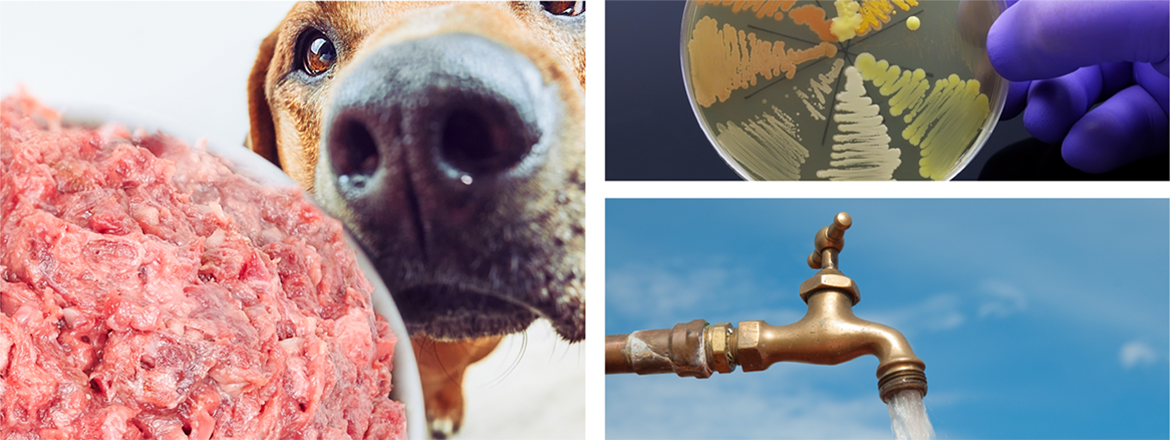
- Raw dog food as a vector for resistant pathogens
- Wildlife populations as both indicators and contributors to the spread of AMR across ecosystems
- Drinking water systems as reservoirs and transmission routes for antimicrobial resistance
Together, these examples demonstrate how AMR can be introduced, amplified, and transported across ecosystems, highlighting the importance of integrated, cross-sectoral approaches aligned with One Health principles. Such an approach facilitates the linkage of human, animal, and environmental data to support early detection of emerging threats and inform targeted intervention strategies to reduce the spread of AMR organisms.
Example 1: Raw dog food as a vector for resistant pathogens

Background: Over the past decade, raw meat-based diets for pets have increased in popularity.5,6 Many pet owners are drawn to these diets because of perceived health benefits, despite limited clinical evidence demonstrating positive outcomes.7,8 Documented concerns around raw meat-based diets include: 1) exposure to pathogens, 2) introduction and amplification of AMR organisms, and 3) a nutritionally unbalanced diet.5,7 There are various pathways by which AMR can transfer to meat either at the production site or along the food processing chain; however, pet food production is not as strictly regulated as food intended for human consumption.9
Studies have shown that raw meat-based diets for dogs are frequently contaminated with multidrug-resistant bacteria, including Escherichia coli, Salmonella, Camploybacter jejuni, and Enterococcus, with some strains resistant to critical antibiotics.10-12 Dogs fed raw meat-based diets are significantly more likely to shed resistant bacteria in their feces. These organisms can persist in household environments, contribute to environmental contamination, and be transmitted to humans through direct and indirect contact.13,14
One Health relevance: From a One Health perspective, the household practice of providing raw meat-based diets to pets represents a common interface between food systems, domestic animals, and human environments. People who feed their pets raw meat-based diets may not be aware of the possible human health risks within the household and how to mitigate them. Fecal shedding of resistant bacteria by pets can also introduce AMR organisms into soil, stormwater systems, parks, and recreational spaces, extending transmission pathways beyond the household into the environment. EPHPs can support reducing AMR risks through educating the pet food sector and pet owners on the importance of safe pet food handling and preparation, including hand hygiene, and the importance of immediate fecal cleanup to minimize risks. It is also important to remember that food products intended for pets do not go through the same food safety regulations as humans and can carry pathogens. Awareness of non-human exposure pathways for resistance bacteria can aid community-level exposure assessments and outbreak investigations.
Example 2: Wildlife populations as both indicators and contributors to the spread of AMR across ecosystems
Background: AMR has been detected in free-ranging wildlife with no direct exposure to antibiotics, a result of antimicrobials used in human medicine, veterinary care, and agriculture reaching the environment.15 A recent systematic review and meta-analysis found resistant E. coli, Salmonella, and Campylobacter across multiple wildlife species, including ungulates such as deer, elk, and moose.16 Wild birds (especially seagulls), wild boar, wild rodents, foxes, raccoons, and bats can also act as reservoirs contributing to AMR.17,18
The presence of AMR in wildlife reflects environmental contamination from human activities such as agricultural runoff, wastewater discharge, and inadequate waste management systems. Wildlife can acquire resistant bacteria through contact with contaminated water, soil, or food sources.16,19 They subsequently act as mobile reservoirs, redistributing AMR across ecosystems through physical movement, water, soil, and vectors such as arthropods.15 20
Despite growing evidence, data on AMR prevalence in wildlife remain limited and dependent on wildlife surveys as there is no systematic surveillance system to monitor AMR in wildlife populations.16 Further research is needed to better understand the role and magnitude of environmental reservoirs within the AMR cycle and the public health implications.20,21
One Health relevance: Human activities have led to an increased risk of AMR in wildlife populations.15 Wildlife now plays an important role in the AMR cycle and can serve as an important indicator of environmental contamination and identification of AMR hotspots.15,22 Many species can function as both sentinel animals (signaling the presence of resistant pathogens in the environment) and vectors that contribute to the spread of resistant pathogens. Patterns of AMR detected in wildlife may reflect underlying environmental contamination in water, soil, and food systems, while wildlife movement across landscapes can facilitate wider dissemination through fecal shedding.
EPHPs can help to reduce the risk of AMR by following a One Health approach when addressing public human and urban wildlife encounters (e.g., racoons, rats, seagulls). There may also be a role in advocating for wildlife surveillance, antimicrobial stewardship that reduces environmental loading of antimicrobials, and improving understanding of landscape features or urban environments that affect the likelihood of human and urban wildlife encounters.
Example 3: Drinking water systems as reservoirs and transmission routes for antimicrobial resistance

Background: Although most communities in Canada have access to safe drinking water, AMR has been documented in certain drinking water sources, treatment processes, and distribution systems.23 Further research is needed to understand the risks posed by AMR in drinking water systems. This is especially important for communities that have experienced long-standing inequities in access to safe drinking water, including some Indigenous communities.24-26 A study of cistern-stored drinking water in two First Nations communities in Manitoba identified elevated bacteria and the presence of antimicrobial resistant genes. The untreated source water did not contain the same bacteria or resistant genes, suggesting contamination originating within the treatment and/or distribution system. The presence of antimicrobial resistant genes may have been due to water stagnation and depleted chlorine residual in the cistern, or contamination entering the cistern from environmental sources, wildlife, or during maintenance or repair activities.26 The growth of biofilms in cisterns could exacerbate the problem by providing an environment conducive to microbial growth and persistence, leading to the accumulation and exchange of resistant genes.27 Other studies have identified AMR genes in treated drinking water systems and distribution systems.28,29 The presence of AMR pathogens or genes in drinking water is of concern as it can lead to infection with resistant pathogens and can increase the frequency and severity of waterborne outbreaks.30
One Health relevance: Drinking water systems sit at the intersection of environmental and public health. The presence of AMR genes in drinking water systems does not necessarily indicate immediate risk but acts as an indicator of potential AMR exposure pathways and reflects broader environmental contamination pressures from human activities such as agriculture, industry, wastewater, and severe weather events (e.g., heavy precipitation and flooding), and wildlife (see example 2). These risks may be amplified in some underserved and Indigenous communities that rely on cisterns and small or aging systems.24,26
A One Health approach emphasizes cross-sector collaboration, including meaningful partnerships with communities, and support for community and Indigenous-led water stewardship initiatives. For EPHPs, routine monitoring of water distribution systems for pathogens and resistant genes, particularly in underserved communities, can help identify emerging risks, inform infrastructure improvements, and strengthen risk communication, including maintenance and treatment strategies for drinking water systems.30 This example underscores the importance of integrated surveillance across human and ecological systems, recognizing that drinking water quality can be compromised by upstream contamination from land use, agricultural and human wastewater management, and environmental sources, and further compromised by downstream hazards in system operation and maintenance.
Lessons learned and One Health considerations
Together, these examples highlight that AMR is present in everyday environments and circulates continuously across human, animal, and ecological systems. Household practices, such as feeding raw meat-based diets to pets, can introduce multidrug-resistant organisms into domestic and community settings, increasing opportunities for human exposure through direct contact with contaminated surfaces, soil, and pet waste.10,13 The detection of AMR in wildlife, independent of direct antibiotic use, highlights broader environmental contamination driven by human activities, including wastewater discharge, agricultural runoff, and land use practices.16,19 Wildlife serves both as indicators of environmental contamination and as reservoirs capable of transporting resistant organisms across ecosystems. Drinking water systems, particularly in small or underserved communities, demonstrate how the built environment can function as both a reservoir and indicator of upstream environmental pressures related to land use, wastewater management, and environmental contamination.26-29
From a One Health perspective, these case studies demonstrate the need for an integrated One Health surveillance system that bridges veterinary health, environmental monitoring, and public health systems in Canada. Such a system would help to identify antimicrobial resistant hotspots, facilitating timely and coordinated actions. They also highlight important equity considerations, as underserved communities may face disproportionate exposure risks. For EPHPs, applying a One Health framework strengthens early identification of emerging AMR threats, supports coordinated risk communication, and enables cross-sectoral responses that recognize the shared environments and animal populations shaping AMR dynamics.
Implications for environmental public health professionals
AMR illustrates the interconnectedness of humans, animals, and the environment. Applying a One Health approach to addressing AMR enables EPHPS to anticipate risks, strengthen surveillance systems, and foster coordinated responses that protect people, animals, ecosystems, and livelihoods. In practice, addressing AMR through a One Health lens can vary and may include:
- Cross-sector collaboration: Build and sustain partnerships with veterinarians, agriculturalists, public health practitioners, Indigenous leaders, water operators, biologists, and other relevant sectors to address shared environmental risks.
- Surveillance and monitoring: Contribute environmental data to integrated surveillance systems to support early detection of resistance patterns, environmental contamination, and emerging exposure pathways.
- Public education and risk communication: Increase awareness of environmental AMR pathways, including raw meat-based pet diets, wildlife reservoirs, and drinking water systems, while promoting practical risk reduction strategies.
- Policy engagement: Inform and influence policies related to antimicrobial use, food safety, water quality, land use, and environmental protection at organizational, community, provincial/territorial, and national levels.
- Support community-led solutions: Engage meaningfully with Indigenous, rural, and underserved communities, recognizing the importance of local governance, traditional knowledge, and cultural approaches to environmental stewardship.
- Professional dialogue and capacity building: Promote ongoing discussion with environmental health professionals about strengthening cross-sectoral partnerships and embedding One Health principles into routine practice.
Together, these One Health actions position EPHPs as key contributors to a coordinated response to support AMR prevention and mitigation efforts across human, animal, and environmental systems.
Further resources
For more information please visit:
- Government of Canada: One health approach to risk assessment
- World Health Organization: One Health
- Pan-Canadian action plan on antimicrobial resistance
- Public Health Agency of Canada’s environmental surveillance strategic framework for antimicrobial resistance
Acknowledgements
Thank you to Dr. Juliette O’Keeffe, NCCEH, for her guidance and support in developing this evidence brief.
References
- World Health Organization. Antimicrobial resistance. Geneva, Switzerland: WHO; 2023. Available from: https://www.who.int/news-room/fact-sheets/detail/antimicrobial-resistance.
- Naghavi M, Vollset SE, Ikuta KS, Swetschinski LR, Gray AP, Wool EE, et al. Global burden of bacterial antimicrobial resistance 1990–2021: a systematic analysis with forecasts to 2050. Lancet. 2024;404(10459):1199-226. Available from: https://doi.org/10.1016/S0140-6736(24)01867-1.
- Public Health Agency of Canada. Pan-Canadian action plan on antimicrobial resistance. Ottawa, ON: Government of Canada; 2023. Available from: https://www.canada.ca/content/dam/phac-aspc/documents/services/publications/drugs-health-products/pan-canadian-action-plan-antimicrobial-resistance/pan-canadian-action-plan-antimicrobial-resistance.pdf.
- Winkler AS, Brux CM, Carabin H, Das Neves CG, Häsler B, Zinsstag J, et al. The Lancet One Health Commission: harnessing our interconnectedness for equitable, sustainable, and healthy socioecological systems. Lancet. 2025;406(10502):501-70. Available from: https://dx.doi.org/10.1016/S0140-6736(25)00627-0.
- Dodd S, Cave N, Abood S, Shoveller AK, Adolphe J, Verbrugghe A. An observational study of pet feeding practices and how these have changed between 2008 and 2018. Vet Rec. 2020;186(19):643-. Available from: https://doi.org/10.1136/vr.105828.
- Freeman LM, Chandler ML, Hamper BA, Weeth LP. Current knowledge about the risks and benefits of raw meat–based diets for dogs and cats. J Am Vet Med Assoc. 2013;243(11):1549-58. Available from: https://doi.org/10.2460/javma.243.11.1549.
- Canadian Veterinary Medical Association. Position statements. safety of raw meat-based pet food products. Ottawa, ON: CVMA; 2023. Available from: https://www.canadianveterinarians.net/policy-and-outreach/position-statements/statements/safety-of-raw-meat-based-pet-food-products/.
- Canadian Academy of Veterinary Dermatology, Canadian Academy of Veterinary Nutrition, Valentine B. Why is raw food so popular? Markham, ON: CAVD; 2022. Available from: https://www.cavd.ca/images/CAVD_CAVN_Raw_Food_QA.pdf.
- Canadian Food Inspection Agency. Regulatory oversight of pet food, treats and chews in Canada. Ottawa, ON: CFIA; 2022. Available from: https://inspection.canada.ca/en/animal-health/terrestrial-animals/exports/pet-food/pet-food-treats-and-chews.
- Ribeiro-Almeida M, Mourão J, Magalhães M, Freitas AR, Novais C, Peixe L, et al. Raw meat-based diet for pets: a neglected source of human exposure to Salmonella and pathogenic Escherichia coli clones carrying mcr, Portugal, September 2019 to January 2020. Euro Surveill. 2024;29(18). Available from: https://doi.org/10.2807/1560-7917.ES.2024.29.18.2300561.
- Francois Watkins LK, Laughlin ME, Joseph LA, Chen JC, Nichols M, Basler C, et al. Ongoing outbreak of extensively drug-resistant Campylobacter jejuni infections associated with US pet store puppies, 2016-2020. JAMA Netw Open. 2021;4(9):e2125203. Available from: https://doi.org/10.1001/jamanetworkopen.2021.25203.
- Antunes P. Raw meat based diets for pets are carrying multi-drug resistant pathogens. Cambridge, UK: Applied Microbiology International; 2024. Available from: https://appliedmicrobiology.org/resource/raw-meat-based-diets-for-pets-are-carrying-multi-drug-resistant-pathogens.html.
- Sealey JE, Hammond A, Reyher KK, Avison MB. One health transmission of fluoroquinolone-resistant Escherichia coli and risk factors for their excretion by dogs living in urban and nearby rural settings. One Health. 2023;17:100640. Available from: https://doi.org/10.1016/j.onehlt.2023.100640.
- Public Health Agency of Canada. Public health notice: outbreak of Salmonella infections linked to dog food and treats. Ottawa, ON: Government of Canada; 2026. Available from: https://www.canada.ca/en/public-health/services/public-health-notices/2025/outbreak-salmonella-infections-dog-food-treats.html.
- Vezeau N, Kahn L. Spread and mitigation of antimicrobial resistance at the wildlife-urban and wildlife-livestock interfaces. J Am Vet Med Assoc. 2024;262(6):741-7. Available from: https://doi.org/10.2460/javma.24.02.0123.
- Smoglica C, Carcagnì A, Angelucci S, Di Tana F, Marsilio F, López-Olvera JR, et al. Systematic review and meta-analysis of antimicrobial resistant bacteria in free-ranging wild mammals. BMC Vet Res. 2025;21(1). Available from: https://doi.org/10.1186/s12917-025-04548-8.
- Li X, Mowlaboccus S, Jackson B, Cai C, Coombs GW. Antimicrobial resistance among clinically significant bacteria in wildlife: an overlooked one health concern. Int J Antimicrob Agents. 2024;64(3):107251. Available from: https://doi.org/10.1016/j.ijantimicag.2024.107251.
- Jardine CM, Janecko N, Allan M, Boerlin P, Chalmers G, Kozak G, et al. Antimicrobial resistance in Escherichia coli iIsolates from raccoons (Procyon lotor) in Southern Ontario, Canada. Appl Environ Microbiol. 2012;78(11):3873-9. Available from: https://doi.org/10.1128/AEM.00705-12.
- Al-Khalaifah H, Rahman MH, Al-Surrayai T, Al-Dhumair A, Al-Hasan M. A One-Health perspective of antimicrobial resistance (AMR): human, animals and environmental health. Life. 2025;15(10):1598. Available from: https://doi.org/10.3390/life15101598.
- Canadian Wildlife Health Cooperative. Wildlife health notes. Is the lack of antimicrobial resistance (AMR) surveillance in wildlife a public health gap? Saskatoon, SK: CWHC; 2019. Available from: https://www.cwhc-rcsf.ca/docs/wildlife_health_notes/WHS%20-%20AMR%20surveillance.pdf.
- Benavides JA, Salgado-Caxito M, Torres C, Godreuil S, editors. Public health implications of antimicrobial resistance in wildlife at the One Health interface. The 2nd International One Health Conference; 2024; Barcelona, Spain: Med Sci Forum. Available from: https://doi.org/10.3390/msf2024025001.
- Höcketstaller K, Marti IA, Bank C, Yilmaz B, Becker J. Antimicrobial resistance in wildlife: associations with environmental factors and taxonomic variation. Environ Res. 2025;281:121968. Available from: https://doi.org/10.1016/j.envres.2025.121968.
- Hayward C, Ross KE, Brown MH, Bentham R, Hinds J, Whiley H. Drinking water plumbing systems are a hot spot for antimicrobial-resistant pathogens. J Hosp Infect. 2025;159:62-70. Available from: https://doi.org/10.1016/j.jhin.2025.02.018.
- Zambrano-Alvarado JI, Uyaguari-Diaz MI. Insights into water insecurity in Indigenous communities in Canada: assessing microbial risks and innovative solutions, a multifaceted review. PeerJ. 2024;12:e18277. Available from: https://doi.org/10.7717/peerj.18277.
- Fernando DM, Tun HM, Poole J, Patidar R, Li R, Mi R, et al. Detection of antibiotic resistance genes in source and drinking water samples from a First Nations community in Canada. Appl Environ Microbiol. 2016;82(15):4767-75. Available from: https://doi.org/10.1128/AEM.00798-16.
- Murdock A, Bashar S, White D, Uyaguari-Diaz M, Farenhorst A, Kumar A. Bacterial diversity and resistome analysis of drinking water stored in cisterns from two First Nations communities in Manitoba, Canada. Microbiol Spectr. 2024;12(3). Available from: https://doi.org/10.1128/spectrum.03141-23.
- Chen J, Li W, Zhang J, Qi W, Li Y, Chen S, et al. Prevalence of antibiotic resistance genes in drinking water and biofilms: the correlation with the microbial community and opportunistic pathogens. Chemosphere. 2020;259:127483. Available from: https://doi.org/10.1016/j.chemosphere.2020.127483.
- Federigi I, Bonetta S, Tesauro M, De Giglio O, Oliveri Conti G, Atomsa NT, et al. A systematic scoping review of antibiotic-resistance in drinking tap water. Environ Res. 2024;263:120075. Available from: https://doi.org/10.1016/j.envres.2024.120075.
- Tiwari A, Gomez-Alvarez V, Siponen S, Sarekoski A, Hokajärvi A-M, Kauppinen A, et al. Bacterial genes encoding resistance against antibiotics and metals in well-maintained drinking water distribution systems in Finland. Front Microbiol. 2022;12. Available from: https://doi.org/10.3389/fmicb.2021.803094.
- Sanganyado E, Gwenzi W. Antibiotic resistance in drinking water systems: occurrence, removal, and human health risks. Sci Total Environ. 2019;669:785-97. Available from: https://doi.org/10.1016/j.scitotenv.2019.03.162.
Citation
Related Resources
Understanding the role of environmental health in One Health using foodborne outbreak case studies
 view
view