

NCCEH Spotlight: Webinar recap of “Public health on the pitch - Radiation readiness for the FIFA World Cup”


Introduction
Low-level radiation exposures are part of everyday life, whether from naturally occurring background sources or some medical procedures (such as imaging, fluoroscopy, and nuclear medicine). While major radiological and nuclear incidents are rare, their consequences can be much more severe, impacting population health, and healthcare systems. They also differ from many other environmental health hazards in that their health effects may be delayed or non‑specific. Preparing for such events during high-profile mass gatherings, such as the FIFA World Cup, can ensure appropriate preparation and response. This can include managing public fear and misinformation, which can spread rapidly, placing additional pressure on frontline clinicians and public health agencies.
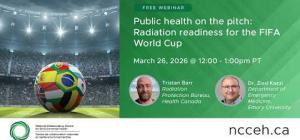
This NCCEH Spotlight provides a recap of the March 2026 webinar Public health on the pitch: Radiation readiness for the FIFA World Cup, and highlights additional issues related to radiation safety relevant to general practitioners, environmental health professionals, and others involved in emergency preparedness and response.
What is radiation?
Radiation is energy that travels as waves or streams of particles. It is generally categorized based on its frequency and energy as non‑ionizing and ionizing radiation. Nonionizing radiation is lower energy and includes radio waves, microwaves, ultraviolet (UV) rays, and visible light. Most forms do not damage biological tissue at common exposure levels; however, UV radiation can damage DNA and is a well-established cause of skin cancer.
Ionizing radiation, in contrast, is higher energy and can alter atoms and molecules, increasing the potential for biological harm. In healthcare settings, ionizing radiation is widely used for beneficial purposes, including X-rays, CT scans, nuclear medicine, and cancer treatment. When used appropriately, the diagnostic and therapeutic benefits of these technologies far outweigh their risks. However, radiological and nuclear emergencies that release uncontrolled sources of ionizing radiation are much more serious.
Everyday radiation exposures in Canada
Most people living in Canada are exposed to low levels of ionizing radiation daily through natural background sources. These include cosmic radiation from space, which people can be exposed to during air travel, naturally occurring radioactive materials in soil and rock, and radon gas, which can accumulate in buildings. Radon exposure represents one of the largest sources of natural radiation exposure, and reducing indoor radon levels remains an important public health priority.
Medical imaging is another source of radiation exposure for many people. Primary care providers routinely request diagnostic tests that involve ionizing radiation, guided by clinical guidelines designed to minimize risk while maximizing benefit.
Why radiation is different from other environmental hazards
Higher dose radiation exposure does not always cause immediate or obvious symptoms. Health effects may be delayed, non-specific, or not clinically apparent without specialized testing. As a result, radiation incidents can be difficult to recognize early, particularly in primary care or emergency settings.
Public perception also plays a critical role. Radiation is strongly associated with fear and uncertainty, and even the suggestion of exposure can lead to large numbers of people seeking medical assessment or taking precautionary measures, such as potassium iodide tablets, without medical advice. For healthcare providers and public health practitioners, radiation readiness therefore requires both clinical awareness and the ability to communicate risk clearly and calmly.
Lessons from Fukushima
The Fukushima Daiichi nuclear accident in 2011 is an important event for understanding approaches to assessing radiological risk and public health response. Although the accident resulted in significant releases of radioactive material in Japan, extensive international assessments have found no expected noticeable increases in cancer rates or hereditary disease attributable to radiation exposure for the general population, with the greatest health impacts linked instead to evacuation, displacement, and psychosocial stress.
In Canada, Health Canada’s radiation monitoring networks detected only very small, short-term increases in radionuclides, with resulting doses estimated at less than 1% of typical annual background radiation exposure and far below levels associated with health effects. No Fukushima‑related radioactivity was detected in samples of food baskets, milk, or fish, in British Columbia, the province nearest to the disaster, and imported foods were found to be well below international safety limits.
Lessons learned from the Fukushima incident underscore the importance of clear risk communication, intergovernmental coordination, and preparedness planning, which are particularly important for managing public concern when detectable radiation does not equate to meaningful health risk.
Mass gatherings and high impact risk
Mass gathering events, such as the FIFA World Cup, create a unique risk environment. Large, dense crowds, international travel, and intense media attention can magnify the consequences of rare emergencies. Even a low probability radiological incident during a major public event could quickly strain healthcare capacity, overwhelm laboratory services, and generate widespread public concern.
Planners and emergency management specialists do not expect such an incident to occur, but preparation is nevertheless important. Primary care and public health practitioners should also be prepared. This includes understanding basic radiation principles, knowing where to access trusted information, and being aware of how provincial and federal response systems would be activated in the event of an emergency.
Why this webinar matters
Against this backdrop, the NCCEH webinar Public health on the pitch: Radiation readiness for the FIFA World Cup explored how Canada prepares for radiological and nuclear emergencies, the role of public health and clinical professionals, and the national resources available to support response. As Canada prepares to host World Cup matches in two cities in 2026, these discussions are timely and directly relevant to practitioners across the country.
After this webinar, participants will be able to:
- Discuss public health considerations in radiological and nuclear scenarios.
- Describe clinical effects of radiation exposure.
- Identify key resources to support the medical response to a nuclear or radiological emergency in Canada.
Additional resources
- Introduction to radiation (Canadian Nuclear Safety Commission)
- Radon in British Columbia (BC Centre for Disease Control)
- BC. Nuclear Emergency Plan (BCNEP) (Government of British Columbia)
- How Canada prepares for radiological and nuclear emergencies (Health Canada)
- Fukushima and health (Canadian Nuclear Safety Commission)
- PHAC Training Portal – METER courses (Public Health Agency of Canada)
About the Author
Dr. Kevin Donak is a resident physician in Public Health and Preventive Medicine (PHPM) at the University of British Columbia (UBC), currently working with Environmental Health Services at the British Columbia Centre for Disease Control (BCCDC). Prior to joining the UBC PHPM Program, he served in the Canadian Armed Forces (CAF) for 14 years, initially as an army officer and later as a family physician, with professional interests in occupational health, environmental health, and emergency preparedness.