

Raising radon awareness and taking action

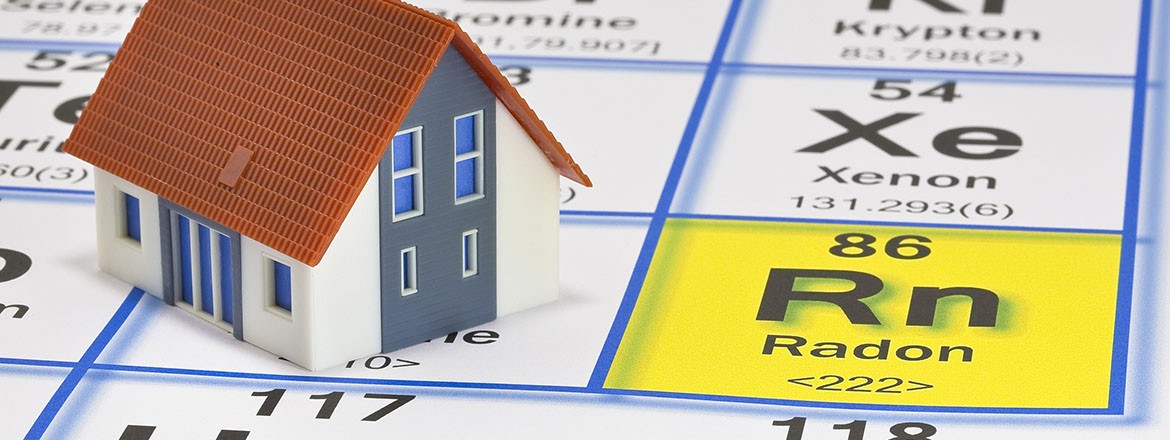
November is Radon Action Month - a time to raise awareness of the leading cause of lung cancer among non-smokers in Canada. Lung cancer caused by radon is preventable, and understanding the risks is a first step to reducing harms. This blog highlights key information and resources that can help environmental health practitioners communicate radon risks and promote equitable access to testing.
What is radon?
Radon is a colourless, odourless gas produced by the radioactive decay of uranium in the ground. As radon breaks down it forms radioactive particles that can be inhaled, causing damage to lung cells that can lead to lung cancer.
Radon can enter buildings through cracks in floors, foundations, construction joints, service pipes, or floor drains. Basements and crawl spaces typically have higher levels due to their proximity to the ground and limited ventilation; however, ground floor rooms, utility spaces, and attached garages can also accumulate radon. Long-term exposure to radon increases the risk of developing lung cancer – but it is a modifiable risk factor.
Understanding exposure to radon
Health Canada’s radon guideline recommends that homes with average annual radon levels above 200 Bq/m3 in the main occupied area should take corrective actions to reduce radon; however, many people are unaware that they are being exposed:
- 1 in 5 people in Canada live in buildings at or above 200 Bq/m3 (2024 survey)
- Only 58% of households in Canada have heard of radon (2023 survey)
- Of those aware of radon, 20% did not know it is a health hazard (2023 survey)
Testing for radon is the only way to assess radon exposure risk. This is especially important in homes, workplaces, schools, and other buildings where people spend several hours each day. Interactive maps from the BC Centre for Disease Control (limited to BC), and Canada-wide maps can provide an indication of areas at higher risk, but they cannot replace radon testing.
Testing involves placing a radon monitor in the basement or lower level room for at least seven days. Both battery-operated and plug-in versions monitors are available, but only devices certified by the Canadian National Radon Proficiency Program should be used. In May 2025, Health Canada recalled several radon detectors due to inaccurate radon detection, highlighting the importance of using approved devices.
Partnerships and equitable access to radon testing
For those unable to purchase their own monitor, many public libraries offer radon screening kits as free loanable items. Screening kits include a monitor, instructions, and additional educational information on radon. New lending initiatives in 2025 include the Manitoba Lung Association partnering with Winnipeg Public Libraries, and a new lending program through Yukon public libraries, adding to the growing number of library lending programs for radon monitors across Canada. The Government of New Brunswick is also now making 90-day test kits available for free province-wide through New Brunswick public libraries.
Other partnerships are amplifying radon awareness. In BC, the BC Real Estate Association has partnered with the BC Lung Foundation and Real Estate Foundation of BC to use roadside billboards, radio, TV, and social media ads to encourage radon testing.
Across Canada, municipalities are also getting involved through Take Action on Radon’s 100 Radon Test Kit Challenge, which provides municipalities or public health agencies with 100 free test kits to distribute to community members. In 2025, Grand Bay-Westfield in New Brunswick was one of over 160 communities to take part in this initiative, where 28 of 100 participating households were found to have radon levels exceeding Health Canada’s guideline of 200 Bq/m3.
Mitigating radon and building code updates
For existing buildings with elevated radon levels, various radon mitigation options are available such as active soil depressurization (ASD), which is preferred, or ventilation methods when ASD is not feasible. A new resource from the BC Institute of Technology (BCIT) published in November 2025 aims to raise awareness among the building profession about radon risks, prevention, and mitigations, including in energy efficient buildings.
For newer buildings, building codes can help to ensure newly constructed buildings minimize radon entry and enable its removal after construction. In 2024, BC updated the Building Code to remove geographic exemptions for certain radon control measures.
Radon mitigation comes at a cost, but partial funding is available from some non-profit organizations such as the Canadian Lung Association and home warranties in some provinces may cover radon mitigation costs.
Lung health screening pilot for people with elevated radon levels
The BC Cancer Agency is currently running a Low-Dose CT (LDCT) screening trial for non-smoking people who live in homes with 800 Bq/m3 of radon or higher. Many provinces provide LDCT screening for smokers, but this program is the first of its kind to explore the use of LDCT for non-smokers with exposure to known environmental lung carcinogens such as radon. Early detection remains a key part of improved outcomes for people living with lung cancer. More information can be found by contacting the project coordinator at [email protected]
Taking action on radon
Environmental health practitioners can take action on radon by raising awareness, promoting library lending initiatives, encouraging municipal participation in testing programs, and sharing key sources of information and tools. For more information see the resources below:
- Take action on radon (A national awareness raising initiative, funded by Health Canada)
- Radon action guide for provinces and territories (Health Canada)
- Radon action guide for municipalities: Building codes, bylaws and provisions (Health Canada)
- Guide for radon measurements in homes (Health Canada)
- Radon resources for homeowners (Canadian National Radon Proficiency Program)
- Radon profile (Carex Canada)
- Information for tenants and landlords (CARST)
- An integrated design approach to radon prevention and mitigation in energy efficient buildings (BCIT)
- Current radon projects (BC Lung Foundation)
From the NCCEH:
- How public health professionals can help reduce radon risk in Canada (Webinar recording, 2024)
- Where the public meets health: Libraries as key partners for advancing public health goals (Blog, 2023)
- Climate change in the Arctic and radon gas: A rising threat from the ground up (Blog, 2022)
- The British Columbia Radon Data Repository – What is it and how can we use it? (Webinar recording, 2021)
- NCCEH Subject guide on radon
Citation
Related Resources
Unmasking the evidence for reducing harms from wildfire smoke: The role of air cleaners and masks
 view
view
Use of low-cost air quality sensors in childcare and long-term care facilities in BC and impacts of wildfire smoke on indoor air quality
 view
view
Do-it-yourself (DIY) air cleaners: Evidence on effectiveness and considerations for safe operation
 view
view