

NCCEH Spotlight: Cold weather health impacts among people experiencing homelessness

Health impacts of cold exposure among people experiencing homelessness: A narrative systematic review on risks and risk-reduction approaches (Akhanemhe, Petrokofsky and Ismail, 2025)
Researchers from the United Kingdom Health Security Agency (UK HSA) recently published a narrative systematic review on exposure to cold weather and health risks among people experiencing homelessness (PEH) in high income countries. This is the first systematic review to assess the association between cold weather exposure and health outcomes in PEH, and the literature on interventions to reduce these risks. This NCCEH Spotlight presents the highlights of the review.
Introduction
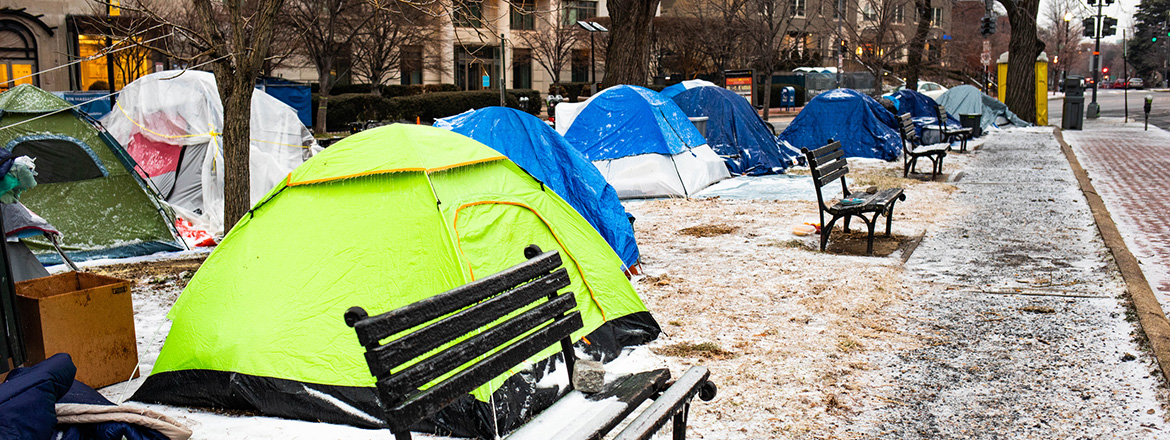
In late fall and winter in Canada, PEH, especially those sleeping rough, face prolonged exposure to cold due to inadequate shelter, increasing their risk of hypothermia and death. Higher rates of chronic diseases, infectious diseases, substance use, and mental health conditions among PEH compared with the general population further reduces their resilience to cold weather.
There is a poor understanding of the full scope of cold exposure health impacts on PEH, the conditions that increase these risks, and effectiveness of available interventions. This systematic review of the literature aimed to assess whether cold exposure increases mortality and morbidity among PEH in high-income settings, and to evaluate interventions to reduce these risks.
Research question and approach
Two main research questions informed the review:
- Does exposure to cold weather significantly increase the risk of cold-related mortality and morbidity among PEH in high income countries?
- What services, programmes and policy interventions have been used to reduce risks from cold exposure among PEH, and how well do they work?
The review identified 24 studies, 19 of which were peer-reviewed articles published between 1983 and 2024, mostly from Canada (4 studies), the United Kingdom (5 studies) and the United States (8 studies), with seven cross-sectional studies, five cohort studies, a case control study, a case cross-over study, three qualitative studies, six mixed methods, and a mixed cohort and cross-sectional approach study. Quality appraisal was conducted using Joanna Briggs Institute critical appraisal tools.
The studies defined PEH differently, varying from unsheltered individuals to those in temporary shelters. Cold exposure measures ranged from ‘extreme cold’ to specific temperature thresholds or related factors such as wind or precipitation. Primary outcomes were mortality and morbidity among PEH, while secondary outcomes included health service use such as emergency department (ED) visits, hospital admissions, and primary care access.
Primary findings
Thirteen studies identified in the review reported cold exposure mortality and morbidity outcomes among PEH.
Mortality
Five studies reported that PEH were at increased risk of mortality due to hypothermia. Evidence from Tokyo (1974-1983), New York City (2005-2014), and France (2008-2010) indicates that PEH account for most outdoor hypothermia deaths in some settings and have mortality risks several times higher than the general population. A retrospective analysis from northern Poland (2010-2016) found that all-cause mortality among emergency shelter users was over three times higher during cold weather periods, while a retrospective analysis from Toronto (2004-2015) reported that the odds of hypothermic injury or death among PEH increased 1.6-fold for every 5 °C drop in minimum temperature below 0 °C.
Morbidity
Six studies quantified cold-exposure-associated morbidity among PEH, with a focus on mental health outcomes. Due to limited evidence, the authors could not draw firm conclusions across the studies. One cohort study from Toronto (2004–2009) found male PEH had higher ED attendance for cold-related injuries than low-income men (6.7 versus 0 per 1000 per years), though overall admissions were low.
Secondary findings
Health service utilization
Six studies presented evidence on health service utilization, reporting that cold exposure among PEH was linked to elevated levels of service utilization such as ED admissions and rates of interventions such as surgeries, mostly due to hypothermic injury. One study from Ontario (2018-2023) reported an increase in ‘non-urgent’ ED attendance over time among PEH. The risk ratio comparing the baseline season and the most recent winter was 1.24, (95% CI: 1.14–1.34), indicating increased use of healthcare facilities as temporary shelter during cold weather.
Interventions
Seven studies identified by the review reported on interventions to reduce health risks from cold exposure among PEH. The interventions identified had multiple components, and all but one included prompt access to shelter as a central feature. Provision of shelter strategies included emergency shelter use activation, pop-up shelters, access to warm spaces, and funding for private sector housing. Program interventions also included risk identification, transportation assistance, hypothermic alerts, harm-reduction based support, expansion of outreach services, and changes to discharge planning from hospitals. The effectiveness of an intervention program was only evaluated in one study from Boston that reported a slight decline in deaths among PEH (2000-03), following a multi-component intervention, though no statistical analysis was conducted.
Evidence gaps
The authors of this systematic review concluded the following:
- There is urgent need for high-quality evidence on the health risks of cold weather conditions for people experiencing different types of homelessness, especially for those sleeping rough.
- Longitudinal research is needed to determine what kinds of support can reduce mortality and morbidity risks among PEH.
- Consistent definitions are needed for what constitutes cold weather exposure, based on recognized standards.
Implications for EPH practice
Evidence from this systematic review highlights the severity of mortality and hypothermic injury risks that PEH face during cold weather, particularly those sleeping rough. Environmental health professionals can incorporate this evidence into their cold weather planning, using it to evaluate how to address gaps through programmatic research and improve advice on when cold-weather shelters should be activated. Further research is needed to investigate cold exposure related mortality and morbidity outcomes for PEH, considering the different definitions of homelessness and cold weather condition classifications (e.g., temperature, precipitation). Further, well planned research should explore what interventions can help to reduce these health impacts of cold exposure.
Additional resources:
- Extreme cold (NCCEH Subject guide, 2025)
- Weather impact guides (Environment and Natural Resources Canada, 2025)
- Extreme cold (Government of Canada, 2025)
- Warming centre guidance(Massachusetts Department of Public Health, Bureau of Climate and Environmental Health, 2024)
- Quebec’s health alert system for cold weather events (NCCEH Webinar, 2024)
- Public health recommendations to reduce the impacts of exposure to winter weather on people experiencing homelessness in British Columbia(BCCDC, 2023)
- Mobilizing extreme cold response plans for people experiencing homelessness (NCCEH Evidence brief, 2022)
AI statement
AI tools were not used in the writing of this document.