

Norovirus

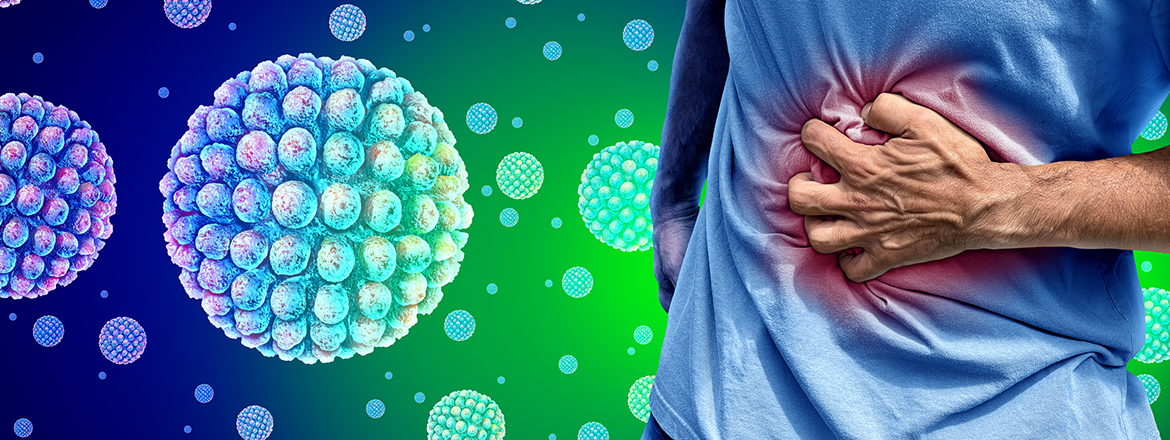
Noroviruses are a group of highly contagious viruses that cause short-term gastroenteritis symptoms including rapid onset of nausea, vomiting, diarrhoea, and potentially chills and fever. Norovirus is primarily spread by fecal-oral or vomit-oral routes through direct person-to-person contact, foodborne, waterborne, or environmental fomite pathways. Exposure to fewer than 10 viral genome equivalents can cause illness. There are many genotypes of norovirus; thus, norovirus illness can occur more than once in the same individual. While GI, GII, and GIV are the only genogroups known to infect humans, GII is the most prevalent genotype circulating in human populations. Infections are more common in winter as colder temperatures favour virus survival. Although symptoms typically resolve in 1-2 days, dehydration can be a serious side-effect, especially for young children, the elderly, pregnant women, and those with compromised immune systems. Good hand hygiene that includes proper hand washing with soap and water is key to preventing norovirus spread. Hand sanitizers alone do not work well against norovirus.
Norovirus outbreaks are typically associated with long-term care facilities, daycares, cruise ships, or other public places where people are in close proximity to one another. Norovirus is the leading cause of acute gastroenteritis across all ages. Norovirus infection was added to Canada’s notifiable disease list in 2007. In 2023 the infection rate was reported as 11.55 per 100,000 population. Changing climates may further exacerbate norovirus transmission and increate illness burden.
The resources listed here are intended to:
- Improve fundamental understanding of norovirus etiology and epidemiology
- Provide guidance on reducing norovirus transmission and managing outbreaks
- Discuss potential climate-driven impacts on norovirus transmission and seasonality.
Understanding norovirus transmission
- Norovirus (US Centers for Disease Control, 2024)
This website provides detailed information on norovirus and symptoms, transmission routes, and infection prevention. It includes easy-to-understand visuals and links to related topics such as treatment, outbreaks, and hand hygiene practices.
- Norovirus (Capece and Tobin, 2023)
This article provides a comprehensive overview of norovirus infection, and discusses norovirus clinical significance, transmission, and management within a healthcare context.
- Norovirus disease debrief (National Collaborating Centre for Infectious Disease, 2023)
This disease debrief provides a summary of essential information about norovirus gathered from key public agencies and academic literature.
- Pathogen safety data sheets: Infectious substances – Norovirus (Public Health Agency of Canada, 2017)
This website outlines the virus's high infectivity, transmission routes (mainly fecal-oral), symptoms (acute gastroenteritis), environmental stability, and safety protocols for laboratory handling. It emphasizes the need for strict hygiene, proper disinfection, and isolation to prevent outbreaks.
- Literature review of environmental factors and major sources of sewage affecting norovirus (Miller et al., 2017)
This report reviews evidence on how norovirus enters and persists in the environment, especially through sewage, and its impact on coastal waters and shellfish safety. It highlights the high prevalence of norovirus in both treated and untreated wastewater and the risks this poses for public health. The report underscores the need for improved monitoring and treatment to reduce environmental transmission.
- Norovirus/Norwalk-like virus(British Columbia Centre for Disease Control, 2012)
This web page provides information for health professionals on case definition, symptoms, causes, complications, tests and diagnoses, treatment and drugs, and prevention of norovirus.
- Norovirus & marine water contamination (British Columbia Centre for Disease Control)
This webpage links to findings from a working group investigating norovirus illnesses from raw oyster consumption, including environmental transmission, sources of contamination, outbreak investigations, and prevention of marine sewage pollution.
Preventing Norovirus transmission and outbreaks
- Recommendations for outbreak prevention and control in institutions and congregate living settings (Ontario Ministry of Health, 2025)
This guidance document provides detailed protocols for outbreak identification and management in long-term care and institutional settings and emphasizes preventive measures such as hand hygiene and respiratory etiquette. It also discusses strengthening control action including restricting visitors, enhancing cleaning, active surveillance, and coordination with public health authorities.
- Norovirus prevention and control guidelines for healthcare settings (US Centers for Disease Control, 2024)
This document outlines comprehensive infection control practices to manage norovirus outbreaks in healthcare settings. It also provides recommendations for isolation procedures, staff protocols, visitor restrictions, and outbreak containment strategies.
- Norovirus fact sheet for food workers (US Centers for Disease Control, 2024)
This fact sheet describes the potential for norovirus transmission via contaminated food and provides tips on how to prevent norovirus infection, including staying home when sick, proper hand washing with soap and water, proper food preparation, and adequate cleaning and disinfection of contaminated surfaces.
- Assessment of the impact on human health of the presence of norovirus in bivalve molluscs: what data do we miss? (Savini et al., 2021)
This report describes several methods that may be used to reduce norovirus and other pathogen levels in shellfish, including depuration, relaying, non-thermal treatments, and heat treatment. It also emphasizes critical data gaps in viral detection, consumption behavior, and quantitative risk assessment needed to strengthen food safety.
- Meta-analysis of the reduction of norovirus and male-specific coliphage concentrations in wastewater treatment plants(Pouillot et al., 2015)
This meta-analysis examines how male-specific coliphage (MSC) concentrations, an indicator of fecal contamination in water and thus of norovirus, are reduced after different water treatments, providing insight into best practices for wastewater treatment plant operators under certain conditions to help reduce norovirus in effluent.
- Infection control for norovirus (Barclay et al., 2014)
This peer-reviewed article reviews norovirus’s epidemiology, virology, and the challenges it poses due to its high infectivity, environmental resilience, and low infectious dose. It emphasizes effective outbreak management strategies in healthcare, including stringent hygiene measures such as handwashing, thorough environmental decontamination, and isolation, while also highlighting ongoing research into disinfectant strategies, surrogate viral models, and future vaccine development.
- Prevention of norovirus infection in schools and childcare facilities (European Centre for Disease Prevention and Control, 2013)
This technical report consolidates international guidelines to offer practical, expert-backed advice on stopping gastroenteritis outbreaks among children. It covers four key phases: primary prevention, immediate outbreak response, infection control, and post-outbreak recovery, including staff training and remediation planning.
Climate-driven influences on norovirus epidemiology
- Environmental indicators for human norovirus outbreaks (Chenar and Deng, 2016)
This literature review describes the environmental factors that influence norovirus transmission and outbreaks. Results of the literature review show that temperature, humidity, and rainfall are the most important environmental variables governing the norovirus epidemic cycle.
- A systematic review and meta-analysis of the global seasonality of norovirus (Ahmed et al., 2013)
This systematic review highlights the distinct but variable global seasonality of norovirus, with a peak in winter months, possibly associated with average rainfall in the wettest month.
- Climate change impact assessment of food- and waterborne diseases (Semenza et al., 2011)
This review examined how climate variables such as humidity, precipitation, ultraviolet light, salinity, as well as extreme weather events such as droughts and floods impact pathogens including Campylobacter, Cryptosporidiumsp., Listeria sp., Norovirus, Salmonella sp., and noncholera Vibrio sp.
Inclusion of external resources in NCCEH Subject Guides is for information only and does not constitute an endorsement of the organization, author, or content. This list is not intended to be exhaustive. Omission of a resource does not preclude it from having value.
Related Resources


Using advanced surveillance tools to understand norovirus evolution, public health impacts, and to enhance outbreak response
 view
view