

Small drinking water systems and private wells

The definition and regulatory oversight of small drinking water systems (SDWS) across Canada varies by provincial and federal jurisdictions. A small system may be defined by size, or by who owns and operates the system (e.g., municipal or private), or by the type of population it serves (e.g., public, seasonal, residential). Most small systems serve less than 500 people, and many have fewer than 15 connections. Many are also considered private or non-municipal supplies (NMS).
About 11% of Canadian dwellings are supplied by an NMS. Some obtain their water from wells, accessing groundwater from confined aquifers, or groundwater under the direct influence of surface water (GUDI), and others may also use a surface water source, especially in the Canadian Arctic. These can include truck to cistern systems that are supplied by a SDWS. Treated water is delivered by truck to properties that are not connected to a piped water supply and deposited into a cistern or storage tank.
Many SDWS are in rural and remote locations and small communities where there are operational, technical, and financial challenges that reduce the capacity to identify and remedy water quality issues quickly. These challenges can increase the risk that users of SDWS and NMS are exposed to microbiological or chemical contaminants during routine operation or following emergencies like fires, floods, or power outages. Water quality can be affected by diffuse or point source pollution in the source water, by damage or direct contamination of wells, or if there is inadequate treatment or failure to maintain quality in distribution or storage systems. In 2023, the majority of boil water advisories in Canada (89%) were for SDWS serving 500 people or less. The causes of boil water advisories in 2023 were mostly related to equipment and process failures (87%), such as broken water mains, system maintenance, power failures or equipment problems. The remaining advisories were due to the detection of microbiological contamination in water.
The resources listed here are intended to assist environmental public health professionals and those responsible for managing SDWS and NMS to:
- Understand key water quality parameters and factors affecting drinking water safety in small systems and wells
- Identify key resources for managing the operational aspects of drinking water safety in SDWS and NMS
- Understand the potential risks to SDWS and NMS during emergencies and actions to restore safe water supplies
Drinking water quality in small systems
These resources aim to improve understanding of the parameters that are used to assess quality of drinking water in SDWS and NMS and the common sources of contamination.
- Potential well water contaminants and their impacts (US EPA, 2025)
This webpage provides information on the natural and human-caused sources of microbiological and chemical contaminants in wells and their possible health impacts.
- Drinking water guidelines and governance (NCCEH, 2025)
This NCCEH subject guide provides an overview of guidelines and governance of drinking water at the federal, provincial and territorial levels and literature on approaches to Indigenous-led and collaborative water governance in Canada.
- Guidelines for Canadian drinking water quality - summary tables (Health Canada, 2025)
This webpage provides a summary of the guidelines for Canadian drinking water based on current evidence on health, aesthetic, and operational impacts of water contaminants.
- Boil water advisories (Environment and Climate Change Canada, 2025)
This webpage provides an overview of the number and primary cause of boil water advisories across Canada from 2010-2023, and the size of communities affected.
- Drinking water treatability database (US EPA, 2025)
This tool provides users a searchable database of water contaminants with information on regulation, properties, fate, and transport plus best available technologies for treatment.
- Drinking water interpretation tool (Nova Scotia Environment, n.d.)
This interactive tool allows users to enter water test results and compare these against Canadian drinking water quality guidelines. Further information on contaminants is provided through The Drop on Water fact sheet series.
- Private wells and rural health: groundwater contaminants of emerging concern (Lee et al., 2020)
This review article presents an overview of contaminants of public health concern in well water in rural North America including nitrates, metals, microbiological, and emerging organic contaminants.
- A systematic review of waterborne disease outbreaks associated with small non-community drinking water systems in Canada and the United States (Pons et al., 2015)
This systematic review reports on the primary causes of waterborne outbreaks in SDWS and identifies seasonal trends.
Managing small drinking water systems
These resources focus on the operational aspects of managing drinking water safety in SDWS and NMS including risk assessment approaches, sampling, testing, and governance structures.
- British Columbia Small Water Systems Online Help Centre (Thomson Rivers University, 2025)
This website provides information on webinars and courses, guidelines, templates and other resources focused on supporting small water system operators in BC.
- Saskatchewan guide to private well and water management (Water Security Agency, 2025)
This guidance document provides advice for private well water users in rural communities, SDWS operators, community well users, and First Nations communities on management of private wells and source water for the purpose of protecting human health and agriculture.
- Safety of non-municipal drinking water (Office of the Auditor General of Ontario, 2025)
This report provides findings of a performance audit of Ontario’s NMS. While Ontario-specific, many key findings related to oversight, testing, and supports for safe operation of NMS can apply across other jurisdictions.
- Small drinking water systems webinar series (US EPA, 2025)
This website provides access to US EPA webinar recordings (2022-2025) on areas of emerging contaminants, treatment and disinfection technologies, and tools for managing small water systems.
- Directory of laboratories (Canadian Association for Laboratory Accreditation (CALA) Inc., 2025)
This directory provides a listing of laboratories accredited by CALA to perform water testing, searchable by location and the chemical or microbiological parameter of interest.
- Private drinking water and public health (US Centers for Disease Control, 2024)
This web collection provides key information on drinking water contaminants in private water supplies, plus a collection of tools for testing and managing private water supplies.
- Small water system guidebook (BC Ministry of Health, 2024)
This guidance document provides information for owners and operators of SDWS on understanding the makeup of a SDWS, their responsibilities and how to assess and minimize health risks.
- Water storage and emerging challenges in a changing climate (O’Keeffe, 2024)
This NCCEH evidence review reviews the factors affecting water quality in storage tanks and cisterns, and the effects of climate change on maintaining safe stored water.
- Public health guidelines for non-municipal drinking water (Alberta Health Services, 2021)
This guidance document provides an overview of best practices for managing non-municipal water systems including source water protection, safe transport and storage of drinking water, treatment approaches, monitoring and maintenance.
- The development of a sustainable operation model for small non-community drinking water systems in Ontario, Canada (Sekercioglu et al., 2019)
This article examines management strategies and barriers to providing safe drinking water in SDWS, and alternative operational models based on a multi-barrier approach.
- Small drinking water systems risk assessment guideline (Ontario MOHLTC, 2018)
This guidance document provides advice to public health inspectors on risk assessment of SDWS, and recommendations for owners and operators, from water testing to treatment and training.
- Small drinking water systems operator’s guide (Southwest Small Drinking Water Systems Working Group, 2018)
This guidance document provides an overview of the roles and responsibilities of public health units and owners and/or operators of SDWS in Ontario.
- Small systems, big challenges: review of small drinking water system governance (McFarlane and Harris, 2018)
This review identifies challenges to improving drinking water quality in SDWS, with a focus beyond technical and operational challenges to governance issues of key importance.
Responding to emergencies
Flooding, wildfires, power outages, or other unplanned events can have an adverse impact on source water, water treatment, storage, and distribution. These resources aim to improve understanding of potential risks to SDWS and NMS during emergencies and actions to restore safe water supplies.
- Well water and health: Overview (Health Canada, 2024)
This webpage provides guidance on measures private well owners can take to protect well water from pathogens and chemicals and ensure well water is safe during and after emergencies.
- Well disinfection resources (multiple agencies)
- Disinfecting drinking water (HealthLink BC, 2025)
- Disinfecting your well (Government of PEI, 2023)
- Shock chlorinating your well (Alberta Government, 2022)
- Well disinfection tool (Public Health Ontario, 2019)
- Disinfecting your well (Northern Health, 2014)
- Private wells after a wildfire (US Centers for Disease Control, 2024)
This website provides information on how to manage power loss, pressure loss, damage and contamination of a well following a wildfire, including tips for flushing and testing.
- Wildfire: Its effects on drinking water quality (HealthLink BC, 2024)
This factsheet provides advice on identifying the signs that a water supply may have been impacted by fire, and advice on what to do if contamination is suspected.
- Wildfire damage and contamination to private drinking water wells (Jankowski et al., 2023)
This journal article provides one of the few post-wildfire studies of well-water quality for inorganic and organic contaminants, including volatile/semi-volatile organic compounds.
- Assessing the damage to private wells after a fire (Boulder County Public Health, 2022)
This decision support tool is designed to help well uses on properties damaged by fire, or where a fire came within 100 ft to assess damage and identify recommended actions.
- After a wildfire: Water safety considerations for private wells (Purdue University, 2021)
This guidance document explains the type of damage and contamination of wells that can be caused by a wildfire, and recommendations for inspection and testing.
- Returning to your home after wildfires (First Nations Health Authority, n.d.)
This fact sheet provides health and safety considerations for returning home after a wildfire including measures to ensure safe drinking water for residents on a SDWS or private well.
- Emergency response and contingency planning for small water systems (BC Ministry of Health, 2016)
This guidance document, designed for operators of SDWS, advises on developing an emergency response and contingency plan for drinking water impacted by emergencies.
- Guidance for issuing and rescinding boil water advisories in Canadian drinking water supplies (Health Canada, 2015)
This guidance document summarizes the factors to consider before issuing or rescinding boil water advisories and guidance for decision makers and those impacted by advisories.
- Emergency response plan for drinking water systems in First Nations communities (ISC, 2014)
This guidance document and templates provide information on developing a community-based emergency response plan for water systems to identify system vulnerabilities, make improvements and set procedures for responding during an emergency.
Inclusion of external resources in NCCEH Subject Guides is for information only and does not constitute an endorsement of the organization, author, or content. This list is not intended to be exhaustive. Omission of a resource does not preclude it from having value.
Related Resources
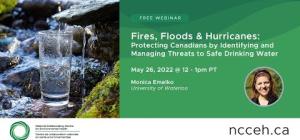
Fires, floods & hurricanes: Protecting Canadians by identifying and managing threats to safe drinking water
 view
view