


Practical guidance for post wildfire cleanup

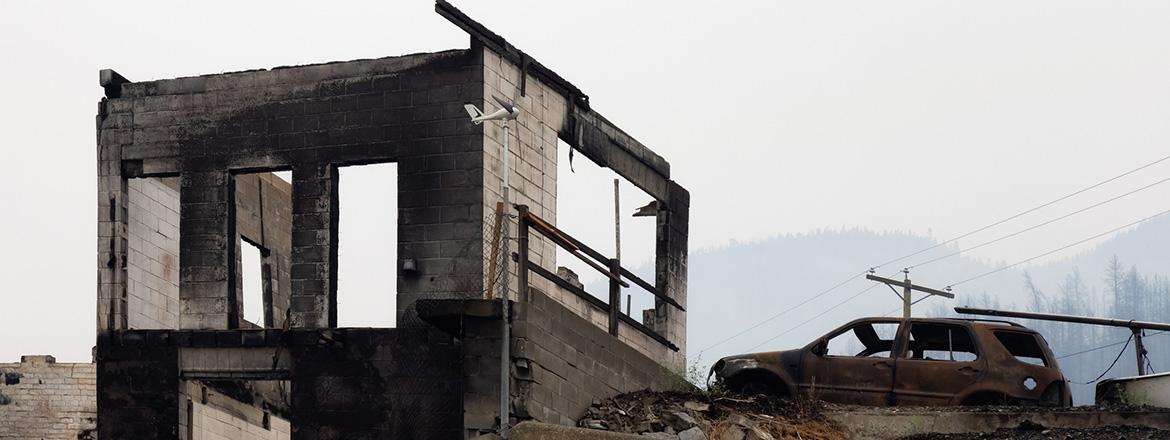
Catastrophic wildfires have had devastating impacts on many Canadian communities over the past decade from Fort McMurray AB in 2016, to Lytton BC in 2021, to Jasper AB in 2024, and many others. As climate change drives hotter and drier summers, more frequent and intense wildfires are expected in the future.
After a fire, affected community members have many questions about how to return home safely. Homes, businesses, schools, long-term care facilities, and public buildings may have been directly affected by fire damage or deposition of ash, smoke, and debris in and around buildings. Electrical hazards may be present in these damaged structures. Temporary power outages may have caused food in fridges and freezers to spoil, and damaged water or sanitation infrastructure may have impaired access to clean drinking water, handwashing, or sewage services. Other potential hazards could include chemical hazards from smoke, chemical spills, oil or gas leaks, or hazardous materials such as asbestos. Many people may also be experiencing psychological distress due to evacuation and personal losses.
To reduce exposure to post-fire hazards, residents and business owners returning to their community should follow advice from fire officials and emergency personnel on when it is safe to return, and advice from public health on how to safely return. Building interior, exterior, and grounds may need cleanup and rehabilitation to remove toxic materials, water systems may require testing and repairs, and advice from experts or trained professionals may be needed to identify what can be safely cleaned and re-used. Recovery can be a long process, both for individuals and for the community.
The resources listed here are intended to assist environmental public health professionals in advising on post-wildfire re-entry and cleanup. These resources identify:
- The types of hazards that may be encountered on returning to a community
- Guidance on how to clean up safely for different settings
- Additional resources to assist post-wildfire recovery
Understanding the hazards after a fire
- Safety guidelines: After a wildfire (US CDC, Apr 2024)
This website provides practical advice for the public on reducing exposure to ash on returning home following a wildfire and other tips for avoiding hazards.
- Post-wildfire hazardous materials guidance for local authorities and First Nations and BC guidance for owners of property impacted by wildfire contaminants (BC Ministry of Env. and Climate Change Strategy, 2023)
These guidance documents provide advice on identifying the environmental health risks associated with wildland-urban interface fires and considerations for community re-entry after a fire. This includes advice on identifying hazards and reducing exposures to contaminants.
- Aerial fire retardants and return to your home following a wildfire evacuation (Alberta Health Services, 2023)
This FAQ document on aerial fire retardants provides information on the composition, health risks, first aid measures, and how to remove them safely.
- Wildfire cleanup: Considerations for California’s public health officials (California Dept of Public Health, 2019)
This resource for public health officials provides an overview of the health hazards associated with post-wildfire debris including asbestos, household hazardous waste, and other pollutants.
- Hazards during wildland fire cleanup (US CDC 2024)
This webpage discusses some of the health and safety hazards that homeowners and workers may encounter after a wildfire to assist preparation for cleanup and recovery activities.
- Health effects from home and building ash (California CUPA, 2018)
This template document provides an example of how to communicate about the health hazards of ash exposure after a structure fire.
Cleaning up after a fire: Guidance
- Reopening buildings, homes, and businesses after a wildfire (Alberta Health Services, 2024)
This guidance document provides general information on reopening buildings and homes, and includes some specific information for food establishments, childcare facilities and schools, personal services, and healthcare clinics.
- Forest fires: What to do after (Gouvernement du Québec, 2024)
This webpage provides advice on what do to when returning to an area or building affected by fire, including advice on cleaning and protecting yourself during clean-up work.
- Wildfire response: Guide for environmental public health professionals (NEHA, 2023)
This comprehensive guidance document for public health practitioners includes sections on managing hazardous materials/waste (including soil sampling) and removal and safe disposal of solid waste, ash or debris, and hazard trees.
- Cleaning up burned structures (Government of Alberta, Jul 2023)
This guidance document provides information on safety risks encountered by workers involved in wildfire cleanup and the types of precautions that can be taken when removing debris and decontaminating a site post-fire.
- Returning home from an evacuation: Cleaning soot, ash or forest fire residue in a home or buildings (Cree Board of Health and Social Services of James Bay, 2023)
This web page provides useful tips including how to stay safe while cleaning up after an evacuation, and additional guidance on kitchen and food safety.
- Returning home after wildfire evacuation for , and Properties with fire damage (Government of Nova Scotia, 2023)
These guidance documents provide advice on returning to a property after a wildfire, including advice on PPE, safe handling of damaged items and perishable food, safety during cleaning up of smoke damage, ash, and soot, and considerations for oil tanks, septic systems, and water wells.
- Returning home safely after a wildfire (Government of Northwest Territories, 2023)
This guidance document provides information and useful checklists for people who have been evacuated due to wildfire, including advice on PPE, safe re-entry, and cleaning homes and yards.
- Indoor air quality after a wildfire (State of Colorado, 2023)
This briefing document provides information on addressing indoor air quality during clean-up and re-entry with advice on cleaning up ash inside a home and the use of air cleaners.
- Returning to your home after wildfires (First Nations Health Authority, 2017)
This guidance document provides practical safety advice on re-entering areas burned by wildfire, advice on drinking water, discarding items or perishable food affected by fire or power outages, and cleaning up smoke damage, ash, soot, or fire retardants and residue.
- Cleaning up after a fire (American Red Cross, ND)
This short guide describes ways to remove smoke odours and other basic cleaning tips.
Cleaning up after a fire: Related research
- Polycyclic aromatic hydrocarbons (PAHs) in wildfire smoke accumulate on indoor materials and create postsmoke event exposure pathways(Laguerre and Gall, Apr 2024)
This peer-reviewed article describes laboratory testing of glass, cotton, and air filter media exposed to smoke for PAH residues. While PAHs persisted on the materials for several weeks, cleaning glass with a commercial cleaner or ethanol, and laundering cotton in a washing machine followed by heat drying reduced PAH concentrations by 62-71% and 48%, respectively.
- Residual impacts of a wildland urban interface fire on urban particulate matter and dust: a study from the Marshall Fire (Silberstein et al., 2023)
This peer-reviewed article reports on a study to understand the composition of dust collected in homes within the perimeter of the 2021 Marshall fire in Colorado for concentrations of pollutants such as PAHs and metals.
- The persistence of smoke VOCs indoors: Partitioning, surface cleaning, and air cleaning in a smoke-contaminated house (Li et al., Oct 2023)
This peer-reviewed article describes a laboratory study in which a test home was exposed to smoke and the effectiveness of different cleaning approaches was evaluated. Portable air cleaners reduced concentrations of fine particulate matter, but vacuuming, mopping, and dusting were more effective for reducing volatile organic compounds (VOCs).
Additional resources for communities recovering from a wildfire
- FireSmart Canada: Resources (2024)
This webpage provides a range of resources including brochures, videos, manuals and checklists for building community wildfire preparedness.
- Wildfire preparedness guide (Prepared BC, 2024)
This guidance document provides general advice for the public on what to do before, during, and after a wildfire, including safe re-entry, food and water safety, and psychological care.
- Wildfire resources (Alberta Health Services, 2024)
This comprehensive webpage provides resources to the public on mental health supports, health care services, and information on restoring and preparing homes for reoccupation after a wildfire.
- Colorado wildfire planning and recovery playbook: Guidance for counties, tribes, municipalities, and water providers (CDPHE and partners, 2025)
This toolkit provides relevant organizations with guidance on navigating post-fire rehabilitation, with advice on 11 critical steps to take before, during, and within the first 30-days after a fire to facilitate community recovery.
See additional NCCEH subject guides on emergency preparedness, response, and recovery:
- Earthquake resources for environmental public health professionals
- Extreme cold
- Extreme heat
- Floods: Prevention, preparedness, response and recovery
- Indigenous disaster response
- Mould: Assessment, remediation and building for resilience
- Oil spills and health
- Psychosocial impacts: Resources for mitigation, response and recovery
- Preventing indoor overheating
- Wildfires and wildfire smoke
Acknowledgements
We acknowledge the valued input of Molly Mastel, Industrial Hygienist, Environmental Health Services, BC Centre for Disease Control, in production of this subject guide.
Inclusion of external resources in NCCEH Subject Guides is for information only and does not constitute an endorsement of the organization, author, or content. This list is not intended to be exhaustive. Omission of a resource does not preclude it from having value.
Related Resources
Unmasking the evidence for reducing harms from wildfire smoke: The role of air cleaners and masks
 view
view
Use of low-cost air quality sensors in childcare and long-term care facilities in BC and impacts of wildfire smoke on indoor air quality
 view
view
Do-it-yourself (DIY) air cleaners: Evidence on effectiveness and considerations for safe operation
 view
viewDaily and hourly exposure to PM2.5 and wildfire smoke and cognitive performance in a brain-training game: A longitudinal study of US adults
 view
viewFires, floods & hurricanes: Protecting Canadians by identifying and managing threats to safe drinking water
 view
view