

Wildfires and drinking water safety: Understanding the risks and building resilience

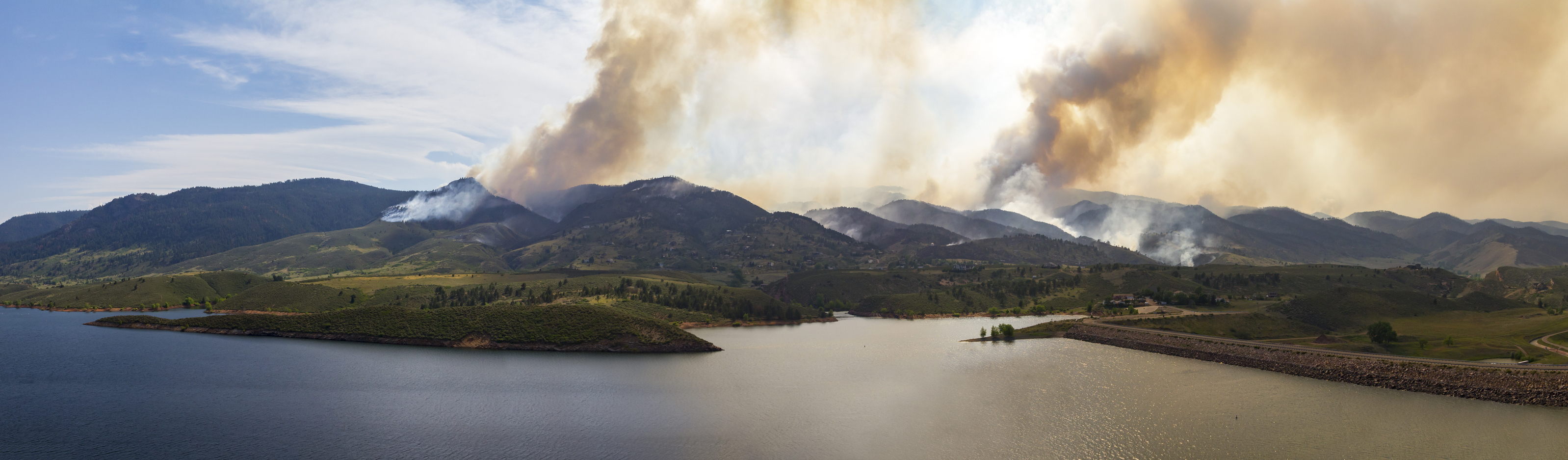
The 2023 wildfire season was the worst on record in Canada, and while the 2024 season was not as severe, communities from Labrador City, to First Nations communities in northern Manitoba, to Jasper, Alberta faced significant disruptions, evacuations, and losses, alongside exposures to smoke and other public health concerns. Among these concerns include the threat wildfires pose to drinking water safety and supply, both immediately following a fire, and in the months to years after. This blog outlines some of these challenges and identifies guidance on preparation, response, and recovery.
Wildfires impacts on drinking water sources and infrastructure
About 88% of the drinking water plants in Canada are supplied by lakes, reservoirs, and rivers, many located in forested areas. These source waters can be directly contaminated during a wildfire by deposited ash, fire retardants, or overland runoff carrying contaminants and sediment from burnt areas, including legacy contaminated sites in some catchments. Wildfires can also change how water moves through a catchment, with loss of groundcover and water repellent burnt ground affecting the flow of sediments, debris, and other pollutants.
Following a wildfire, contaminated source water can become harder to treat due to increased levels of sediments, nutrients, ions, metals, and organic matter (OM) arising from burnt material. If treatment processes cannot adequately remove some of these additional contaminants, they can quickly clog systems, deplete chlorine residuals, and increase the risk of forming harmful disinfection by—products (DBPs), as chlorine reacts with elevated OM.
Wildfires can affect other aspects of the drinking water source-to-tap pathway (Fig 1).

Figure 1 The drinking water source to tap pathway
Effects on treatment and distribution systems can range from power outages impairing water treatment, pumping, or monitoring, to disrupted access routes restricting personnel from accessing treatment plants, carrying out repairs, or delivering treatment chemicals. Treatment plants, pump houses, distribution pipes, or storage tanks can also suffer fire damage, which can cause a loss of supply or result in microbiological or chemical contamination of water via line breaks and pressure losses. Infiltration of smoke or debris through openings and vents can contaminate reservoirs and storage tanks, and destruction of well caps or housing can allow contamination into wells.
Water lines may also be contaminated with volatile and semi-volatile organic compounds (VOC/SVOCs) such as benzene, methylene chloride, toluene, xylene, and others, especially following interface fires. These pollutants can enter water systems through direct burning or melting of plastic pipes, or via pressure losses or cross connections drawing contaminants in from areas with a high proportion of burnt structures. Research following the 2017 Tubbs and 2018 Camp fires in California, the 2021 Marshall fire in Colorado, and the August 2023 Maui wildfires found VOC contamination exceeding safe drinking water limits in some areas. These contaminants are only beginning to be recognized as post-wildfire concerns for drinking water systems, and approaches to testing and remediation are still needed.
Persistent effects on water quality and treatability
Source water treatability can pose a challenge to water treatment plants for months to years following a wildfire. Some contaminants can increase by several orders of magnitude above pre-fire conditions and quality becomes much more variable, often coinciding with spring runoff and periods of heavy rainfall. These issues can cause problems such as:
- Increased sediment clogging intakes and filters, increasing the need for clarifying treatments (e.g., coagulants).
- Increased organic matter reducing disinfection effectiveness and forming DBPs.
- Elevated nutrients increasing potential for cyanobacterial blooms in source waters.
- Changes in water quality (e.g., pH) affecting corrosion control processes for lead or other treatment processes.
Increased post-fire monitoring of source water can inform adaptations to treatment processes to manage variable quality. Removing OM and other contaminants pre-chlorination can prevent downstream problems (e.g., DBP formation), but conventional approaches may be less effective for some fire-derived contaminants. For example, the character of OM derived from non-fire related sources can differ from OM derived from ash, and processes to remove OM such as coagulation, can require a higher coagulant dose or alternative treatment. These issues can significantly increase treatment costs, which can post serious operational difficulties for small systems with less flexibility to adapt their processes.
Recognizing when peaks in different contaminants could occur post-wildfire can help to manage variability in water quality. For example, increased turbidity or occurrence of cyanobacterial blooms in source waters can peak within the first few months following a fire; pH could be altered for up to a year afterwards; heavy metals can peak 1-2 years after a fire and challenges with DBP formation can persist for a decade or more. While most variability resolves within 5 years, some effects can persist for a much longer as found in a 2022 review of post-wildfire effects on source water quality. Additional research is needed to understand how fire-related VOC/SVOCs may diffuse back into water systems in the months following a fire.
Building water system resilience to wildfire
Approaches to preparing, responding, and recovering from wildfire impacts on drinking water will differ based on the characteristics of a watershed, the size and intensity of a fire, the types of materials burned, and local capacities. Communities, utilities, and small system operators all have a role to play, but require advice on preparation and planning for response and developing tools for recovery. While not exhaustive, some key considerations are listed below.
Preparation
Preventing loss and contamination of water assets is a key element of preparation. Elevating pre-season awareness for residents, businesses, facility managers, and water operators can include general advice such as adopting FireSmart practices to reduce fire risks around homes, water tanks, wellheads, or other water infrastructure. Additional advice may be needed for farms and other rural properties on protecting water storage, animal watering, or irrigation infrastructure from wildfire damage and pollutants. Preparing for an interruption in supply could involve renewing emergency water supplies and topping up finished water storage tanks and ensuring back-up generators are working to prevent power losses to treatment systems or pumps. For building owners and facility managers advice on safely shutting down building water systems could help to reduce losses and cross-contamination post-fire.
For operators of private and community water supplies, encouraging baseline water quality monitoring pre-wildfire can enable changes to be detected post-fire. Communicating with facilities or laboratories pre-season about the types of fire-related contaminants and test methods that may be sought post-fire, such as for VOCs, can ensure capacity to test is available when it’s most needed.
Response
Water system operators and suppliers should develop or review emergency response plans for wildfire threats. Following a fire, rapid responses are needed to quickly assess damages, identify sources of contamination, and to repressurize and remediate systems. However, isolating damages, pressure losses, and sources of contamination can be time and resource intensive for water utilities. Advice may be needed on developing sampling plans to identify both localized and systemic contamination issues. Short-term water advisories can prevent public exposures to waterborne pathogens or contaminants until possible contamination is assessed and repairs are made. Lessons from the review of the 2023 Maui fires suggest that being proactive in issuing water advisories during an approaching fire can allow utilities to focus on stopping water losses, protecting assets, containing damages, and preventing contamination. Early communication from utilities and public health can ensure advice is disseminated before any interruptions to communications occur.
Aesthetic issues such as changes in taste, odour, and colour can reduce public confidence in the water supply, so frequent communication and open access to water testing results can keep the public informed and avoid exposures to contaminated water. Greater awareness and access to testing for wildfire-related VOCs may be needed in areas with a higher level of property damage, along with strategies for dealing with VOC contamination, such as flushing, replacing damaged pipework, or removing water meters from damaged properties to prevent cross-connections back into a distribution network.
Recovery
Helping facilities, businesses, and residents recover and return home safely can include ensuring they understand the health risks and possible contamination issues when returning after an evacuation. Pre-prepared factsheets distributed through emergency response or evacuation centres can include advice on identifying changes in water quality (e.g., colour, turbidity, or odour), testing exterior faucets for pressure losses (e.g., bubbles, unsteady flow), and advising on post-fire water testing. Advice on restoring water quality could also include how and when to flush pipework. For private systems, advice on inspection, testing, and decontamination of wells, cistern inspection and cleaning, or tailored advice for agricultural water users may be needed in affected areas.
Wildfires can pose significant financial and logistical challenges for both regulated and unregulated water systems. Good advice and supports are therefore needed to prepare for managing source water variability and adjusting and optimizing treatment processes after a wildfire. Longer-term strategies for preventing source water contamination, protecting assets, and developing strong response and recovery plans can assist in building resilient systems.
Further guidance:
- Wildfire response: Guide for environmental public health professionals (National Environmental Health Association, 2023)
- Maui recovers (County of Maui Dept. of Water Supply, 2024)
- Response and recovery to wildfire caused drinking water contamination (Purdue University, 2022)
- Colorado post-fire recovery playbook for counties, tribes, municipalities. and water providers (Multi-agency collaboration, 2021)
- Water sector utility: Incident action checklist for wildfire (US EPA, 2022)
- Addressing contamination of drinking water distribution systems from volatile organic compounds (VOCs) after wildfires (US EPA, 2021)
- Be Well Aware (Health Canada, 2019)
Citation
Related Resources
Unmasking the evidence for reducing harms from wildfire smoke: The role of air cleaners and masks
 view
view
Use of low-cost air quality sensors in childcare and long-term care facilities in BC and impacts of wildfire smoke on indoor air quality
 view
view
Do-it-yourself (DIY) air cleaners: Evidence on effectiveness and considerations for safe operation
 view
view