

Uses and limitations of low-cost sensors in a changing climate

Background
As a Senior Scientist with the British Columbia Centre for Disease Control (BCCDC), Dr. Eric Coker has been working with low-cost sensors for public health research and practice for over 5 years. This work includes deploying sensors to various locations in BC affected by wildfire smoke and analyzing the data to better understand exposures and identify strategies to reduce their impacts on population health.
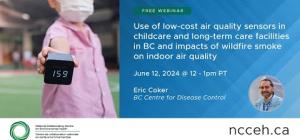
In the June 2024 NCCEH Seminar Series, Dr. Coker presented on the use of low-cost sensors at care facilities across British Columbia. The presentation sparked considerable interest, particularly in understanding the broader applications and limitations of these sensors. This blog post delves deeper into how low-cost sensors can be used effectively in various contexts, the challenges they present, and some real-world examples of their utility.
Why do we need low-cost sensors?
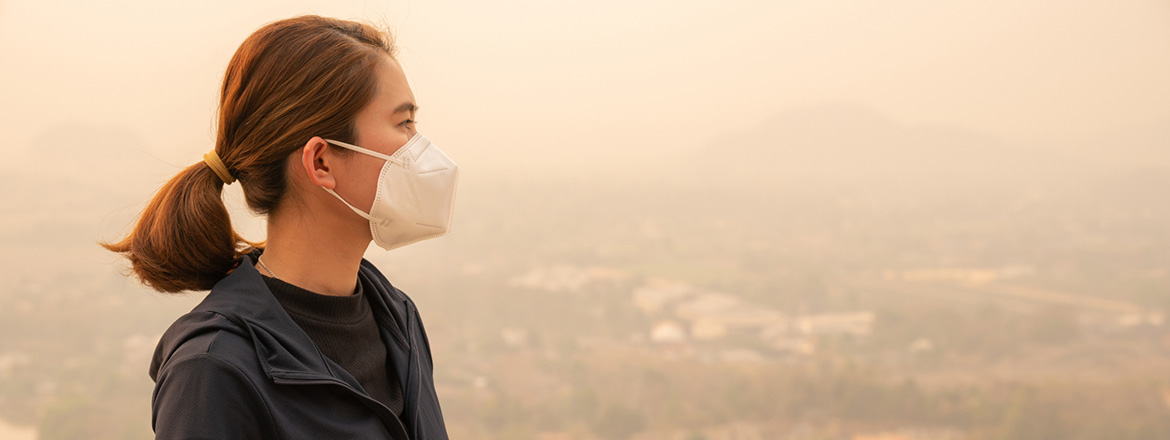
Climate change is increasing the frequency and intensity of wildfire smoke events, posing significant challenges to communities across Canada and beyond. These smoke events can also co-occur with extreme heat events, compounding health risks. The combination of poor air quality and high temperatures can exacerbate respiratory and cardiovascular conditions, especially in susceptible populations such as the elderly, children, and those with chronic health conditions. Moreover, these climate impacts often disproportionately affect rural and remote communities, including Indigenous communities, where there are no regulatory air monitoring stations. As the public health challenges of climate change become more evident, there is a growing interest in low-cost sensors as tools to monitor and respond to these emerging health threats.
What are low-cost sensors?
Low-cost sensors are compact devices designed to measure different pollutants in the air, such as fine particulate matter (PM2.5), nitrogen dioxide (NO2), carbon monoxide, or ozone (O3). They are called sensors because the technology works by “sensing” and processing signals with mathematical algorithms to quantify air pollutant concentrations. For example, changes in light scattering are used to sense PM2.5 in the air, and changes in electrical current due to chemical reactions are used to sense gases.
Low-cost sensors have gained popularity because of their ability to provide air quality data at a fraction of the cost of conventional air monitoring stations. Their reduced cost is driven by advancements in computing and communication technologies. Their affordability and internet connectivity make them particularly valuable in resource-limited or remote settings where large-scale, expensive monitoring networks are impractical.
Advantages of low-cost sensors
One of the primary benefits of low-cost sensors is their accessibility. Their affordability allows for widespread deployment regionally, nationally and internationally, enabling communities, researchers, and public health practitioners to gather air quality data. This approach can be useful in areas where air quality is not routinely monitored, and has helped to quantify wildfire smoke impacts, and identify air pollution hot spots, sources , and exposure disparities. Additionally, low-cost sensors have been shown to facilitate community-engaged approaches to air quality monitoring, empowering communities to participate in research and access data.
Internet connectivity is another key feature of low-cost sensors, which contributes to their potential as a public health tool. Internet connectivity enables transmission of real-time air quality data for visualization, mapping, and downloads on both city-wide and global scales. The PurpleAir network and Clarity network are examples of large, internationally linked low-cost sensor networks that provide widespread real-time data visualization and mapping to the public.
Many low-cost sensors also measure temperature and humidity together with PM2.5 and gases. This information can help individuals and communities respond more effectively when wildfire smoke and extreme heat occur together.
Challenges and limitations
Despite their many advantages, low-cost sensors have some important limitations. First, these sensors typically have lower accuracy and precision compared with reference-grade air monitoring instruments. Factors such as temperature, humidity, sensor aging, and cross-reactions with other air pollutants can affect their performance, leading to inaccurate data. Similarly, intermittent internet or power access can lead to data loss. As a result, the value of low-cost sensor data depends on careful quality control and validation methods. Even so, low-cost sensor data may never achieve the confidence necessary for regulatory purposes, such as evaluating airshed compliance with the Canadian Ambient Air Quality Standards (CAAQS).
Another challenge is the interpretation of the data collected by low-cost sensors. Public health practitioners, such as Environmental Health Officers, need to understand the limitations of these devices to make informed decisions. For example, uncorrected (raw) PM2.5 data from these sensors are recorded and displayed using short averaging periods (e.g., 1-minute or 5-minutes). These short periods do not match the longer periods (e.g., 1-hour or 3-hour) used for health risk messaging tools such as the Canadian Air Quality Health Index (AQHI). Furthermore, these raw data are not bias-corrected, and should interpreted with caution for health risk communications, such as the AQHI.
Growing acceptance of low-cost PM2.5 sensors among federal agencies
Of all air pollutants, PM2.5 is widely accepted as being most harmful to human health. Because of the concerns about low-cost sensor data quality, air quality researchers and government agencies were initially hesitant to rely on these devices for PM2.5 data. However, there has been a paradigm shift in the way government agencies and researchers view low-cost PM2.5 sensors over the past decade. This shift has been driven by the development of correction factors for PM2.5, coupled with the knowledge that the more widely distributed sensors become geographically, the more representative and useful the data become.
As a case in point, Environment and Climate Change Canada (ECCC) has developed AQMap. AQMap is an online platform that displays outdoor PM2.5 data from thousands of low-cost sensors alongside data measured by government agencies. The data on AQMap are displayed with color-coding that aligns with the Canadian AQHI, making it particularly useful for the Canadian context. Similarly, the US Environmental Protection Agency (US EPA) is leveraging data from thousands of low-cost PM2.5 sensors in its Fire and Smoke Map. These tools provide communities in North America with timely and quality-controlled data about their local air quality, particularly during wildfire events. This shift demonstrates the increasing trust in low-cost sensors as practical tools for public health monitoring and response.
Real-world applications of sensor networks at the BCCDC
While low-cost sensors have proven their utility for monitoring outdoor air quality during wildfires, other uses are emerging. Because Canadians spend most of their time indoors and a significant amount of exposure to PM2.5 from wildfire smoke occurs indoors, using low-cost sensors to monitor indoor air quality is a growing area of interest.
Pilot project at one acute care facility
Against this backdrop, the BCCDC piloted the deployment of low-cost sensors at one in-patient hospital in Vancouver, BC during the summer of 2020. When a significant wildfire smoke event occurred in September, the study demonstrated there was a considerable amount of PM2.5 infiltration, which contributed to poor indoor air quality at the hospital. By happenstance, the sensors were also in place to capture the wide ranging and concerning indoor temperature impacts of the June 2021 heat dome at the hospital. This pilot study provided clear evidence that strategic use of low-cost sensors provides valuable information in the context of growing climate change impacts.
Larger project at multiple daycare and long-term care facilities
Based on results from the pilot study, the BCCDC has dramatically expanded its use of low-cost sensors, including the deployment of indoor and outdoor sensors at more than 50 childcare and long-term care facilities across BC. This ongoing initiative aims to better understand and improve indoor air quality during wildfire smoke events, specifically in spaces where children and the elderly spend a lot of time. The data have already shown that indoor PM2.5 increased by approximately 300% on days impacted wildfire smoke. The sensors have been instrumental in developing strategies to communicate indoor air quality information, with the goal of protecting the health of susceptible groups. In particular, the BCCDC developed a web-based, mobile-accessible data dashboard for the participating care facilities that provides them with indoor and outdoor PM2.5 concentrations in real-time. The data displayed are quality controlled and summarized by the BCCDC, so they meaningfully correspond to the AQHI. The data visualizations are supplemented with tailored public health messaging about when to take actions to protect indoor air quality for sensitive groups (e.g., young children) and the types of actions to take.
Sensors in cleaner air spaces
In collaboration with Fraser Health and Vancouver Coastal Health, the BCCDC recently expanded this low-cost sensor network to evaluate whether community spaces can serve as informal cleaner air spaces (CAS) during wildfire events. This initiative focuses on identifying places that are already familiar to community members and that may also offer protection from the harmful effects of wildfire smoke. By using low-cost sensors to monitor indoor and outdoor air quality in these places, the project will provide actionable insights that can help public health officials and community leaders make informed decisions about where to direct susceptible populations during smoke events.
Conclusion
Low-cost sensors are transforming environmental monitoring by broadening data access and coverage. As sensor technology rapidly evolves, it is clear that individuals, communities, and both governmental and non-governmental organizations will increasingly rely on these tools to safeguard public health—particularly in underserved areas and regions heavily affected by wildfire smoke. However, as we unlock the potential of low-cost sensors, it is vital for both the public and health professionals to stay informed about their strengths and limitations, ensuring that the data are applied responsibly. By empowering communities with actionable insights, these sensors are not just tools for today but crucial assets in building climate resilience for the future.
Additional Resources
For those interested in learning more about low-cost sensors and their applications, the US EPA provides a comprehensive guide on choosing, using, and interpreting data from these devices.