


The right to a healthy environment (R2HE) and its role in research under the Canadian Environmental Protection Act (CEPA)


This blog summarizes the recent changes to the Canadian Environmental Protection Act, 1999 (CEPA), which recognizes that every individual in Canada has the right to a healthy environment (R2HE). Currently the R2HE applies only in the administration of CEPA, such as when the federal government is doing research or making decisions under CEPA. The National Collaborating Centre for Environmental Health (NCCEH) is conducting a project to better understand how research under CEPA at Health Canada and Environment and Climate Change Canada can incorporate elements and principles of the R2HE to support its implementation.
What is CEPA?
CEPA is the cornerstone federal environmental law to protect human health and the environment from the effects of pollution. The Act provides the legal foundation for a range of federal environmental and health protection programs. These include activities related to the assessment and management of risks from chemicals, plastics, and living organisms; programs related to air and water pollution, hazardous waste, greenhouse gas emissions; waste disposal at sea; and environmental emergencies. The Minister of Health and the Minister of Environment and Climate Change share responsibilities for the parts of CEPA that apply to the assessment and management of toxic substances.
What is the R2HE under CEPA?
In June 2023, CEPA was amended through the Strengthening Environmental Protection for a Healthier Canada Act (also known as Bill S-5), which modernized the approach to environmental protection in Canada. Through this amendment, CEPA now recognizes that every person in Canada has the R2HE within the context of the Act. This right applies when the federal government is conducting work or making decisions under CEPA, such as studying environmental risks, managing harmful substances, or developing regulations to control substances. The R2HE does not apply to other laws, provincial matters, or non-environmental federal decisions. At the same time, the right is not absolute and federal government decision‑makers must balance the R2HE under CEPA on a case-by-case basis with other practical considerations. For example, this means considering the strength of the scientific evidence related to pollution impacts, whether a technology is available to control pollution, or if a solution is affordable.
Why should environmental health practitioners care about R2HE?
The R2HE under CEPA represents an important shift in how environmental protection and human health considerations are framed at the federal level. The R2HE Implementation Framework (see Figure) is guiding how the right is operationalized, in part through greater attention to environmental justice, populations who may be disproportionately impacted by pollution, Indigenous rights, and participation in decision making in chemicals management. For environmental health practitioners (EHPs), especially those working with Indigenous communities, formal recognition of the R2HE under CEPA may create new opportunities to learn from, bring forward, and incorporate local knowledge on exposures, community conditions, and inequities to inform federal priorities, risk assessments, and risk‑management decisions. There is a need to recognize Indigenous Science and Knowledge as valid evidence for action and decision-making, and consider approaches such as bridging, braiding, and weaving of Indigenous Knowledge and Western science. In this way, the R2HE has the potential to strengthen the alignment between federal environmental policy and the realities observed by EHPs on the ground, even if its direct impacts on day‑to‑day EHP practice are not fully apparent at this stage.
What is the NCCEH doing about R2HE?
To help support the protection of the R2HE, Health Canada and ECCC conduct research, studies, and monitoring activities under CEPA. This can include studies on chemicals and other substances with the aim of preventing or reducing risk to human health and the environment. Data generated may include information on lifetime exposures to better understand the risks posed by cumulative chemical exposures, how these risks are linked to disease, who is most at-risk, and how risks can be reduced. Health Canada and ECCC researchers submit research proposals to address knowledge gaps through programs such as the Chemicals Management Program, the Air Quality Program, and other stand-alone funding under Bill S-5. Increasingly they will be required to explain how their work supports implementation and protection of the R2HE.
The NCCEH is working with Health Canada and ECCC to support the incorporation and assessment of R2HE considerations in CEPA‑related research proposals. Through interviews with Health Canada and ECCC staff, the NCCEH is helping to identify the needs of investigators and peer reviewers to clarify where additional guidance on R2HE is required. These insights will inform the development of practical resources to help both researchers and reviewers consistently apply R2HE considerations in research proposals submitted and reviewed under CEPA.
As part of this project, the NCCEH developed a project primer that provides more information about R2HE under CEPA, and the NCCEH project. For more, please see the Primer.
Figure: Elements of the Implementation Framework for the Right to a Healthy Environment under the Canadian Environmental Protection Act
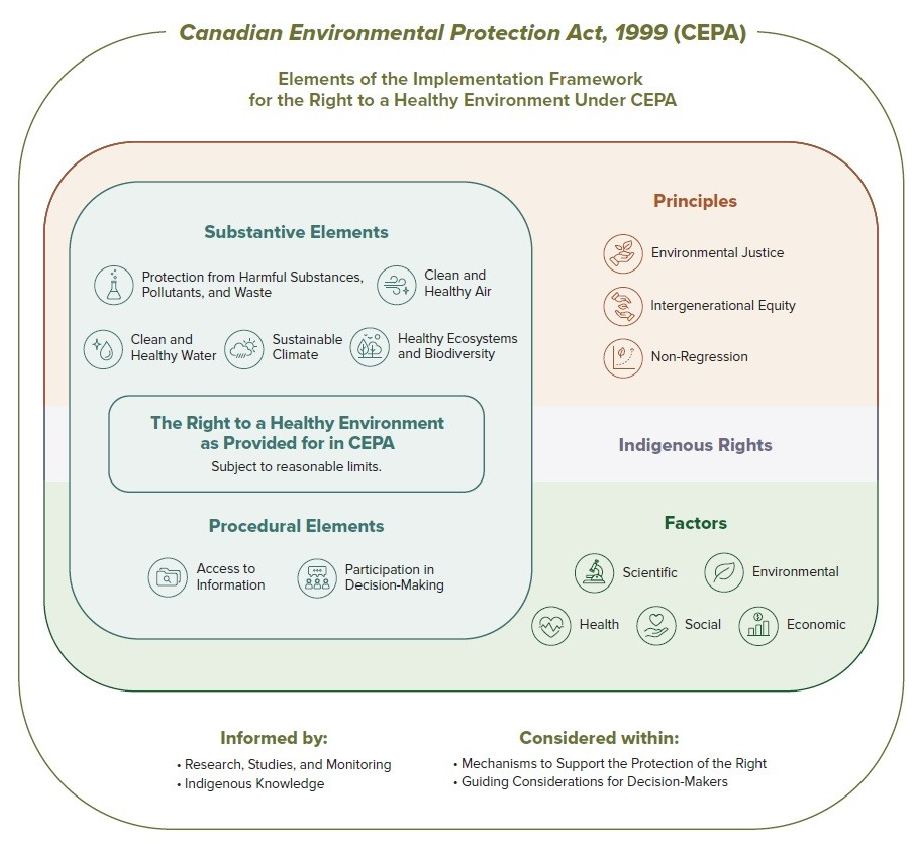
Source: Implementation Framework for the Right to a Healthy Environment July, 2025
Citation
Related Resources
Community-based participatory research approach to transforming protection for priority populations from extreme temperatures
 view
viewINTerventions, Equity, Research and Action in Cities Team (INTERACT): Research and knowledge translation for scaling our understanding of health and the built environment
 view
view


Accessibility in the face of a pandemic: How inclusive features are undermined in health crises
 view
view